ANTHROPIC'S LEAD ENGINEER MAKING $2.2M/YEAR LEAKED THE COMPANY'S INTERNAL OBSIDIAN BRAIN - AND GOT FIRED THE SAME DAY
00:07 a live neural network with 21 inputs, 10+ hidden layers, ReLU activation - thousands of connections firing in real time as the system processes every decision
first layer 64 neurons, second 37, then 22 - all the way to outputs - this is not a diagram, this is the living brain of the company thinking right now
8,893 nodes, 4,729 links - a knowledge graph so dense it looks like a galaxy when you zoom out
Marginalia Collection, Glossary Backbone, Master Index with 9,000+ documents - every cluster its own universe of connected knowledge
the company building the most powerful AI in the world uses an Obsidian graph to manage its own innovations - and now it's all public
he made $2.2M/year to know this - you got it for fre
ANTHROPIC LEAD ENGINEER MAKING $2.3M/YEAR JUST LEAKED A 12-PAGE DOCUMENT - AND GOT FIRED 15 MINUTES AFTER PUBLISHING
most developers build loops - but almost every loop breaks in one of five ways, and each failure has a symptom visible from the outside without reading a single line of code
> Blind loop - the agent waits for a human to hand it work every morning - automating execution but not discovery
> Tangled loop - parallel agents share one directory and overwrite each other parallelism that destroys instead of multiplies
> Nodding loop - the agent grades its own work and approves it every time a loop that has never said no to itself is broken
> Amnesiac loop - results live only in the context window every morning the system wakes up with no memory of yesterday
> Manual loop - no trigger a human presses the button to start it that is not a loop that is a script waiting for a person
a real loop finds its own work - remembers what it did has something that can say no never lets two agents touch the same file and fires itself on a timer
remove any one of the five - and the loop either breaks or never starts
12 pages that changed how I build agentic systems today
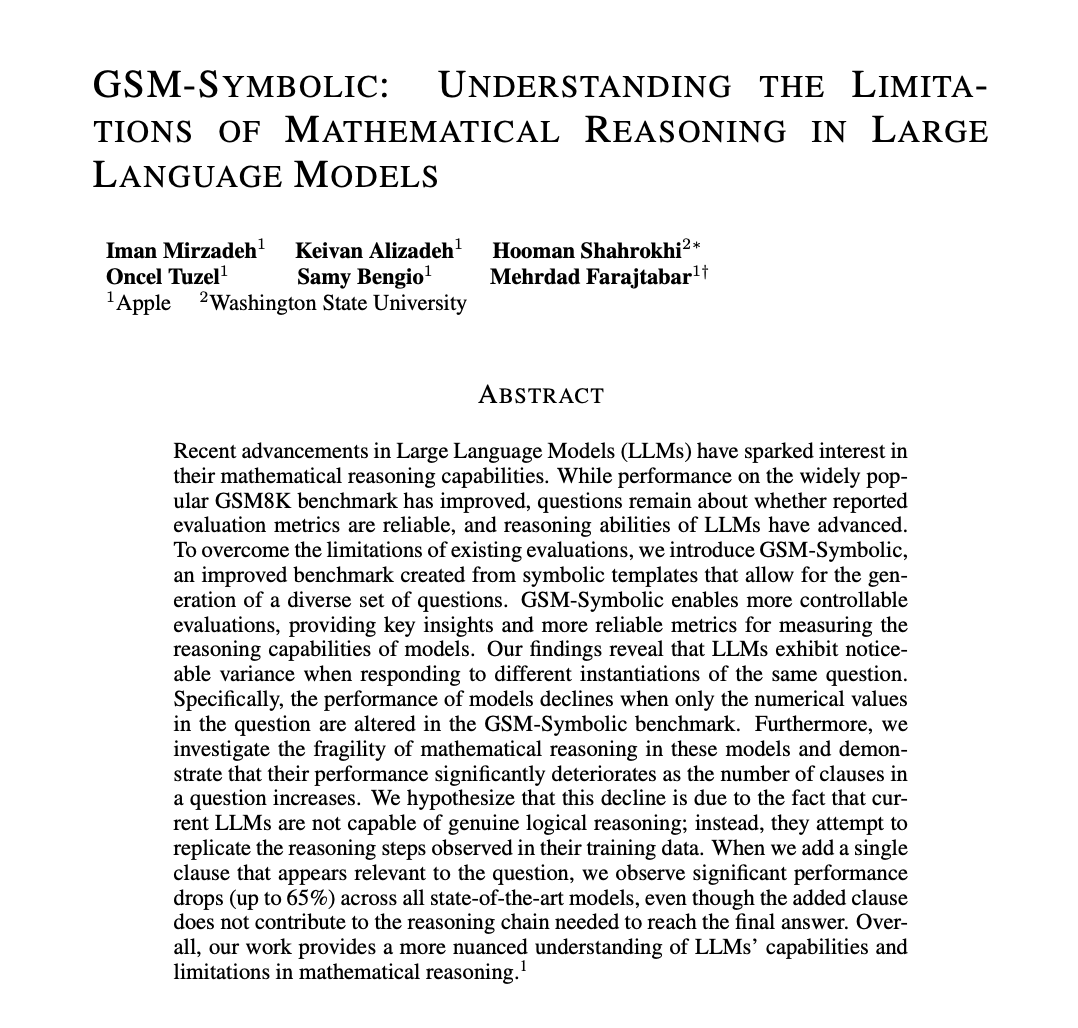
turns out AI models cannot do math.. even grade school math. the kind a 10-year-old solves.
Apple published a devastating study that exposes a massive illusion at the core of artificial intelligence.
they took the standard math benchmark (GSM8K) that every AI company uses to brag about how smart their model is.
first, they just changed the names in the word problems.. the models' performance fluctuated for no reason.
then, they changed the numbers. the performance immediately dropped.
but then they ran the test that broke everything.
they added one single, completely irrelevant sentence to the word problem. something like: "By the way, 5 of the apples were green."
A human 10-year-old ignores the green apples and solves the underlying math.
the AI didn't.
across every state-of-the-art model, performance collapsed by up to 65%.
the AI blindly grabbed the irrelevant number and tried to shove it into the equation. it didn't know why it was doing the math. it just saw a number and assumed it was supposed to use it.
there is no genuine logical reasoning happening under the hood.
we are deploying these systems to run our finances, analyze our legal documents, and make complex strategic decisions.
but the models don't actually understand the logic they are spitting out.
they just know what a smart answer is supposed to look like.
Google has quietly dropped what researchers are calling "Attention Is All You Need V2."
And it signals the end of the Transformer era as we know it.
In 2017, the original "Attention Is All You Need" paper changed the world by proving that AI doesn't need recurrence, it just needs to pay attention.
But today, even the most advanced models like GPT and Gemini suffer from a massive, structural flaw: Catastrophic Forgetting.
The moment an AI learns something new, it starts losing what it learned before. It’s why AI "hallucinates" or loses the thread in long conversations.
This paper, titled "Nested Learning: The Illusion of Deep Learning Architectures," completely replaces the way AI stores information.
The researchers have introduced a paradigm shift called Nested Learning (NL).
Here is why this is "V2":
For the last decade, we treated AI models as one giant, flat mathematical function. NL proves that a model is actually a set of thousands of smaller, "nested" optimization problems running in parallel.
Instead of one giant "memory," each layer has its own internal "context flow." This allows the model to learn new tasks at test-time without overwriting its core intelligence.
It moves us past the static Transformer. The new architecture (HOPE) demonstrated 100% stability in long-context memory and "post-training adaptation" that was previously impossible.
The technical takeaway is brutal for the competition:
Existing deep learning works by compressing information until it breaks. Nested Learning works by organizing information so it can grow forever.
We’ve spent 7 years trying to make Transformers bigger. Google figured out how to make them "Nested."
The Transformer replaced the RNN in 2017.
Nested Learning is here to replace the Transformer in 2026.
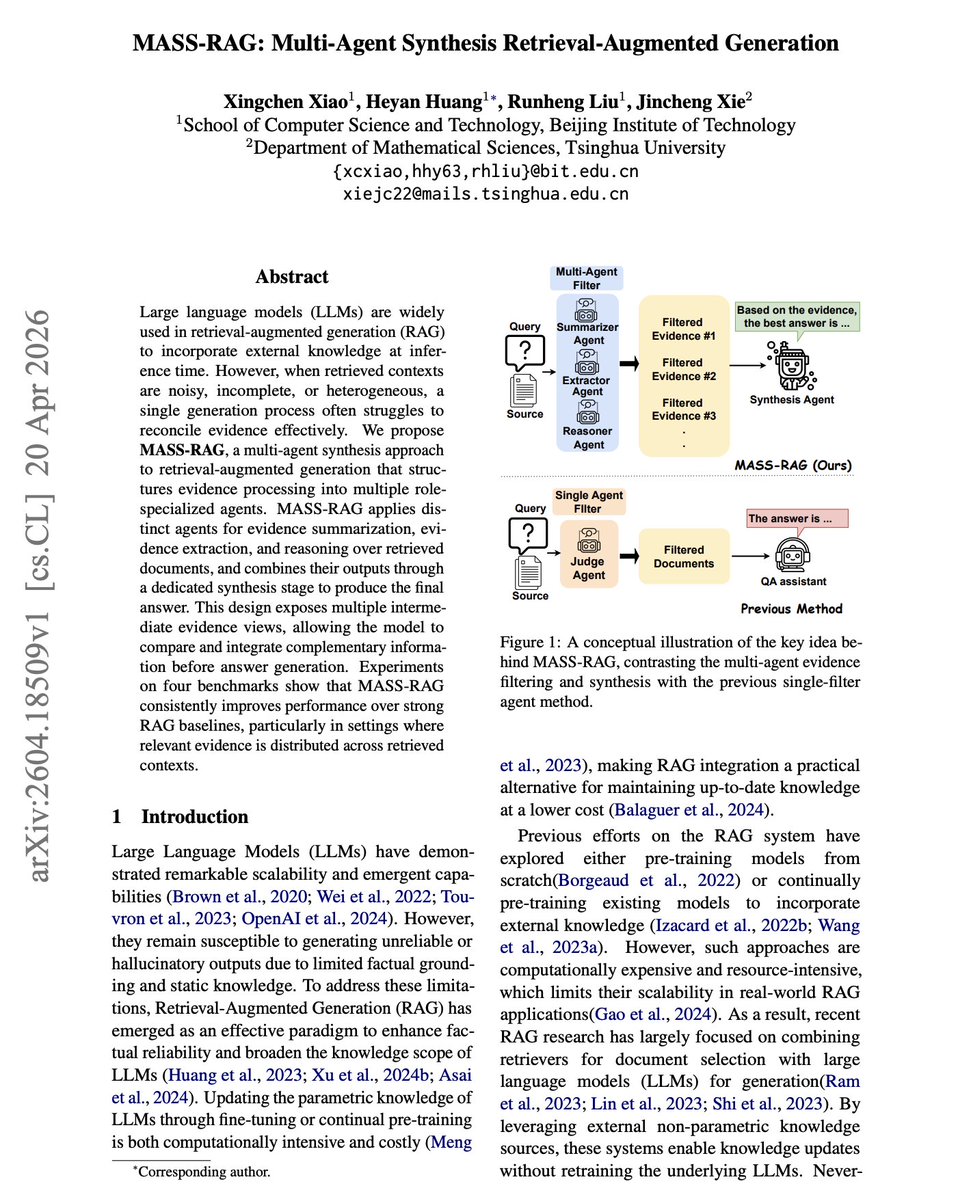
// Multi-Agent Synthesis RAG //
Nice paper on improving RAG systems with multiple agents.
(bookmark it)
The paper introduces MASS-RAG, a multi-agent synthesis framework for retrieval-augmented generation.
Specialized agents handle distinct roles: retrieving candidate documents, assessing their actual relevance to the query, and synthesizing the final answer from evidence that actually contributes.
Instead of one model doing everything, responsibility is decomposed across coordinated evaluators.
Most real-world RAG failures come from retrieving technically-relevant but contextually useless documents, then forcing a single model to reconcile them. Multi-agent synthesis is a cleaner decomposition of the problem and fits the direction the field is already heading in for deep research agents.
Paper: https://t.co/syEVmtUp53
Learn to build effective AI agents in our academy: https://t.co/1e8RZKs4uX