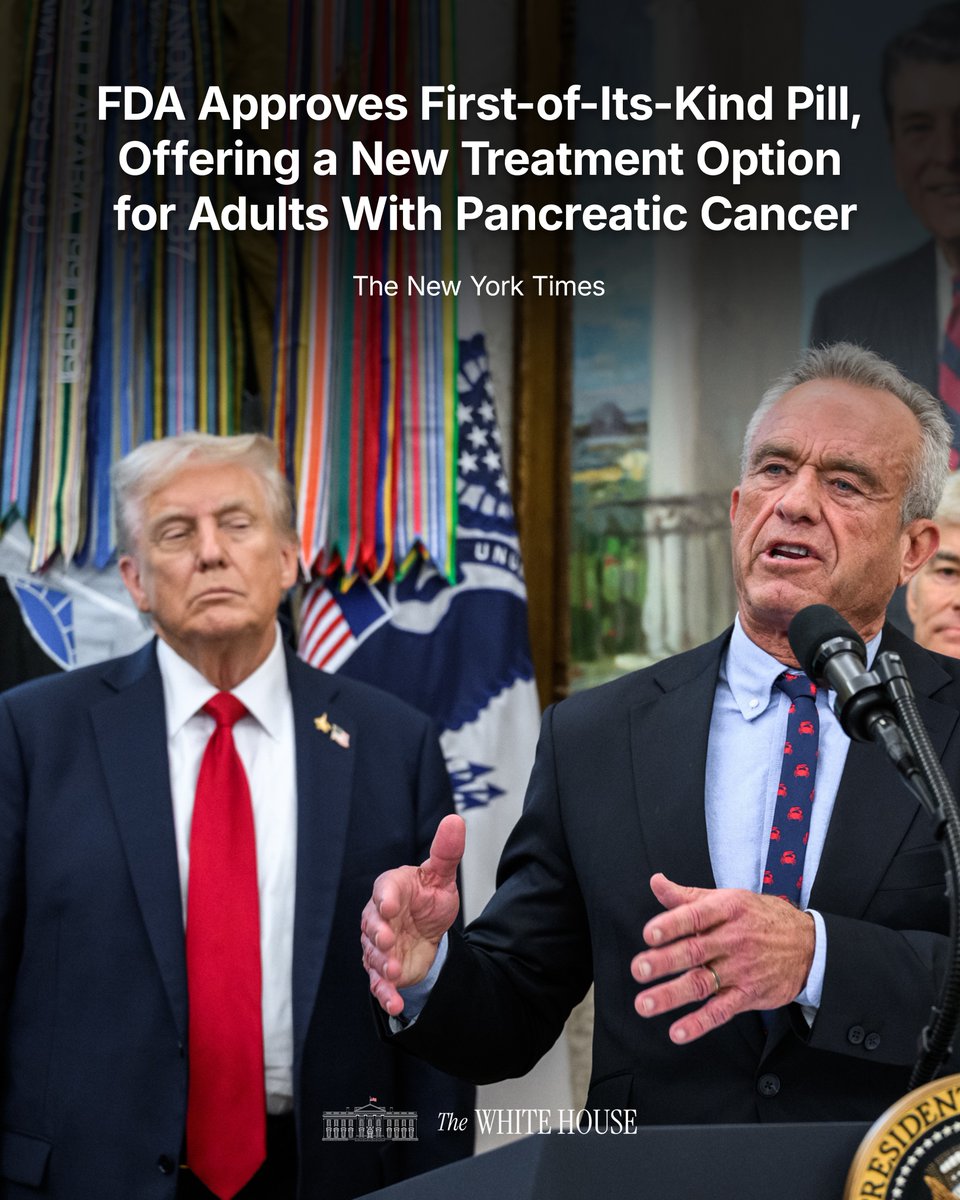
Under the leadership of @POTUS & @SecKennedy, the @FDA has approved a new treatment option for adults with advanced pancreatic cancer.
This approval provides an important new option for patients facing one of the most aggressive cancers & reflects the FDA’s commitment to moving with urgency while maintaining a thorough, science-based review grounded in gold-standard science.
With the passage of Bill C-18, things are changing in the online news space. Here's how you can keep accessing The Globe and Mail journalism you value. https://t.co/k90Ij24kqL
The Canada-U.S. auto industry has been closely integrated since the 1965 auto pact, with huge benefits for both countries: lower consumer costs, better wages for workers, major productivity gains and higher profits for U.S.-based automakers, writes Tom MacDonald. But President Donald Trump does not believe in win-win arrangements. He is happy to inflict economic losses on his own country as long as he thinks that he is inflicting greater losses on a trading partner.
For Canada, the moment is dire. More than 125,000 people are directly employed in the country’s auto sector, and 427,000 jobs are indirectly linked. In 2024, the sector was responsible for $17-billion of economic activity. If the integrated North American auto market unravels, the fallout compounds and spreads across the wider economy.
How should Canada respond?
Perhaps previous experience should guide us. Before the 1965 auto pact (eventually superseded by free-trade deals), Canada’s auto tariff was up to 25 per cent. The auto pact granted the Detroit 3 (GM, Ford and Chrysler – now Stellantis NV) duty-free entry to the Canadian market for vehicles and parts, but with specific conditions. One was that, each year, they had to produce as many vehicles in Canada as they sold here. “Build ‘em where you sell ‘em,” the principle went.
Bearing that in mind, we should definitely mirror whatever auto tariffs Trump imposes, while tying any tariff relief for the Detroit 3 to their continued levels of Canadian production. But let’s also remember that this is a global industry. Matching Trump’s tariffs may only result in U.S. manufacturers shifting to their Mexican operations to supply the Canadian market.
To prevent such trade diversion, and to keep our domestic auto manufacturing sector alive, Canada should enact a 25-per-cent global tariff on all vehicle imports.
Starting soon! Join NIH leadership for the webinar, Understanding NIH's Unified Funding Strategy: What the Research Community Needs to Know.
📅Today, 10–11 a.m. ET
Tune in to learn about the Unified Funding Strategy and get answers to common questions: https://t.co/4tcKpG488i
Some people with lung cancer develop cachexia, a condition that causes severe weight loss, muscle loss, weakness, and fatigue.
NIH-funded researchers found that in mice, a high-fat diet strengthened nerve signals between certain lung tumors and the brain, making cachexia worse.
More research is needed to determine whether these findings apply to people, but the results may help guide future nutrition interventions for cancer care.
Learn more: https://t.co/Lx25g0EDey
The future of biomedical research depends on sharing high-quality data. The NIH S-index aims to recognize and reward researchers whose shared datasets drive new discoveries and advance science beyond publications alone.
Congratulations to the winners of the NIH S-index Challenge, whose innovative approaches are helping shape this new metric for data sharing!
Learn more about the winning teams: https://t.co/5Uo0rRxoPD.
Scientists uncovered new clues about how specialized immune cells in the brain called microglia change with age. NIH-funded research found that immune cells originating in bone marrow can enter the human brain and contribute to its population of microglia.
These findings may open new avenues for studying and treating neurological diseases.
Learn more: https://t.co/NlaqwDQftg.