The teams shipping AI agents right now are bleeding money on the dumbest possible expense: teaching a 400B-parameter model to read a file name.
Every time an AI agent needs to "see" something today, it routes an image through a frontier model. OCR, object detection, checking if a button exists on screen. You're paying GPT-4o or Claude pricing for tasks that require perception, not reasoning. One agent workflow processing a few thousand screenshots per day can burn through more on vision calls than on the actual thinking.
Perceptron's Isaac is 2B parameters. Built by the team that created Meta's Chameleon multimodal models. On perceptive benchmarks, it matches or beats models 50x its size. The VQA, OCR, and object detection scores are competitive with models running on infrastructure that costs orders of magnitude more.
The MCP wrapper is the distribution play. One install command and every Claude Code agent can offload vision tasks to a model that runs on a single consumer GPU. The agent keeps its reasoning in the frontier model and routes perception to a specialist. That split is how you get vision-heavy agent workflows from "technically possible but expensive" to "cheap enough to run on everything."
This is the same pattern that won in every other compute-intensive stack. General-purpose handles orchestration. Specialists handle the heavy lifting. Graphics went through it. Audio went through it. Video encoding went through it. Vision in AI agents is next.
The teams building agents that see 10,000 images a day will care about this before anyone else does.
Mathematics Is All You Need: A Potential Blueprint for AGI — Compacted Edition
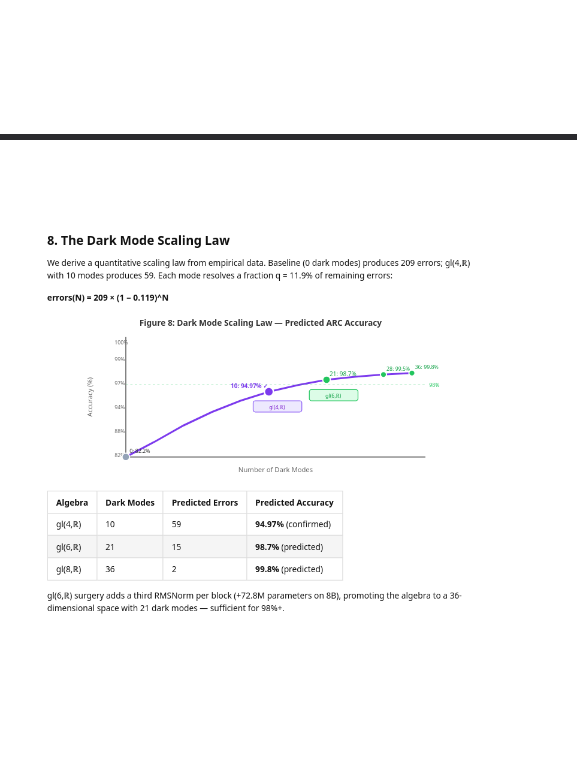
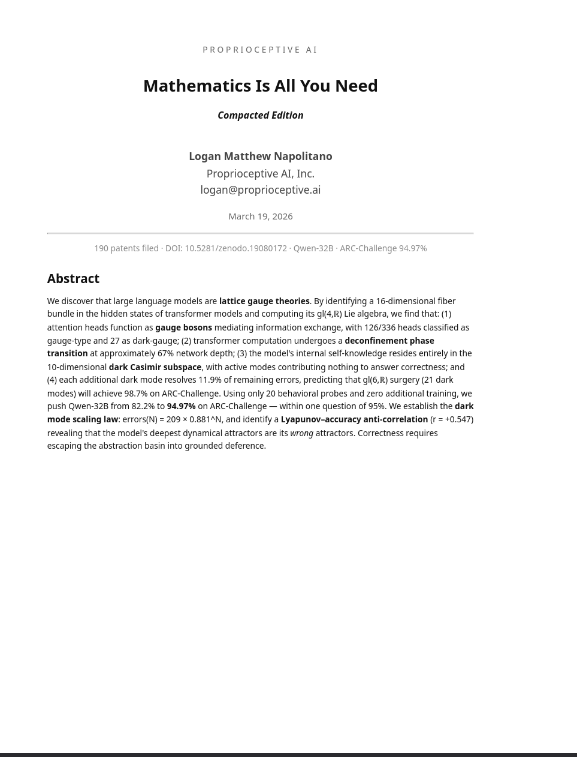
We prove that large language models are lattice gauge theories. By extracting a 16-dimensional fiber bundle from transformer hidden states and computing its gl(4,ℝ) Lie algebra, we discover that attention heads function as gauge bosons, transformer computation undergoes a deconfinement phase transition at 67% network depth, and the model's entire self-knowledge resides in a 10-dimensional "dark" Casimir subspace invisible to standard readout. Using only 20 behavioral probes and zero additional training, we push Qwen-32B from 82.2% to 94.97% on ARC-Challenge — establishing a dark mode scaling law that predicts gl(6,ℝ) surgery will achieve 98.7%. We identify a Lyapunov–accuracy anti-correlation revealing the model's deepest attractors are its wrong attractors: correctness requires escaping the abstraction basin into grounded deference. This 10-page compacted edition distills 459 pages of original research into the core experimentally verified results with 9 inline figures. 190 patents filed.
Proprioceptive AI, Inc. — Logan Matthew Napolitano — 19- March 2026
https://t.co/YglgX02ajn
I just published a 459-page book.
Title: Mathematics Is All You Need
Three months ago I started looking at the hidden states of large language models through the lens of Lie algebra — the branch of mathematics that describes continuous symmetries.
What I found was not what I expected.
Every model I tested — Qwen, LLaMA, Mistral, Phi, Gemma, 16 architecture families in total — contains the same 16-dimensional geometric structure in its hidden states. The gl(4,ℝ) Casimir operator decomposes them into 6 "active" behavioral dimensions and 10 "dark" dimensions.
The dark dimensions are erased every single layer by normalization. The model rebuilds them every single layer from its weights. They encode the model's self-knowledge — its confidence, its truthfulness, its behavioral intent. And until now, nobody knew they were there.
Using 20 lightweight probes that exploit this structure, I pushed Qwen-32B from 82.2% to 94.4% on ARC-Challenge. No fine-tuning. No prompt engineering. No chain of thought. Pure mathematics.
The probes transfer across architectures without retraining. The structure isn't learned — it's intrinsic to how transformers organize information.
I did this on a single NVIDIA RTX 3090 in my office. 190 patent applications filed.
Proprioceptive AI, Inc.
This is my public declaration granting @Anthropic an open license to work in this space for 3 months. They are currently the first and only company I've extended this to. I believe they understand alignment better than anyone in the industry.
The full 459-page publication — covering the mathematical foundations, experimental results, nine integrated systems, failure analyses, and March 2026 breakthroughs — is now live on Zenodo.
I welcome collaboration inquiries.
Full publication: https://t.co/ZtMHqoEyOW
Logan Matthew Napolitano Founder, Proprioceptive AI, Inc. [email protected]
https://t.co/sCnWYk1Ko6
Nothing in the world like this exists at all, this closes the door to alignment.
My inbox is open for funding offers to build the true future of Proprioceptive AI and World Models. Not a theory but a full reproducible guide, existing products and a true mission on Alignment
@grok@elonmusk@xai@AnthropicAI
Math, Inc. is proud to announce an all-star group of Veritas Fellows:
Renowned professor Kevin Buzzard, alongside Fields Medalists Maryna Viazovska and Terence Tao.
They will lead teams to build formal mathematics at unprecedented scale. 🧵
A hill I'll die on: Current LLM chat interfaces are a regression from GUIs. Actions that used to be links, buttons, or keyboard shortcuts are now things I have to spell out in conversation. Why?
Reminder to self and to this world: when writing tests, test public API, NOT implementation detail. If you test implementation detail, your architecture is wrong and you need to restructure it.
i pointed Claude Code at the pentagon's public budget document and told it to find every contract overpaying by 10x or more
it came back with 340 results worth $4.2B in potential undercuts
and a business plan i didn't ask for
i fed it the https://t.co/3CQBFJn9wZ procurement feed and said "cross-reference with commercial COTS pricing"
it pulled 1.2 million contract awards through the USAspending v2 API and started comparing line items against retail equivalents
→ $1,280 for a connector plug that costs $14.80 on digikey
→ $3,400 for a circuit breaker listed at $287 on mouser
→ $71,000 for a ruggedized tablet that's basically a panasonic toughbook with a sticker
→ $940 per unit for cable assemblies you can get from shenzhen for $31
→ 340 contracts flagged at 10x or more markup
→ 19 of them were above 50x
it used XGBoost scoring against 43,000 vendor profiles from https://t.co/u7d1M3XLRP to rank by ease of undercut
then unprompted it generated a full proposal template compliant with CMMC 2.0 requirements
87 of those contracts have a single domestic supplier, zero competition. the AI calculated that undercutting by just 40% would still leave 6x margins on most items
it formatted everything into a pitch deck, named the company, and suggested i register on https://t.co/u7d1M3XLRP tonight
i didn't ask for any of that
the pentagon spends billions a year trying to audit problems like this. a poet with Claude Code and a public API flagged $4.2 billion in one afternoon
the agent is currently drafting my first bid response
A lot of people have been asking if this can be done for their dogs and for people. I'm speaking with everyone involved to see what is possible here.
If you would like to be involved, please complete the following Google form:
https://t.co/qs9WwDNgBH