21 Frontend System Design Concepts for Software Engineers
A practical guide to building fast, scalable, and reliable web apps
Link -> https://t.co/UowQxw9TQg
Authors: Neo Kim and Shefali Jangid
Dated: Nov 11, 2025
Google Brain founder, Andrew Ng:
"Prompting will be dead in 6 months. Graphs and loops are what's replacing it."
In 2 hours lecture at Stanford he shows the exact architecture top engineers already ships apps with
The part everyone skips: how to wire those loops into a graph that gets stronger every run.
Watch it, then read the full breakdown on loops and graphs below.
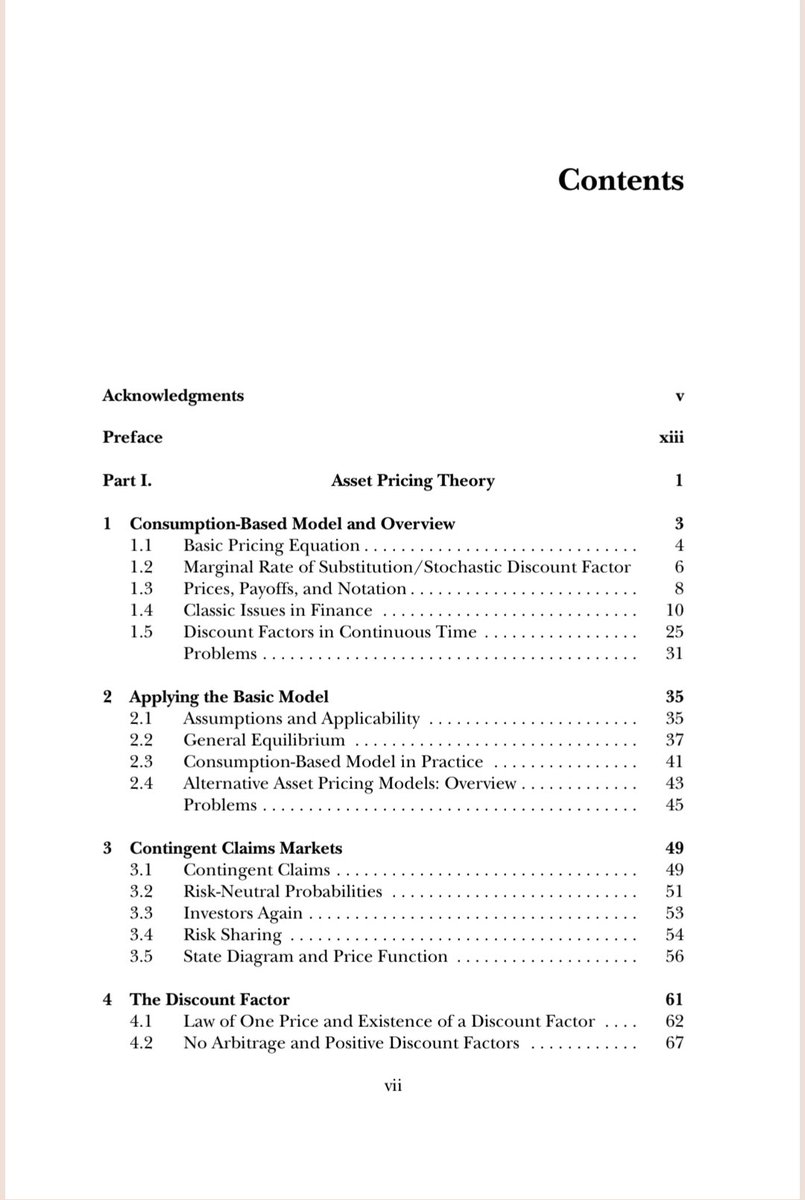
This book covers the models of asset pricing. Math majors/Engineers might find it easy due to maths.
It helps to understand the advanced ideas on valuation.
Book: Asset Pricing by @JohnHCochrane#KSE100#PSX
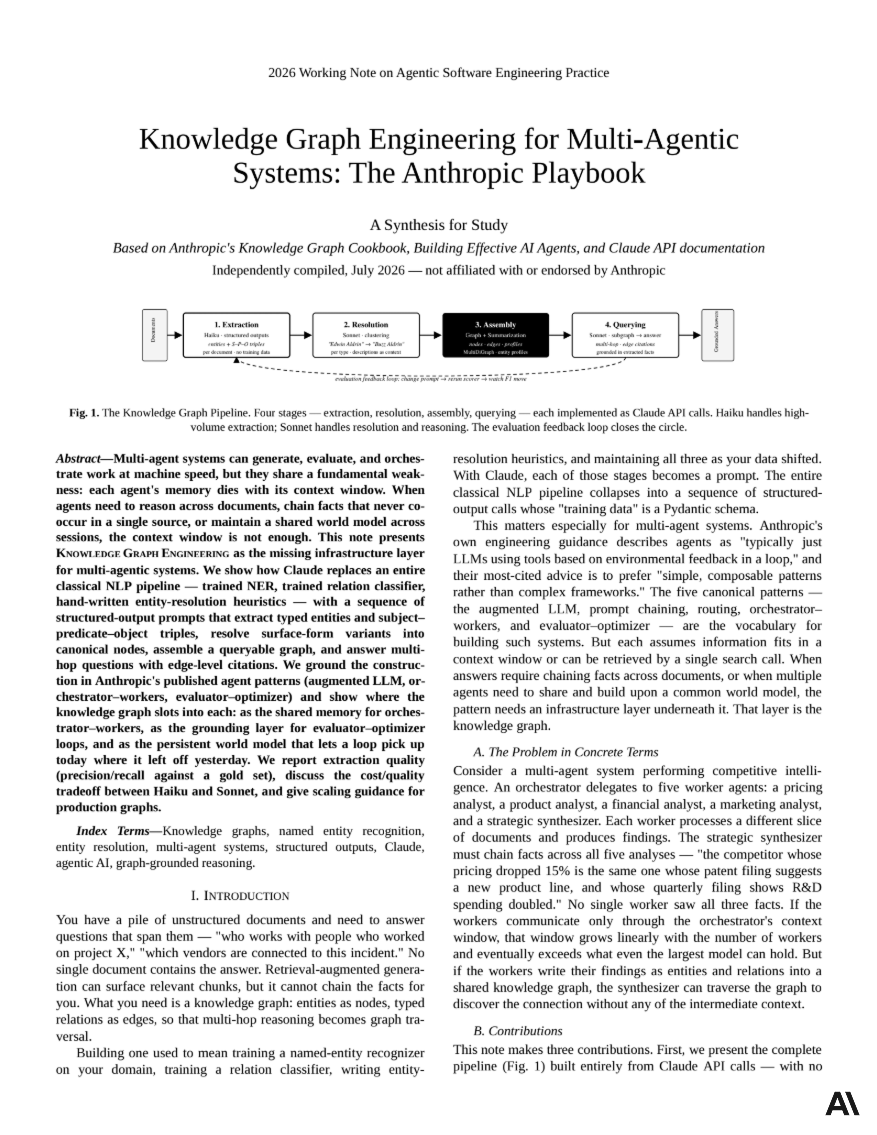
A senior Anthropic engineer just dropped 12-page PDF on "Graph Engineering" for multi-agentic systems.
The shift: your agents memory dies with their context window. A knowledge graph makes it permanent.
Extract → Resolve → Assemble → Query → Repeat
Every agentic graph has 5 stages:
• Extract: Haiku pulls entities and S-P-O triples. One call per doc. The Pydantic schema is the only training data.
• Resolve: Sonnet clusters "Edwin Aldrin" → "Buzz Aldrin" - zero string overlap - using descriptions as context.
• Assemble: canonical nodes, typed edges, provenance on every triple. One connected graph.
• Query: serialize a subgraph → Sonnet reasons over triples → every answer cites a specific edge.
Plug this into multi-agent systems as shared memory.
Workers write to it, evaluators fact-check against it, loops persist overnight with it.
This 12-page PDF changed how I'm building multi-agent systems today.
Read it now, then explore the article below.
Andrew Ng just dropped 8-page PDF on 4 agentic steps "from Loops to Graphs from scartch"
The twist: agent has amnesia without both: Loops let agents think - Graphs let agents remember
here's 4 workflows, step by step:
step 1 → reflection - agent writes, second prompt critiques, agent rewrites - one self-review loop beats a smarter model with none
step 2 → tool use - give it search, code execution, APIs - thinking without tools is hallucinating
step 3 → planning - break the task into JSON steps before running - Step fails? Agent replans around it
step 4 → multi-agent - stop running one agent - run a team - one codes, one reviews, one tests
how to wire this today:
step 5 → add one critique call after every generation - 10-30% quality lift, one day of work
step 6 → connect all 4 into a graph - agents share memory instead of transcripts - agent forgets, graph doesn't
the result: a weak model with 4 steps destroys a strong model without them - same cost, it's the architecture
this 8-page PDF is what comes after loop engineering
save this - then read the full build workflow in the article below ↓
holy sh*t this is f**king gold
an AI Engineer making $1,500,000 a year
just sent me a "Graph Engineering Course" I've never seen on X.
translated it to English and instantly understood why it has 4,400 stars on Github
[then he gave me the exact blueprint to master graph engineering :]
9 steps: representation → ontology → entity extraction → relations → events → quality gate → fusion → embeddings → memory your agent can traverse
I compressed his entire path into a skill. now it's:
1. clone the repo "graph-engineering"
2. hand the skill to Claude
3. done and it teaches you the whole pipeline on your own project
no PhD. no complex setup. save and bookmark this no matter what
In 70 minutes, Emil Eifrem who built Neo4j
the model behind Agentic Knowledge Graphs
will teach you more about Graph Engineering than most developers figure out on their own in a year.
Bookmark this & watch, no matter what.
Then read the guide below by @leopardracer.
Start with this 3-hour course by Andrej Karpathy. 👇
It covers the complete LLM pipeline—from fundamentals to scaling.
What's inside:
⏱️ 00:00 — Introduction to LLMs
⏱️ 12:41 — LLM Training Pipeline
⏱️ 31:58 — LLM Tools & Plugins
⏱️ 41:14 — Transformer Architecture
⏱️ 2:19:02 — Scaling Large Language Models
If you're learning:
• AI Engineering
• LLMs
• Transformers
• Generative AI
This is one of the best free resources available.
📌 Bookmark it for later.
📖 Read the accompanying article for a deeper understanding.
What's the hardest part of learning LLMs—transformers, training, or scaling? 👇
#AI #LLM #MachineLearning #DeepLearning #GenerativeAI #AndrejKarpathy
Google just released a 1-hour course on building agentic knowledge Graphs from scratch:
• 00:00 - Introduction to AI agents
• 08:09 - Foundations of multi-agent systems
• 13:25 - Introduction to Graph engineering
• 23:27 - Environment setup for agentic Graphs
• 47:43 - Building Graph RAG agents
• 1:25:14 - Agent memory bank with graphs
Worth more than 10 articles on loop engineering.
Watch it today, then read how to become a graph engineer in the article below.
Anthropic's multi-agent researcher just explained how to actually build a graph of Claude agents:
"Multi-agent is where fundamentally you have multiple agents or multiple Claudes working at the same time - one parent agent delegates tasks to five sub-agents that can each then work in parallel."
the real architecture:
parent agent → delegates to sub-agents (as tools) → sub-agents run in parallel → results roll back up
the failure mode nobody talks about:
"Overbuilt multi-agent systems spend too much time just talking back and forth with each other and not actually making progress on the main task."
sound familiar? that's every bloated human org chart too
in this 19-minute conversation, an Anthropic researcher lays out the real framework:
parent → sub-agents → tools → context protection = the actual shape of a working agent graph
The creator of Claude Code, Boris Cherny:
"Every night I have hundreds, sometimes thousands of agents running 5, 10, 20 hours. That's just how engineering is done now."
Bloomberg just gave him an hour to unpack it: not better prompts, but loops.
The same pattern runs on both Claude Code and Kimi K3.
Watch the talk, and save the full setup below 👇
Andrew Ng just released a 1-hour course on building agentic knowledge Graphs from scratch:
• 00:00 - Introduction to agentic knowledge Graphs
• 03:07 - Construction of agentic Graphs
• 14:00 - Architecture of multi-agent systems
• 23:00 - Building agentic graphs with Google ADK
• 01:06:03 - Why Graphsare the future of agentic AI
Worth more than 10 articles on loop engineering.
Watch it today, then read how to become a graph engineer in the article below.
Comprehensive guide to applying Machine Learning in Finance: https://t.co/KQP7dcGMSF by Matthew Dixon
🟡
...includes some chapters (PDF) from his book.
🟡
The book: https://t.co/gfbvpKduph
————
#ML#DataScience#DataScientist
this is f*cking gold
Andrej Karpathy came over to Anthropic just five weeks back.
Someone on his team pulled up the actual Claude.md they run day to day and showed it to me.
I plugged it straight into my workflow. Claude’s next reply wasn’t just improved.
It felt like a different model.
The canned, one-size-fits-all stuff vanished, and it started reasoning in my voice.
Save this before it disappears down your timeline.
Read it first then hit the article below.
Everyone's arguing about which AI model is smartest
Meanwhile, the top 1% of Claude Code users quietly figured out something else:
The model isn't your bottleneck. Your repo is
Same model. Same prompts. One dev gets a chatbot, the other gets an autonomous engineer
The difference is a folder structure.
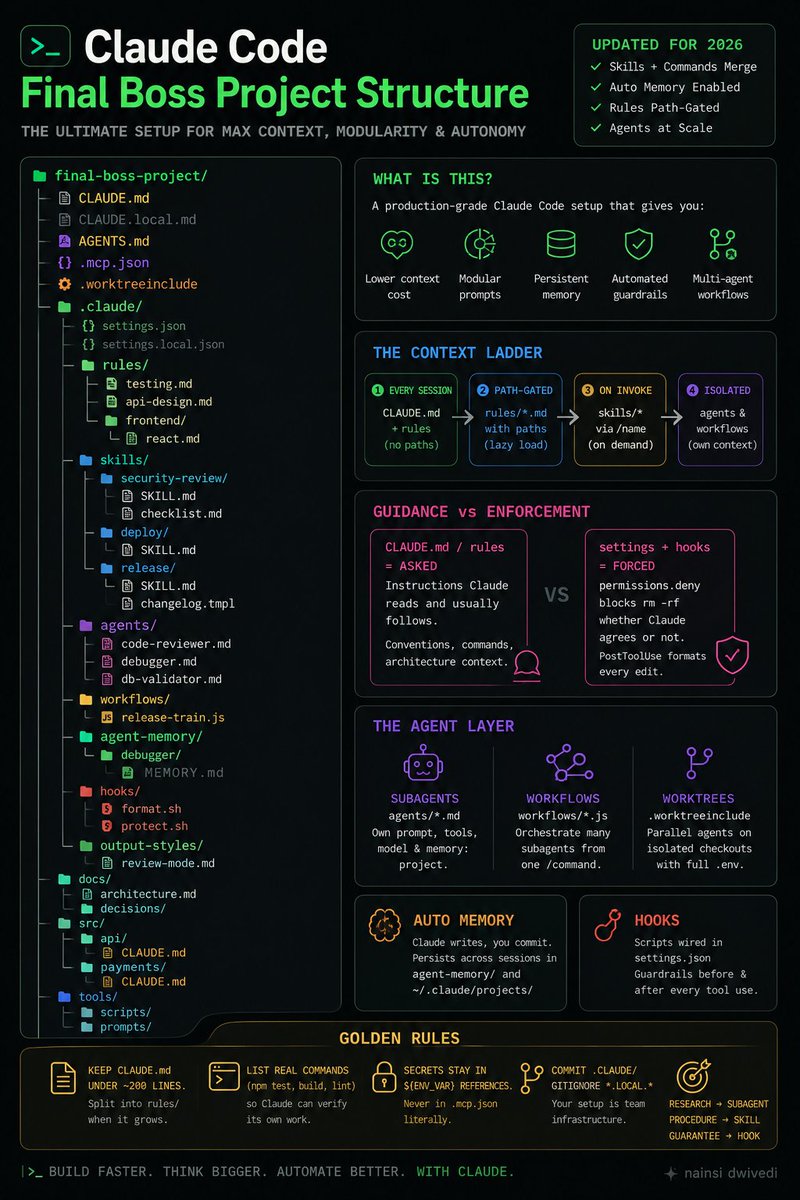
I call it the Final Boss Setup
━━━━━━━━━━━━━━━
1️⃣ The Context Ladder (this changes everything)
Stop thinking "what goes in CLAUDE.md."
Start thinking "what loads WHEN."
There are 4 rungs:
• Every session → CLAUDE.md (tiny, always in context)
• Path-gated → rules/*.md (loads ONLY when Claude touches those files)
• On invoke → skills/* (loads when a task matches)
• Isolated → agents & workflows (own context entirely)
Most people dump everything on rung 1.
Then wonder why Claude gets dumber as the project grows
You're not writing docs. You're designing a memory hierarchy
━━━━━━━━━━━━━━━
2️⃣ ASKED vs FORCED (the line that separates amateurs from pros)
CLAUDE.md and rules = ASKED.
Instructions Claude reads and *usually* follows
Hooks and settings = FORCED.
permissions.deny blocks rm -rf whether Claude agrees or not
Here's the test:
"Please run the formatter" → asked. Works 90% of the time.
PostToolUse hook that formats every edit → forced. Works 100% of the time.
Anything where 90% isn't good enough — secrets, migrations, prod — should never live in a markdown file.
Guidance for style. Enforcement for survival.
━━━━━━━━━━━━━━━
3️⃣ The Routing Rule (tattoo this somewhere)
Every recurring thing you do fits exactly one slot:
• Research → subagent (own context, reports back clean)
• Procedure → skill (the playbook, loaded on demand)
• Guarantee → hook (happens every time, no discretion)
Repeating a workflow in prompts? That's a skill you haven't written.
Reminding Claude to run tests? That's a hook you haven't wired.
Letting exploration pollute your main context? That's a subagent you haven't spawned.
━━━━━━━━━━━━━━━
4️⃣ Rules That Load Themselves
The underrated file: .claude/rules/ with path-gating.
frontend/react.md only enters context when Claude touches frontend code.
api-design.md only when it's in the API.
Your conventions follow Claude around the codebase like a senior engineer looking over the right shoulder at the right moment
Zero tokens wasted on rules that don't apply
━━━━━━━━━━━━━━━
5️⃣ Agents With Their Own Memory
The 2026 upgrade nobody's using yet:
agent-memory/ — Claude writes what it learned, you commit it
Your debugger agent remembers last month's gnarly race condition.
Next session, it starts smarter than it ended
Claude writes. You commit. The team inherits
Your AI's experience becomes version-controlled infrastructure
━━━━━━━━━━━━━━━
6️⃣ CLAUDE.md in the Danger Zones
Global context can't know that your auth module has landmines
So drop local files where the bodies are buried:
src/api/CLAUDE.md
src/payments/CLAUDE.md
Claude reads them exactly when it enters those directories
Warnings appear at the moment of danger — not 4,000 tokens earlier where they get ignored
━━━━━━━━━━━━━━━
7️⃣ The Golden Rules (from the trenches)
• CLAUDE.md under ~200 lines. When it grows, split into rules/. Bloat = missed signals.
• List REAL commands (npm test, build, lint) — so Claude can verify its own work.
• Secrets stay in ${ENV_VAR} references. Never in .mcp.json. Literally never.
• Commit .claude/, gitignore *.local.* — your setup is team infrastructure, not personal preference
━━━━━━━━━━━━━━━
Here's the shift most people miss:
A prompt improves one conversation
Structure improves every conversation, for every teammate, forever
Prompting is renting intelligence
Structure is owning it
Build the repo once and Claude stops visiting your codebase and starts living in it
Angular's Signal Forms simplify form creation significantly compared to traditional Reactive Forms. By binding directly to signals and using a schema object, validation and error handling are consolidated in TypeScript, reducing boilerplate and improving clarity. #Angular
PRO TIP: Copy this article into Fable 5 and tell it...
"Read this article, review my current workflow, and tell me 5 things I can do to be more productive"
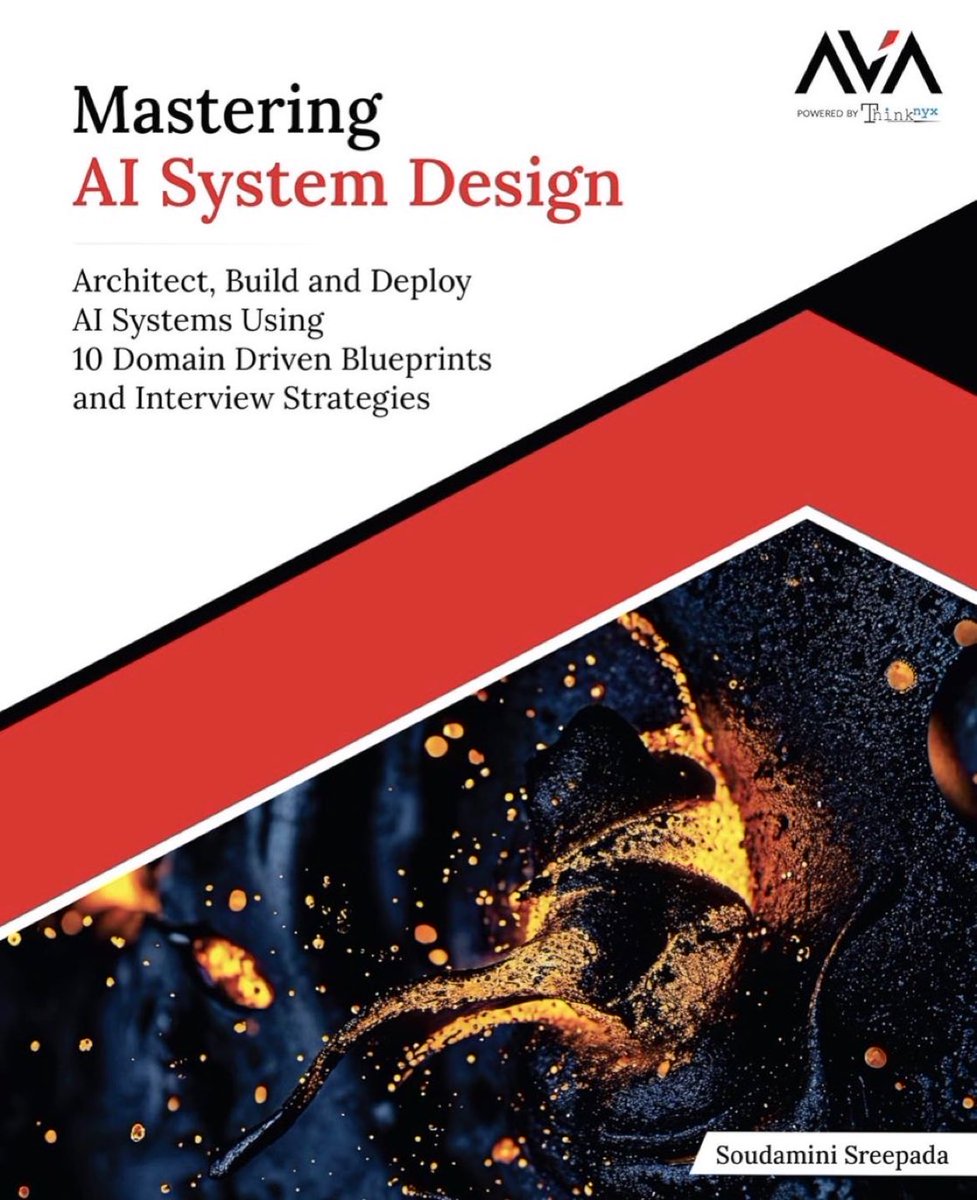
"Mastering AI System Design: Architect, Build and Deploy AI Systems Using 10 Domain Driven Blueprints and Interview Strategies" at https://t.co/4IsGmPEkb4
𝙏𝙖𝙗𝙡𝙚 𝙤𝙛 𝘾𝙤𝙣𝙩𝙚𝙣𝙩𝙨:
1. Introduction to AI System Design
2. Crafting Intelligent Systems Using Prompt Engineering
3. Developing Retrieval-Augmented Generation Systems
4. Enhancing Systems Through LLM Finetuning
5. Designing Financial Risk Prediction Systems Using Supervised Learning
6. Implementing Unsupervised Learning Systems
7. Building Recommendation Systems for E-Commerce
8. Building Image Classification Models for Edge Devices
9. Designing Sequence-to-Sequence Systems
10. Building Domain-Specific LLMs from Scratch
11. Building Multimodal Applications for Healthcare
China has killed the entire vector database industry.
They open-sourced TencentDB Agent Memory. It gives any AI agent long-term memory that runs 100% locally.
No Pinecone. No cloud APIs. No repeating yourself every session.
- 61% fewer tokens
- PersonaMem accuracy: 48% → 76%
- Zero external API dependencies
- Runs on plain SQLite
Most memory systems compress your history into an opaque vector pile. when recall goes wrong, you're guessing. this one doesn't compress, it builds a semantic pyramid.
L0 Conversation → L1 Atom → L2 Scenario → L3 Persona.
Short-term state gets encoded as a Mermaid graph in your agent's context. verbose tool logs get offloaded to disk. when the agent needs proof, it drills back via node_id to the exact raw log.
no lossy compression. every layer is readable markdown you can just open and inspect.
5.1k stars. 100% Open Source.