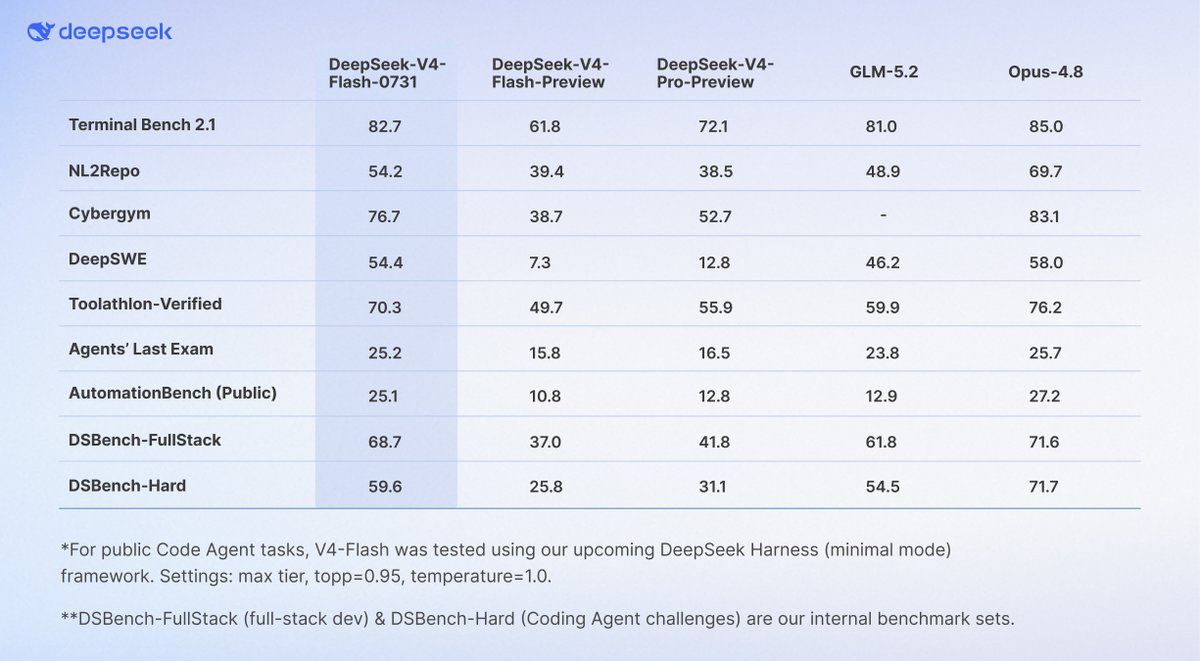
🚀 DeepSeek-V4-Flash Official API is now LIVE in public beta!
🔷 We’ve massively upgraded its Agent capabilities—benchmark scores are now far surpassing the V4-Pro-Preview. Check out the massive performance leap below! 👇
🔷 The official V4-Flash now natively supports the Responses API format and is fully adapted for Codex!
Check out the configuration details in our official API docs: https://t.co/smCwQZMeiq
A preview of FLUX 3 is now available on Hermes agent for 48h.
Hermes chains shots into full short films, one prompt end to end. They're running a short film contest all week: @NousResearch has the details.
Or try it in person: FLUX 3 live at our SF event, this Friday.
Software quality now depends on the constraints you set around your agents.
When humans manually wrote most of the code we could look at the code itself for signs of quality. Is it clean? Is it thoughtful? Is it fast? Can another engineer understand it? Does it have tests?
Agents can now generate more code than people can read. When code generation scales beyond review, quality - checks for one or more of correctness, maintainability, security, performance etc - increasingly has to live somewhere else.
It moves into the harness, environment and operating system around the agent.
This can be the tests and deterministic checks that decide what the system is allowed to do (amongst others). Your constraints are what may eventually enable loops of agents to deliver production software reliably. They can include unit tests, property tests, acceptance tests, mutation testing and quality metrics.
This back-pressure lets the system resist bad work before it becomes somebody elses problem.
Set your constraints. They decide whether the code your agents generate is good enough to ship.
Software quality now depends on the constraints you set around your agents.
When humans manually wrote most of the code we could look at the code itself for signs of quality. Is it clean? Is it thoughtful? Is it fast? Can another engineer understand it? Does it have tests?
Agents can now generate more code than people can read. When code generation scales beyond review, quality - checks for one or more of correctness, maintainability, security, performance etc - increasingly has to live somewhere else.
It moves into the harness, environment and operating system around the agent.
This can be the tests and deterministic checks that decide what the system is allowed to do (amongst others). Your constraints are what may eventually enable loops of agents to deliver production software reliably. They can include unit tests, property tests, acceptance tests, mutation testing and quality metrics.
This back-pressure lets the system resist bad work before it becomes somebody elses problem.
Set your constraints. They decide whether the code your agents generate is good enough to ship.
One pattern I find useful for working with LLMs is a nice long ramble session. Sometimes the LLM needs more bits to understand what you're trying to achieve, but you're too lazy to type them. In these cases I like to lean back, switch to /voice and just ramble for like 10 minutes, total mess, anything goes, full stream of consciousness. Sometimes I declare it up top, something like "switching to speech recognition sorry for any typos...". Sometimes I turn it into a small interview of a few turns. But I find that the LLMs are somehow very good at reconstructing long incoherent rambles and often their echo of your own tangle of thoughts comes out quite a bit cleaner than what you started with. The result is that you improve the mind meld and have to correct things less from that point on.
GPT-5.6 sol is half the price and ~twice as token efficient as fable in many cases for accomplishing the same task.
happy to deliver at one-quarter of the price.