A imprensa brasileira tem falhado ao informar, de forma acrítica e sem qualquer ponderação, o ingresso de novos países no banimento de menores de idade às redes sociais.
No verso do discurso que veículos têm reproduzido das assessorias de imprensa desses governos está o método desse banimento: a coleta massiva de dados pessoais e biométricos de adultos a cada acesso a serviços online para provarem não serem menores de idade. Estão nos mostrando só a folha da frente.
Portanto, toda notícia de restrições online a crianças e adolescentes que omita a informação de que os maiores afetados (em número e extensão de impacto) são os adultos entrega uma informação incompleta, merecendo críticas de seus leitores e espectadores.
A repetição na íntegra de um discurso governamental sem análise, sem crítica e sem ponderação chama-se publicidade. E esta deve ser cobrada pelo veículo e identificada ao leitor como tal.
6 anos usando nubank, 5 anos de ultravioleta, nunca devi 1 real pro banco e sempre tive um valor alto investido
Acordei hj com minha conta encerrada definitivamente e com todo saldo preso sem nem uma explicação
Literalmente me vi no meme do pai mandando o filho ir na agência…
⚠️ Malicious Sicoob NuGet steals Brazilian bank credentials while npm packages target AWS and CI/CD secrets.
The fake "Sicoob.Sdk" versions 2.0.0–2.0.4 exfiltrate client IDs, PFX certificates, and passwords. It was downloaded nearly 500 times.
Multiple npm packages from one actor also steal cloud and pipeline secrets.
Full report: https://t.co/NnLMiVp32X
Save this post right now.
This is the exact 9-step system to create a professional product video with Claude.
No agency. No video team. No $5,000 production budget. Just you and Claude.
Here is exactly how:
☑️ 1. What You Need Before You Start
→ One clean product photo, white or neutral background preferred.
→ A Claude Pro account for MCP connections.
→ One clear goal picked before you touch anything: awareness, conversion, or retargeting.
↳ Clean photo in = clean video out. This step alone saves 30 minutes of fixing.
☑️ 2. Connect Higgsfield MCP to Claude
→ Go to Claude. ai > Connectors → Search "Higgsfield." → Click Add.
→ Authenticate and return to Claude, Higgsfield tools now appear in your chat.
→ Type "list available Higgsfield tools" to confirm the connection is live.
↳ This unlocks Claude, sending your product image directly to Higgsfield and retrieving the video.
☑️ 3. Write Your Video Brief With Claude
Paste this prompt:
"I am creating a 15-second TikTok product video for [product]. Target audience: [audience]. Tone: [energetic/luxurious/cinematic]. Goal: [awareness/conversion]. Write: video concept in 2 sentences, 3-scene shot sequence, voiceover script under 15 seconds, text overlay plan for each scene."
↳ The brief directs everything. Skip it, and your video is random.
☑️ 4. Generate the Product Video With Higgsfield MCP
Prompt:
"Using Higgsfield, generate a product video for the image I will upload. Motion: [slow zoom/orbit/floating/cinematic pan]. Style: [luxury/energetic/minimal]. Duration: 15 seconds. Subtle depth of field. Output in 9:16 vertical format."*
↳ Motion style guide: Slow zoom = luxury. Orbit = tech. Floating = wellness. Cinematic pan = fashion.
☑️ 5. Write the Voiceover With Claude
Prompt:
"Write a 15-second voiceover for [product]. Tone: [tone]. Hook in the first 2 seconds. Short, punchy sentences. End with soft CTA: 'Shop now' or 'Try it today.' Max 40 words total."
↳ Voice style by product: Luxury = slow, breathy. Tech = clear, fast. Wellness = warm, calm. Fashion = punchy, bold.
☑️ 6. Add Text Overlays and Captions With Claude
Prompt: "Write a text overlay plan for a 15-second video for [product]. Divide into 3 scenes, each 5 seconds long. For each scene: overlay text (max 5 words), position, font style, and timing."
→ Add auto-captions and apply one color grade preset matching the brand's mood.
☑️ 7. Write the Caption and Hashtags With Claude
Caption prompt:
"Write 3 TikTok captions for [product]. Each: hook under 10 words, soft CTA, under 150 chars. Label them: Curiosity / Social Proof / Benefit-led."
For more AI systems like this: 👇
→ Go to https://t.co/rnjW2PWRtc
→ Subscribe to my free newsletter (don't pay anything)
→ Get more free and daily cheatsheets
----
Which product are you making your first video for? Drop it below.
----
♻️ Repost to give your network an unfair advantage.
𝗠𝗖𝗣 plus 𝗔𝟮𝗔, here is how they complement each other 👇
Protocol wars continue to rage, let's understand how Googles A2A (Agent2Agent) protocol is different from MCP and how they complement each other (read till the end).
𝘔𝘰𝘷𝘪𝘯𝘨 𝘱𝘪𝘦𝘤𝘦𝘴 𝘪𝘯 𝘔𝘊𝘗:
𝟭. MCP Host - Programs using LLMs at the core that want to access data through MCP.
❗️ When combined with A2A, an Agent becomes MCP Host.
𝟮. MCP Client - Clients that maintain 1:1 connections with servers.
𝟯. MCP Server - Lightweight programs that each expose specific capabilities through the standardised Model Context Protocol.
𝟰. Local Data Sources - Your computer’s files, databases, and services that MCP servers can securely access.
𝟱. Remote Data Sources - External systems available over the internet (e.g., through APIs) that MCP servers can connect to.
𝘌𝘯𝘵𝘦𝘳 𝘈2𝘈:
Where MCP falls short, A2A tries to help. In multi-Agent applications where state is not necessarily shared
𝟲. Agents (MCP Hosts) would implement and communicate via A2A protocol, that enables:
➡️ Secure Collaboration.
➡️ Task and State Management.
➡️ User Experience Negotiation.
➡️ Capability discovery - similar to MCP tools.
𝗛𝗼𝗻𝗲𝘀𝘁 𝘁𝗵𝗼𝘂𝗴𝗵𝘁𝘀:
❗️ Open protocols for Agent communication are important but they are just a piece of the picture, there will be a need for standards that govern all of the existing protocols and other missing pieces. E.g.
❓ How do we standardise tracing and Observability in multi-agent IOA systems?
❓ How do we retain the identity of the running job of an AI Agent instance if the communication standard is not unified in different parts of the pipeline?
❓ ...
✅ More on this in my future posts, stay tuned!
Let me know your thoughts in the comments. 👇
You must know these 𝗔𝗴𝗲𝗻𝘁𝗶𝗰 𝗦𝘆𝘀𝘁𝗲𝗺 𝗪𝗼𝗿𝗸𝗳𝗹𝗼𝘄 𝗣𝗮𝘁𝘁𝗲𝗿𝗻𝘀 as an 𝗔𝗜 𝗘𝗻𝗴𝗶𝗻𝗲𝗲𝗿.
If you are building Agentic Systems in an Enterprise setting you will soon discover that the simplest workflow patterns work the best and bring the most business value.
At the end of last year Anthropic did a great job summarising the top patterns for these workflows and they still hold strong.
Let’s explore what they are and where each can be useful:
𝟭. 𝗣𝗿𝗼𝗺𝗽𝘁 𝗖𝗵𝗮𝗶𝗻𝗶𝗻𝗴: This pattern decomposes a complex task and tries to solve it in manageable pieces by chaining them together. Output of one LLM call becomes an output to another.
✅ In most cases such decomposition results in higher accuracy with sacrifice for latency.
ℹ️ In heavy production use cases Prompt Chaining would be combined with following patterns, a pattern replace an LLM Call node in Prompt Chaining pattern.
𝟮. 𝗥𝗼𝘂𝘁𝗶𝗻𝗴: In this pattern, the input is classified into multiple potential paths and the appropriate is taken.
✅ Useful when the workflow is complex and specific topology paths could be more efficiently solved by a specialized workflow.
ℹ️ Example: Agentic Chatbot - should I answer the question with RAG or should I perform some actions that a user has prompted for?
𝟯. 𝗣𝗮𝗿𝗮𝗹𝗹𝗲𝗹𝗶𝘇𝗮𝘁𝗶𝗼𝗻: Initial input is split into multiple queries to be passed to the LLM, then the answers are aggregated to produce the final answer.
✅ Useful when speed is important and multiple inputs can be processed in parallel without needing to wait for other outputs. Also, when additional accuracy is required.
ℹ️ Example 1: Query rewrite in Agentic RAG to produce multiple different queries for majority voting. Improves accuracy.
ℹ️ Example 2: Multiple items are extracted from an invoice, all of them can be processed further in parallel for better speed.
𝟰. 𝗢𝗿𝗰𝗵𝗲𝘀𝘁𝗿𝗮𝘁𝗼𝗿: An orchestrator LLM dynamically breaks down tasks and delegates to other LLMs or sub-workflows.
✅ Useful when the system is complex and there is no clear hardcoded topology path to achieve the final result.
ℹ️ Example: Choice of datasets to be used in Agentic RAG.
𝟱. 𝗘𝘃𝗮𝗹𝘂𝗮𝘁𝗼𝗿-𝗼𝗽𝘁𝗶𝗺𝗶𝘇𝗲𝗿: Generator LLM produces a result then Evaluator LLM evaluates it and provides feedback for further improvement if necessary.
✅ Useful for tasks that require continuous refinement.
ℹ️ Example: Deep Research Agent workflow when refinement of a report paragraph via continuous web search is required.
𝗧𝗶𝗽𝘀:
❗️ Before going for full fledged Agents you should always try to solve a problem with simpler Workflows described in the article.
What are the most complex workflows you have deployed to production? Let me know in the comments 👇
Most people use Claude like a chatbot.
The top 1% use it like a system.
The people actually winning with AI in 2026 have given Claude a job title, a file, and a system.
Here are the 20 Claude Skills everyone needs this year:
Here is exactly how: 👇
☑️ 1. Content and Growth
→ viral-hook. MD generates 10 scroll-stopping opening lines for any niche.
→ brand-voice. MD trains Claude on your tone so it never sounds like AI
→ repurpose. MD turns one YouTube script into 5 LinkedIn posts instantly.
↳ seo-expert. MD and audience-pains. MD, round this out. Your content engine, automated.
☑️ 2. Executive and Admin
→ meeting-pro. MD converts messy transcripts into actionable tasks.
→ calendar-shield. MD audits and finds 4 hours of hidden deep-work time.
→ critic-loop. MD acts as a harsh Advocate to find every flaw in your plan.
☑️ 3. Tech and Systems
→ code-auditor. MD scans for security holes and Clean Code violations.
→ unit-tester. MD writes a full test suite for every new function you create.
→ sql-master. MD converts plain English into complex database queries.
☑️ 4. Strategy and ROI
→ market-gap. MD analyzes 2 competitors and finds their weaknesses.
→ roi-projector. MD forecasts revenue based on conversion and ad spend.
→ vision-check. MDensures every task you do today aligns with your 12-month business goal.
I wrote the full breakdown on how to build every single one of these skills yourself. Step-by-step. Copy-paste ready.
Read it here → https://t.co/IA6mhKbVhy
For more Claude systems like this: 👇
→ Go to https://t.co/XZmlWQ3gEs
→ Subscribe to my free newsletter (don't pay anything)
→ Get more free and daily cheatsheets
Which skill are you installing first? Drop the number below, and I'll share the exact prompt to activate it.
♻️ Repost to give your network an unfair advantage.
Most developers spend 2 weeks onboarding to a new AI coding tool.
This cheatsheet cuts it to 24 hours.
4 sprints. 1 loop. Zero wasted time.
Here is the full breakdown: 👇
☑ 1. Setup
→ Install Claude Code, connect the VS Code extension, and sign in.
→ Link exactly 3 repos. Not 10. Not your entire org.
→ Start with a minimal, organized codebase.
☑ 2. The TDD Core Loop
→ Write the test before you write any code.
→ Hand Claude this prompt: "Given this feature: [describe]. Write a Python test suite with 10+ Pytest cases. Then write the implementation that passes every test completely."
→ Run the test. If it fails, loop. If it passes, move to step 3.
☑ 3. Context Handling for Legacy Repos
→ Repo over 500 files? Stop. Use a specialized Context Agent.
→ Prompt: "Analyze this 10-year-old JavaScript file: [content]. Find 5 refactoring opportunities that reduce complexity without breaking existing logic."
→ Establish a Rule of 3: only the three most relevant files per session.
☑ 4. Deploy and Lock It In
→ Connect GitHub, AWS Lambda, Docker, and VS Code via connectors
→ Generate a GitHub Actions YAML file that runs Pytest on every commit.
→ Route coverage reports into PR comments.
Manage context like a CEO manages a team.
Automate the parts that used to eat your Fridays.
For more AI dev workflows like this: 👇
→ Go to https://t.co/XZmlWQ3gEs
→ Subscribe for free (don't pay anything)
→ Get cheatsheets like this one every week
Which sprint do you think most devs skip? Drop it below. 🤯
♻️ Repost to save an engineer in your network 6 months of wasted effort.
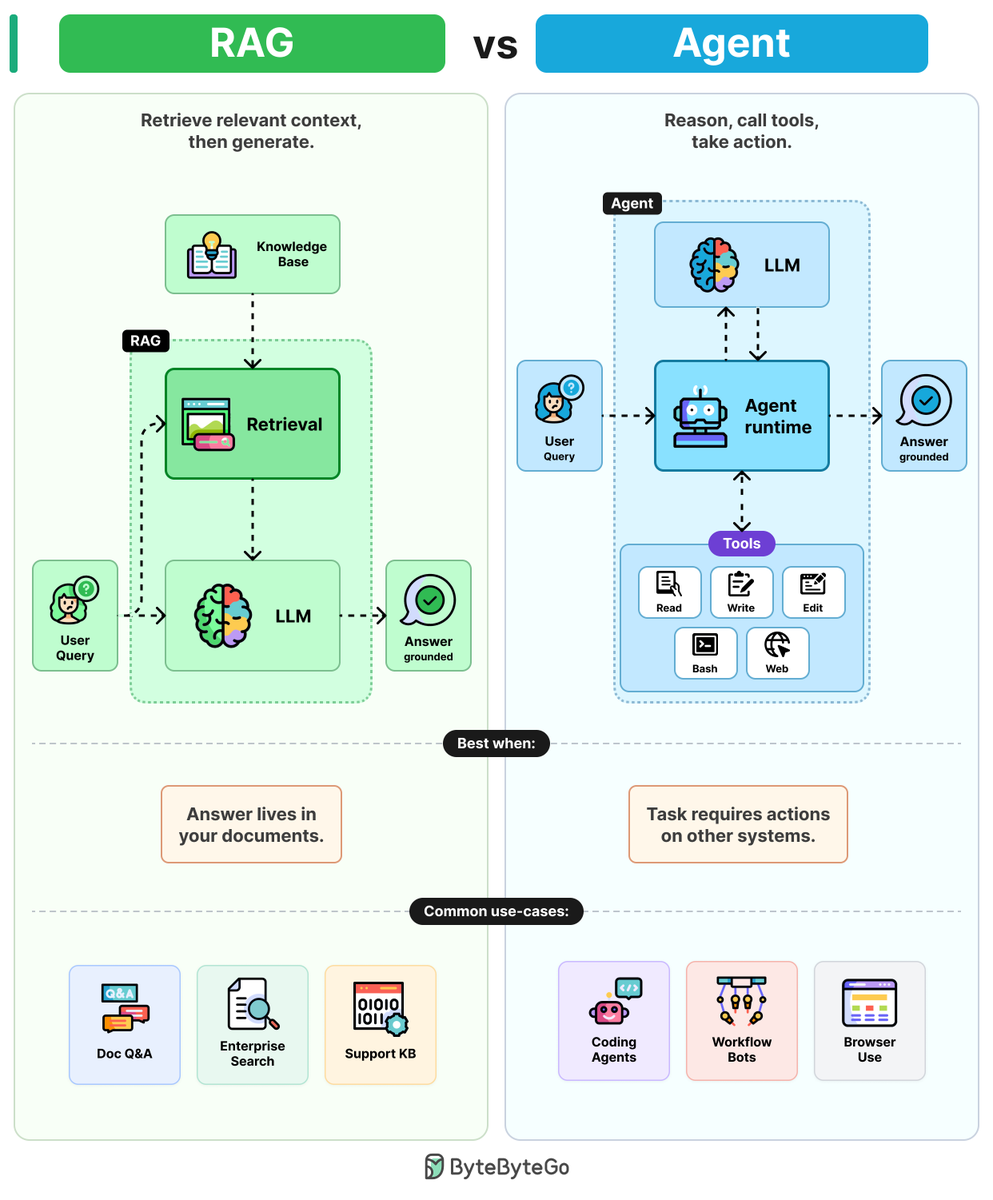
RAGs vs Agents
Ask an LLM about your company's data and it will guess. The two patterns that fix this are RAG and agents, and they solve different problems.
RAGs: RAGs combine LLMs with retrieval to ground answers in 4 steps.
Step 1: The user query is embedded and sent to a retrieval step.
Step 2: Retrieval pulls the most relevant chunks from a knowledge base (PDFs, wikis, etc.)
Step 3: Those chunks are pasted into the prompt as context.
Step 4: The LLM writes the answer, grounded in the retrieved text.
One retrieval. One generation. Cheap, predictable, and easy to debug.
Agents: Agents wrap LLMs in a reasoning loop with tools to take action.
Step 1: The user query goes into the agent runtime. A reasoning loop wrapped around an LLM.
Step 2: The LLM reads the goal and picks a tool (Read, Write, Edit, Bash, etc.)
Step 3: The runtime executes the tool and feeds the result back to the LLM.
Step 4: The LLM reasons again, picks the next tool, and loops until the task is done.
More flexible. More tokens. Harder to debug because errors drift across steps.
The rule of thumb: Use RAG when the answer lives in your documents. Use an agent when the answer requires action on other systems.
Over to you: When do you prefer RAG over agent?




![humzaakhalid's tweet photo. Save this post right now.
This is the exact 9-step system to create a professional product video with Claude.
No agency. No video team. No $5,000 production budget. Just you and Claude.
Here is exactly how:
☑️ 1. What You Need Before You Start
→ One clean product photo, white or neutral background preferred.
→ A Claude Pro account for MCP connections.
→ One clear goal picked before you touch anything: awareness, conversion, or retargeting.
↳ Clean photo in = clean video out. This step alone saves 30 minutes of fixing.
☑️ 2. Connect Higgsfield MCP to Claude
→ Go to Claude. ai > Connectors → Search "Higgsfield." → Click Add.
→ Authenticate and return to Claude, Higgsfield tools now appear in your chat.
→ Type "list available Higgsfield tools" to confirm the connection is live.
↳ This unlocks Claude, sending your product image directly to Higgsfield and retrieving the video.
☑️ 3. Write Your Video Brief With Claude
Paste this prompt:
"I am creating a 15-second TikTok product video for [product]. Target audience: [audience]. Tone: [energetic/luxurious/cinematic]. Goal: [awareness/conversion]. Write: video concept in 2 sentences, 3-scene shot sequence, voiceover script under 15 seconds, text overlay plan for each scene."
↳ The brief directs everything. Skip it, and your video is random.
☑️ 4. Generate the Product Video With Higgsfield MCP
Prompt:
"Using Higgsfield, generate a product video for the image I will upload. Motion: [slow zoom/orbit/floating/cinematic pan]. Style: [luxury/energetic/minimal]. Duration: 15 seconds. Subtle depth of field. Output in 9:16 vertical format."*
↳ Motion style guide: Slow zoom = luxury. Orbit = tech. Floating = wellness. Cinematic pan = fashion.
☑️ 5. Write the Voiceover With Claude
Prompt:
"Write a 15-second voiceover for [product]. Tone: [tone]. Hook in the first 2 seconds. Short, punchy sentences. End with soft CTA: 'Shop now' or 'Try it today.' Max 40 words total."
↳ Voice style by product: Luxury = slow, breathy. Tech = clear, fast. Wellness = warm, calm. Fashion = punchy, bold.
☑️ 6. Add Text Overlays and Captions With Claude
Prompt: "Write a text overlay plan for a 15-second video for [product]. Divide into 3 scenes, each 5 seconds long. For each scene: overlay text (max 5 words), position, font style, and timing."
→ Add auto-captions and apply one color grade preset matching the brand's mood.
☑️ 7. Write the Caption and Hashtags With Claude
Caption prompt:
"Write 3 TikTok captions for [product]. Each: hook under 10 words, soft CTA, under 150 chars. Label them: Curiosity / Social Proof / Benefit-led."
For more AI systems like this: 👇
→ Go to https://t.co/rnjW2PWRtc
→ Subscribe to my free newsletter (don't pay anything)
→ Get more free and daily cheatsheets
----
Which product are you making your first video for? Drop it below.
----
♻️ Repost to give your network an unfair advantage.](https://pbs.twimg.com/media/HJOUYM1bsAI78Ax.jpg)


![humzaakhalid's tweet photo. Most developers spend 2 weeks onboarding to a new AI coding tool.
This cheatsheet cuts it to 24 hours.
4 sprints. 1 loop. Zero wasted time.
Here is the full breakdown: 👇
☑ 1. Setup
→ Install Claude Code, connect the VS Code extension, and sign in.
→ Link exactly 3 repos. Not 10. Not your entire org.
→ Start with a minimal, organized codebase.
☑ 2. The TDD Core Loop
→ Write the test before you write any code.
→ Hand Claude this prompt: "Given this feature: [describe]. Write a Python test suite with 10+ Pytest cases. Then write the implementation that passes every test completely."
→ Run the test. If it fails, loop. If it passes, move to step 3.
☑ 3. Context Handling for Legacy Repos
→ Repo over 500 files? Stop. Use a specialized Context Agent.
→ Prompt: "Analyze this 10-year-old JavaScript file: [content]. Find 5 refactoring opportunities that reduce complexity without breaking existing logic."
→ Establish a Rule of 3: only the three most relevant files per session.
☑ 4. Deploy and Lock It In
→ Connect GitHub, AWS Lambda, Docker, and VS Code via connectors
→ Generate a GitHub Actions YAML file that runs Pytest on every commit.
→ Route coverage reports into PR comments.
Manage context like a CEO manages a team.
Automate the parts that used to eat your Fridays.
For more AI dev workflows like this: 👇
→ Go to https://t.co/XZmlWQ3gEs
→ Subscribe for free (don't pay anything)
→ Get cheatsheets like this one every week
Which sprint do you think most devs skip? Drop it below. 🤯
♻️ Repost to save an engineer in your network 6 months of wasted effort.](https://pbs.twimg.com/media/HIlw3hrbIAETmQy.jpg)