Imagine if a nuclear fusion company had a working reactor & >$20B in annual revenue. They believed that their research would enable them to create a small, more portable reactor in the next year, but also that the reactor could be easily turned into a gigaton nuclear bomb. Independent scientists were divided about whether they could make that new type of reactor in the next year, but generally agreed that if they could, a bomb wouldn't be much harder, and that would be extremely dangerous.
I'm not sure the people leading AI companies, including technical staff, are correct about AI speedup & imminent RSI capabilities. But the fact that they believe it is totally enough justification to stop them!
Fully closing the RSI loop would be much more dangerous than developing a portable gigaton nuclear weapon, even though that's ~200x the yield of the biggest nuclear bomb ever tested.
https://t.co/0agux45jYU
What is the difference between reversing a diffusion in distribution and reversing its realized stochastic flow?
Hichem Brahmi’s MSc thesis studies backward flows for OU, VP and CIR diffusions, with numerical reconstruction and Lamperti transform for CIR.
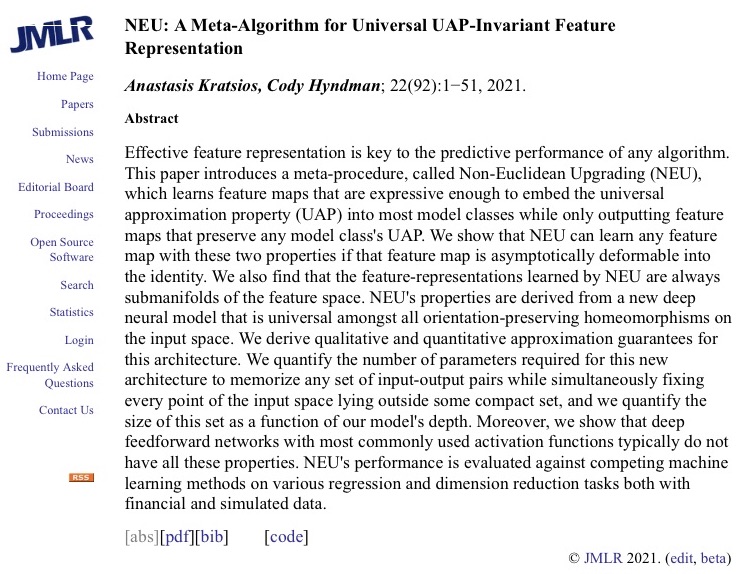
When we transform data, how should we transform the constraints?
Aleksandar Krstic’s MSc thesis explores transformed admissible sets, extending our earlier NEU work to constrained estimation and yield curves.
https://t.co/KC1Vyf4siw
The CMS is pleased to announce Dr. Carlo Pagano (@Concordia) as the recipient of the 2026 Coxeter-James Prize.
La SMC est heureuse d'annoncer que le Dr Carlo Pagano (Concordia) est le lauréat du prix Coxeter-James 2026.
🔗Media release | Communiqué : https://t.co/Iv34EQKPf8
👏 🏆
Félicitations à Carlo Pagano, de @Concordia, pour avoir remporté ce prix, qui récompense les jeunes mathématiciens ayant apporté une contribution exceptionnelle à la recherche mathématique. ⤵️
👏🏆
Congratulations to @Concordia's Carlo Pagano for winning @canmathsociety's Coxeter-James Prize, recognizing young mathematicians who have made outstanding contributions to mathematical research.⤵️
Félicitations au Dr Carlo Pagano, qui a rejoint le Département de mathématiques et de statistique de l'Université Concordia en 2022 ! Il fait partie des jeunes mathématiciens, statisticiens et spécialistes des données exceptionnels que nous avons recrutés ces dernières années !
The CMS is pleased to announce Dr. Carlo Pagano (@Concordia) as the recipient of the 2026 Coxeter-James Prize.
La SMC est heureuse d'annoncer que le Dr Carlo Pagano (Concordia) est le lauréat du prix Coxeter-James 2026.
🔗Media release | Communiqué : https://t.co/Iv34EQKPf8
Congrats to Dr. Carlo Pagano, who joined the Dept. of Mathematics and Statistics @Concordia in 2022! One of several amazing young mathematicians, statisticians, and data scientists we hired in recent years!
The CMS is pleased to announce Dr. Carlo Pagano (@Concordia) as the recipient of the 2026 Coxeter-James Prize.
La SMC est heureuse d'annoncer que le Dr Carlo Pagano (Concordia) est le lauréat du prix Coxeter-James 2026.
🔗Media release | Communiqué : https://t.co/Iv34EQKPf8
An important piece by @P_A_Kirschner on something that doesn't get discussed enough.
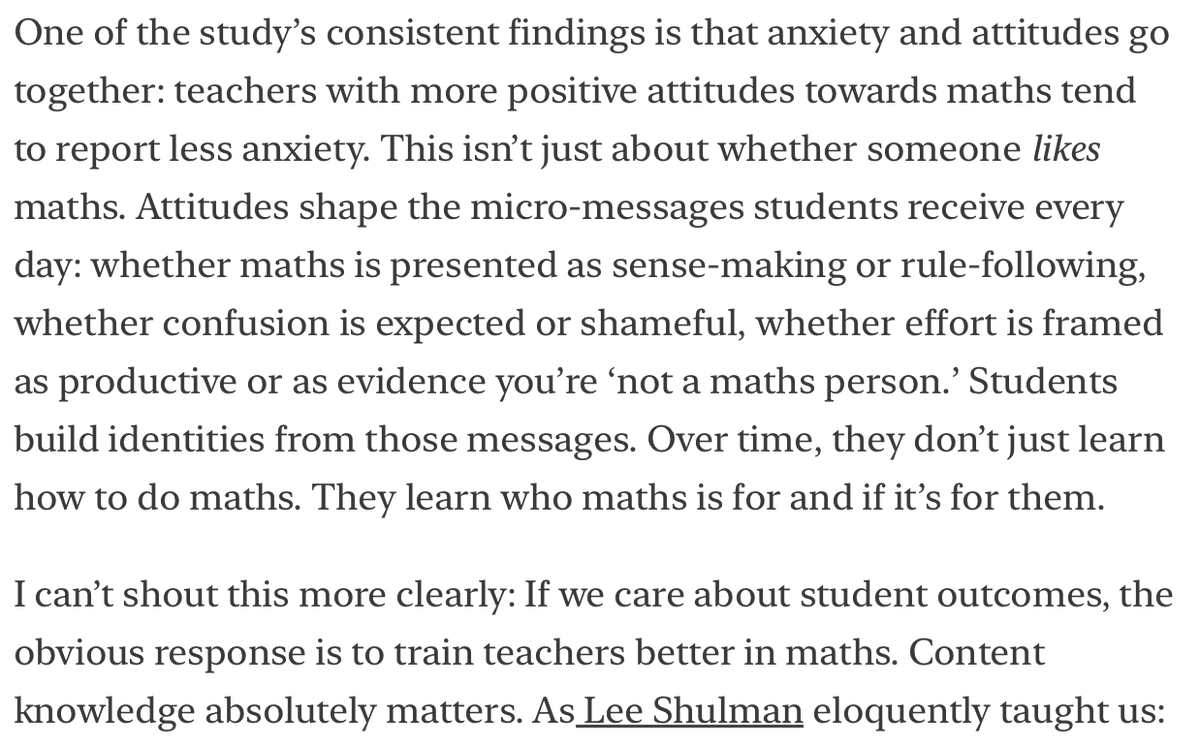
You can't teach what you don't know. Students notice when teachers are uncomfortable with math or dislike math. "If we care about student outcomes, the obvious response is to train teachers better in maths. Content knowledge absolutely matters."
Yet in Canada, it's routinely assumed that high school graduates have adequate content knowledge of K-8 math and therefore have the foundations to teach it, after some pedagogy courses. It's a false assumption, and there are few mechanisms in place to fix it before teachers enter the classroom. In my experience, math content knowledge is even downplayed by education faculties.
People worry about math anxiety, but knowing more math and being comfortable with math makes someone more confident with math (the real antitdote to math anxiety). That goes for students, but it also goes for teachers.
https://t.co/862Kn8IUss
Join us for the #CAST talk with Prof. Wei Sun @Concordia on "Parameter Estimation for Stochastic Differential Equations Driven by Levy Noise with Time-Dependency."
Oct 17, 2025 | 3:30-4:30 pm ET | https://t.co/foteZ2TBHW
In 🤝 with the School of Math and Stats @CarletonU
Something has broken tonight in the bond market. We are seeing a disorderly liquidation.
If I had to GUESS, the basis trade is in full unwind.
Since Friday's close to now ... the 30-year yield is up 56 bps, in three trading days.
The last time this yield rose this much in 3 days (close to close) was January 7, 1982, when the yield was 14%.
This kind of historic move is caused by a forced liquidation, not human managers make decisions about the outlook for rates at midnight ET.
This is one of the scenarios we had in mind in this paper.
Trading against disorderly liquidation of a large position under asymmetric information and market impact
https://t.co/JEU3p2Pe7i
“Fears grew on Wall Street that the sell-off would feed on itself with hedge funds forced to sell down equities and other risky assets to raise cash and meet margin calls.” https://t.co/zCBloyPmer
New Proofs Probe the Limits of Mathematical Truth https://t.co/sHTZbhNZLR via @QuantaMagazine
Featuring amazing research by Carlo Pagano, Department of Mathematics and Statistics, @Concordia
Do you know the person in a Saree walking with Nobel laureates Julian Schwinger and Abdus Salam?
She is particle physicist TK Radha who had a brief but impressive career in the 1960s. After here PhD in IMSc, Chennai Oppenheimer invited her for a visit to IAS. She then did a postdoc with L. Schiff with Stanford.
Radha had written papers with the likes of Marshak and Schiff, and eventually received an Assistant Professorship at U of Alberta.
But she took a break from her career to care for her child and eventually dropped out of academia.
It was not the end of her academic story.
Almost a decade after dropping out of particle physics, she started taking computing courses at U of Alberta and ended at the top of her class. Because of her background, the physics department immediately hired her as a programmer.
For the next 16 years, she worked as a programmer, helping physicists with numerical computations. She would sometimes contribute her own ideas to their projects, which led to her being listed as co-author on several publications.
In a different world, she could have had a long and illustrious career as a particle physicist.
No, You Don't Get An A for Effort "Every teacher should be rooting for students to succeed..[but] the true measure of learning is not the time & energy you put in. It’s the knowledge & skills you take out" Sometimes it's about working smarter, not harder https://t.co/mgt7QrTUF0
Keep in mind that the people behind all this mind-bending modern AI didn't just code, they also knew extensive math. They didn't say "there's no point in learning math because you can just have the computer do it for you." It's about skill-stacking, not skill replacement.