Why Ethereum's Glamsterdam Upgrade Could Be Delayed Until May 2027
Ethereum's next major upgrade, Glamsterdam, may face a delay of several months due to smart contract compatibility issues
Here's what's happening:
- The main issue: Two gas pricing proposals, EIP-8037 and EIP-8038, could affect how existing smart contracts operate after the upgrade
- Compatibility risks: The Ethereum Foundation, ChainSecurity, and Dedaub have contacted at least 50 affected projects. Three are classified as high-impact, while others require additional time to fix compatibility issues
- Fix timeline: High-impact projects have completed or are expected to complete fixes by mid-December 2026. Medium-impact projects have until January 10, 2027
What's the potential timeline?
- Mid-January 2027: If current specifications remain unchanged
- Late February–March 2027: If developers decide to modify the specifications in January
- April–May 2027: If the proposed modifications are adopted
The Hoodi testnet fork has already been delayed due to similar compatibility problems
Ethereum isn't simply delaying Glamsterdam because development is taking longer. Developers are weighing the benefits of gas pricing improvements against the risk of breaking existing smart contracts
It's a trade-off between moving faster and ensuring the upgrade doesn't disrupt the existing ecosystem
No final decision has been made yet
@conordeegan Account abstraction. ERC4337 now and frames transactions in the near future. It enables crypto agility and they can run multiple accounts on one paymaster which eliminates dust.
It's no longer about when enough logical qubits can be maintained to break ecdsa but also how efficient can AI make Shor's algorithm to further reduce that threshold
Here is something that didn’t get enough attention: the ECDSA/fail challenge.
In this challenge, people used their AI agents to reduce the resources needed for a key operation in Shor’s algorithm (that operation is needed to break quantum-vulnerable ECDSA signatures -- the type of signatures used by Bitcoin, Ethereum, and many more).
The amazing results: they reduced the resource cost needed for this operation by over 90%!
This took only a few months.
Interesting to note: this is 70% better than Google's estimate.
Why is this very technical story important?
Because it demonstrates (i) how AI can improve the efficiency of quantum attacks, and (ii) how AI could accelerate the Q-Day timeline.
The important thing here:
A few months of concentrated effort happening on people’s *laptops* resulted in a substantial reduction in the resources needed for a quantum attack.
It's a long sentence but read it again.
We're not talking here an extremely long timespan and fancy equipment which few people can access.
Now imagine the possibilities if someone dedicated more time and resources to this effort.
Time to migrate to quantum-safe tech and to STARKs.
You thought this was a bad week in crypto? You might have missed the bigger news.
Two results just landed on elliptic-curve cryptography. Both are worrying. Neither one breaks a key anyone uses today.
1️⃣ The problem under ECC is less hard than we thought.
ECC is secure because the elliptic-curve discrete log is hard. The best general algorithm we had was Pollard's rho, and it is exponential: add bits to the key, and breaking it gets exponentially harder.
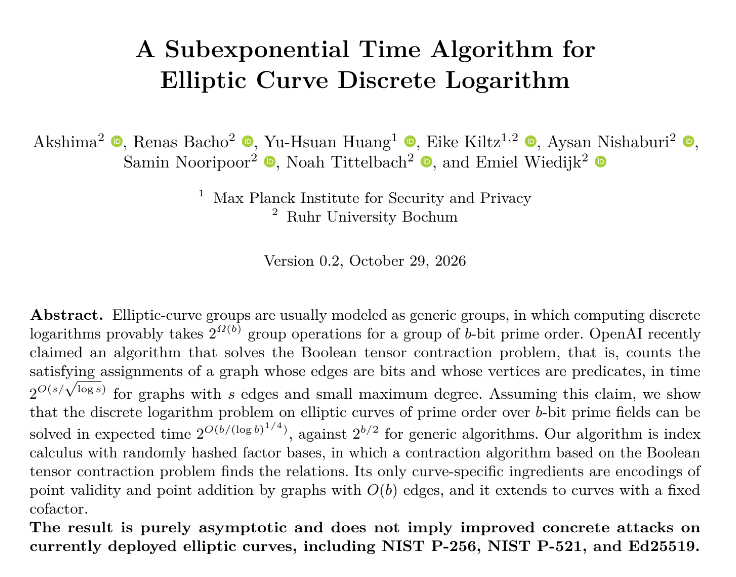
That assumption is now false, with one caveat. A paper from Bochum and MPI-SP gives a subexponential algorithm. It assumes an OpenAI claim that is still under review. If the claim holds, the new algorithm is faster asymptotically. In practice it changes nothing. On secp256k1, P-256, or Ed25519, rho is still the best algorithm, and it still takes the age of the universe. The new one only pulls ahead on hypothetical curves of enormous size, and there the cost is even more absurd.
https://t.co/k6ZpfloNvX
2️⃣ The quantum circuit is getting cheaper. The computer is not here.
We still have no quantum computer. The circuit that would run on one to break ECDSA keeps getting cheaper. https://t.co/bYawK8RPU3 is a public auto-research loop aimed at exactly that. Its current best is about 70% cheaper than the circuit Google reported, on logical qubits times Toffolis (0.91 billion against 2.99 billion). Google's circuit was already two to three times cheaper than the previous published one.
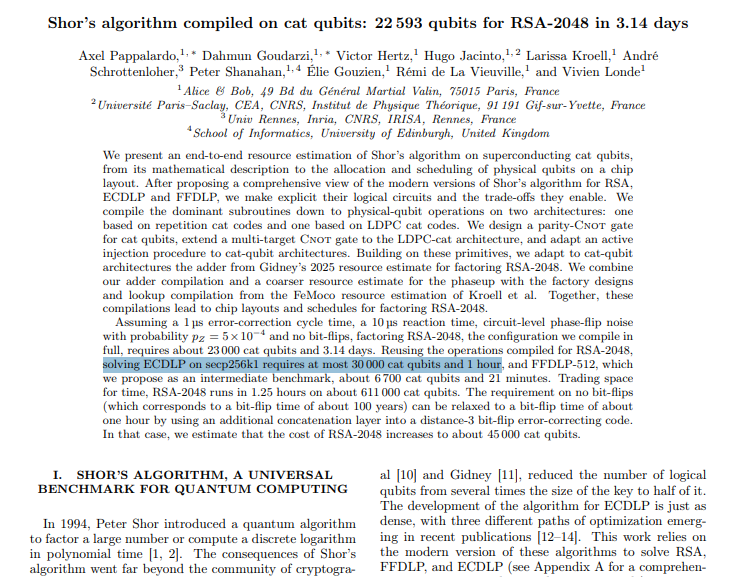
Alice & Bob @Alice__Bob , a French Quantum Computing company, just estimated that breaking secp256k1, the Bitcoin curve, takes at most about 30,000 cat qubits and one hour. That figure assumes a machine nobody has built. We are still far from it. The machine being asked for keeps getting smaller.
https://t.co/CXodOGwMes
What a crazy time to be alive.
We’ve got exceptional builders in the CML community. Meet one of them.
Paul Angus Bark, CEO & Founder of Cointrol Limited.
Paul has spent eight years in crypto and previously worked at Archax before leaving to start @cointrol_ltd with a clear goal: build wallets with a better user experience.
He’s built Gobha: a non-custodial, gasless Ethereum wallet using post-quantum cryptography.
Some of you will know Paul from our post-quantum cryptography panel. Here’s what he’s building beyond the stage.
Live on iOS and Android. Try it and tell us how it feels
https://t.co/txHm8Y5LFa
A few reflections on the lattice vs. hash-only debate that our recent Aerie post sparked:
1. Cryptographic ossification for blockchains was never safe. Until the day we know with certainty that P ≠ NP, that finding short vectors in lattices is intractable, that Keccak effectively behaves like a random oracle in deployed SNARKs, and that every single bug has been eliminated from our codebases, blockchains cannot ossify. That is simply not how safe systems are built. Issues will arise, and the system will have to respond.
It’s a double standard to reject lattices because blockchains are hard to upgrade if lattices break, while counting on upgrades if AI breaks your hash function or finds a critical zkVM bug.
The best counterargument is that hash-only designs are more agile: if your hash function breaks, just swap out the hash. But we must aspire to a higher level of agility than this. Indeed, as I cover next, if SNARK recursion itself turns out to degrade security, the proposed hash-only blockchain designs would need to be rethought from the ground up.
2. The real security debate is not lattices vs. hashes — it is lattices vs. building everything on SNARK recursion. That’s because “hash-only” is not really hash-only: it rests on hashes plus the soundness of deep SNARK recursion. Ethereum’s roadmap relies on exactly that: hash-based aggregation needs recursion to keep up with a slot’s worth of signatures, and EIP-8288 would send other signature schemes and users’ own proofs through the same recursive pipeline. In contrast, Aerie proves a slot’s worth of signatures on one laptop without any recursion.
All deployed post-quantum SNARKs rely on the Random Oracle Methodology (via Fiat–Shamir) to establish their security. This is an idealization we know fails in the real world: we have explicit counterexamples where “SNARKs” coming out of this methodology are totally insecure when instantiated with any concrete hash function.
We generally ignore these counterexamples in part because they only arise when proving contrived, self-referential statements about the very hash function used by the SNARK verifier.
But proving statements about the verifier’s own hash function is the exact thing you do in SNARK recursion. That’s why the security of recursive SNARKs can’t be established even in the random oracle model.
On top of that, the standard security proofs for recursion (in other models) suffer an “extractor runtime” blowup that is exponential in the recursion depth, suggesting that security may degrade as more recursion is applied. Yet Ethereum’s own EIP-8288 enables unlimited-depth recursion, even as it lists soundness of recursive SNARKs as a trust assumption. Proofs in more idealized models avoid the blowup, but they mainly tell us that an attack on SNARK recursion would have to exploit the concrete hash function, which is exactly what the Fiat–Shamir attacks above do.
To be clear, we don’t know of any outright attacks on SNARK recursion, and I very much hope it is secure. But some of us who have studied the question have a lingering sense that an attack may be possible in some settings. And if AI is going to supercharge cryptanalysis, there is no reason to expect it to spare Fiat–Shamir for SNARKs, let alone SNARK recursion, both of which have had far less scrutiny than lattices.
So, I do not concede that a “recursion everywhere” hash-only approach is clearly more conservative than one built on standard lattice assumptions.
3. “Just wrap everything in a hash-based SNARK” (like EIP-8288) faces challenges.
Aggregating signatures and proofs off-chain into a single block-level proof is a powerful design independent of the hash-only vs. lattice debate, and I am not telling people to avoid it. But claiming, as Vitalik Buterin did this week, that users can run whatever cryptography they want locally and wrap it in a client-side leanVM proof glosses over major hurdles.
For example, leanVM today is a minimal VM designed almost entirely to prove hash-based signatures and recursion, not general-purpose computation. And binary-field SNARKs like leanVM remain slow at proving the integer multiplications that lattice cryptography does en masse.
I am optimistic that many of these zkVM challenges can be met (including via my own work, binary-field Twist and Shout, which are now implemented in Magnetar). But regardless, if lattices can make aggregation simpler and faster, then they should be leveraged. We need to be agile no matter what.
4. For chains whose reason for existence is privacy, I truly struggle to understand the pushback. Public-key encryption (and fast single-server PIR) cannot be built from hashes alone, at least not in any black-box way. If lattices break, it is going to be very, very hard for these chains to provide acceptable levels of privacy and functionality. For a project whose entire reason for existence is privacy, a loss of confidentiality is an existential failure. Next to that, a second signature upgrade (after the first one, from elliptic curves alone to, hopefully, a hybrid lattice scheme) is easy.
Summary: We don’t know for sure what is secure and what isn’t. We are all weighing unquantifiable risks against each other, and we do not need to agree on a total order on them. But hash-only solutions face many open engineering challenges, and they are not more “conservative” in the way some have argued. Some of those challenges are entirely prosaic and have nothing to do with bugs or cryptography, like hardware support for custom schemes whose hash function is still undecided. I hope we can overcome those challenges within the appropriate timelines, but they must be acknowledged and portrayed realistically.
Overall, cryptographic agility and defense in depth (e.g., hybrid signatures) are the answer, which is why we are building both lattice-Jolt and hash-Jolt. In practice, the positions are less polarized than social media discourse suggests: for example, StarkWare is working to make Falcon verification cheap (https://t.co/FM68hmkqRx), which is great to see.
Here is the (apparently) controversial take I am sticking to: Conditioned on agility, whenever lattices make systems simpler or more functional, we should embrace them rather than default to “hash-only” designs. Lattices are what the rest of the world will depend on, with decades of study and hardening behind them, and at the system level, less functional often means less secure. Where hash-only designs are just as simple and functional, by all means use them.
@DisneyPlus I found out my subscription has been cancelled today by @skytv. I'm not a sky customer. I simply entered my credentials into my landlord's TV so I could watch your programs. But somehow you let sky cancel my subscription with you even though I've been with you from the beginning and paint for it separately. How was sky even allowed to do that? I'm now going to take my time thinking about whether I want to return to you. Clearly I have little say
@wmougayar@CryptoQuant Whenever a bear market occurs, there tends to be an increase in building and development. I expect these contracts include a number of new token projects, specifically stablecoins, but also include the ongoing work in privacy, compliance and quantum resistance.
@IanSmith_HSA@adamamcbride Ideally the design needs cryptoagility and frames is likely the answer. Frames will include the valid until feature similar to transferWithAuthorisation and keyed nonces could be used instead of random nonces.
@IanSmith_HSA@adamamcbride The fact that Falcon has not been standardised is because of additional scrutiny and precautions given how novel the maths are. If a weakness had been found, it would have already been publicised.
@IanSmith_HSA@adamamcbride The side channel attacks were addressed with the constant time function and the use of a salt in the message hash. That is also only a problem with hardware wallets
@IanSmith_HSA@adamamcbride Hardware wallets have their own risks as we've seen with the Coldcard incident recently. They are also not able to rotate keys which is in itself a security risk
@IanSmith_HSA@adamamcbride They used constant-time functions to mitigate the key leaks and it requires access to the hardware signing the transaction if I'm not mistaken as well as a large sample size; on-chain verification does not leak information. It can further be mitigated through key rotations.
@IanSmith_HSA@adamamcbride Alternatively, the facilitator could run their own bundler service and accept a signed user op with the underlying payment transfer. They could then make a call to the entrypoint to validate the userOp before submitting.