Has anyone ever wondered why Do is called Do, Re is called Re, and Mi is called Mi? The story behind the origin of the musical scale is interesting and unexpected.
It all begins with a Benedictine monk who lived in the 11th century (995–1050), named Guido d’Arezzo. He noticed a peculiarity in a very popular hymn to Saint John the Baptist at the time.
This hymn was composed of 7 verses, each with a different musical note. For this reason, the monk named each note using the first two letters of each verse. Here is the hymn:
Ut queant laxis (Ut) Resonare fibris (Re) Mira gestorum (Mi) Famuli tuorum (Fa) Solve polluti (Sol) Labii reatum (La) Sancte Ioannes (Si)
(So that your servants, with free voices, may resound the wonders of your deeds, cleanse the guilt from our stained lips, O Saint John the Baptist)
Since the syllable “Ut” was not easy to sing, it was replaced by “Do” in 1640 by Giovanni Battista Doni.
Not many people in the world of music, today so far removed from God, know that the names of the musical notes come from a hymn to the greatest of His prophets. Happy Saint John’s Day!
@EricRSammons The SSPX is a fraternal order of priests, so those existing bishops would have to become members, including taking St. Pius X's Oath Against Modernism: https://t.co/9HdL4ixfHU
Despite the earliness, I'm rooting for these guys to build the much needed modern, reliable, affordable American work truck. I sent my $25 to reserve. If it doesn't become a reality, perhaps they can help push the big mfgs to make it happen.
The root failure of the modern software stack is duplicated context. Every layer reconstructs reality from fragments, until screenshots become a disconnected sign language between systems.
We built Shrine, a namespace OS, around a different premise: every interaction should operate on the same underlying reality.
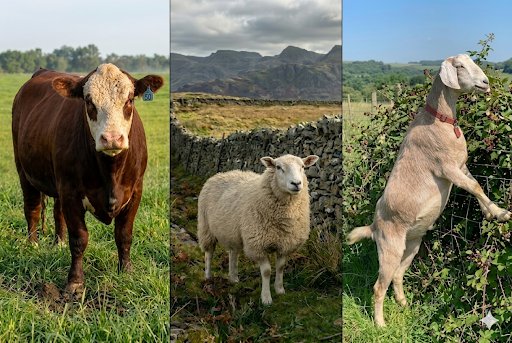
A pasture grazed by cattle alone is a good pasture.
A pasture grazed by cattle and sheep, together, is something else entirely.
The cattle take the long grass, the coarse stems, the rougher patches. The sheep follow behind and clean up what the cattle ignored: the shorter regrowth, the wildflowers, the species the cattle wouldn't touch. The pasture gets grazed at two heights, by two different mouths, on two different patterns. Twice the use. Twice the work. None of the waste.
Add a goat and the bramble line goes. Add a pig on the woodland edge and the parasite cycles break. Add a few geese and the weeds you didn't even know you had quietly disappear.
The result is consistently the highest-biodiversity, highest-productivity, lowest-input agricultural system on earth. Higher protein per acre than arable. More carbon in the soil. More birds. More wildflowers. Less disease. Less input. Each species breaks the parasite cycle of the others. Each one prefers the plants the others avoid. The system tunes itself.
This is not innovative. It is what almost every functional agricultural society on earth has done forever. Roman estates. Medieval manors. Mongolian camps. Welsh hill farms.
The single-species, single-field, single-product model that replaced it is about a hundred years old and is running out of steam on every metric you can measure.
The fix is older than the problem. It is a Welsh farm with cattle on the lower pasture, sheep on the upper, a goat on the bramble line, and a couple of geese in the orchard.
The farmer would explain it in four minutes if you asked.
The policy paper has not asked.
The problem I had for the first 31 years of my life as a protestant was everyone claiming to teach the “clear teaching of the Scriptures” taught vastly different things on every conceivable topic.
The solution I found, very much thanks to the Church Fathers, is that Christians had always believed the Catholic Faith, that it was very much in Scripture, and once I understood it, so many parts of Scripture that had been confusing or elusive for so long suddenly began making sense.
But yes, if you reduce everything to everyone reading the Bible “for themselves” (ironically, something we NEVER see in Scripture), then it is natural to conclude that this intrinsically anti-scriptural, rebellious act (reading the Bible as if Christ never established a teaching office in His Church, first in the Apostles and later in their successors) would naturally lead you away from that Church—particularly if you are encouraged to do so by those who already have.
When simulation becomes the norm, it weakens the human capacity for discernment. As a result, our social bonds close in upon themselves, forming self-referential circuits that no longer expose us to reality. We thus come to live within bubbles, impermeable to one another. Feeling threatened by anyone who is different, we grow unaccustomed to encounter and dialogue. In this way, polarization, conflict, fear and violence spread. What is at stake is not merely the risk of error, but a transformation in our very relationship with truth.
One of my best friends worked at a Trump golf course as a caddy in high school. It was a good job as a high schooler.
I vividly remember him coming home after a shift one day and proudly pulling out a crisp $100 bill: "Trump tipped me this!"
It was a lot different back then.
@Voltropy@jlehman_ I often run volt sessions that grow beyond the 128k context token limit and am unable to compact the session. Besides running compact manually more zealously, is there something that can be done automatically when the threshold is approaching?