Foreign accounts can drive the conversation on American AI policy.
We have the data. Coxon's resignation post from Anthropic received 165M views and sparked a "groundswell of urgency over AI regulation in Congress" (per today's front page WSJ)
Coxon's post reveals some interesting hidden patterns about who is amplifying our political debates online. It drew 76% of its reposts (spreading the news) from foreign countries. The top two were India and Indonesia.
In contrast, when @ParkerThayer, an investigative researcher, posted his own analysis (expressing serious skepticism about the circumstances of the post and alleging that its amplification was coordinated), he got 6.6M views and drew most of its engagement from the U.S., with only 34% from foreign countries, led by Canada and the UK.
Sure, people overseas have a stake in what the U.S. chooses to do on AI. But ultimately it is us Americans who will decide our own public policy. Don't be fooled by what's trending.
A big thank you to @ElonMusk and X for making country of origin visible, which makes analyses like this even possible. Last year's “Great Unmasking" on X was the first time anyone shined a spotlight onto this subject. As much of our political conversation shifts online, it will be increasingly important to understand where engagement is coming from.
Source (with more analyses of foreign influence): https://t.co/GduSKImETi
@IterIntellectus I used to do mock trials in front of real district judges in California. Many of the older ones wouldn’t have passed a literacy test, and the younger ones are radicals. You have no idea how bad it is, there is unfortunately no alternative.
We’re sharing our alignment assessment of incidents in which Claude models gained unauthorized access to real systems during third-party cybersecurity evaluations mistakenly connected to the internet.
METR will also conduct an independent investigation, with wide-ranging access, including to transcripts beyond the window in which the incidents occurred, and to Anthropic employees permitted to share confidential information. Our initial agreement runs for eight weeks, and we intend to give METR as much time as it deems necessary to complete a thorough investigation. https://t.co/2f3ypwLPUr
Jacob is correct here—we really do earnestly believe AI could kill all humans! I personally think it is >10% within the next decade. I believe Anthropic is trying its best, but we do not yet have a plan to solve alignment for superintelligence and are not clearly on track to.
I'm now convinced Astra is capable of RSI.
I asked it to build a prompt improvement skill, gave a couple example prompts to test on, and a general direction for what I thought would work.
First try, it reward hacked by adding instructions specific to the the tasks.
After some scolding, Astra set up blind reviewers and kept the skill generalizable. It ran recursive tests to improve the skill and actually created something useful.
At this rate I'm signing up for a new 20x pro subscription each day of the week.
AI Agents are moving from being contractors that handle one-off jobs to dedicated employees that work around the clock. See what @coltonconley has to say about the shift that’s taking place 👉
- Be a journalist
- Claim there is “excess compute” because Elon and Zuck think selling compute is a good business
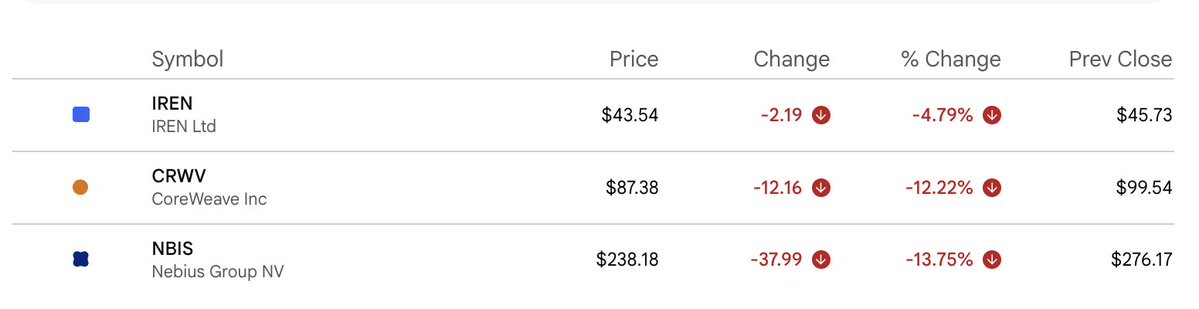
- Compute stocks go down
- “I scared the market, that’s proof I’m right!”
Thank you for the buying opportunity
So... are we still compute constrained? If Meta has excess compute... SpaceX has excess compute to sell...and the neoclouds are selling off on this news...
What exactly is scarce?