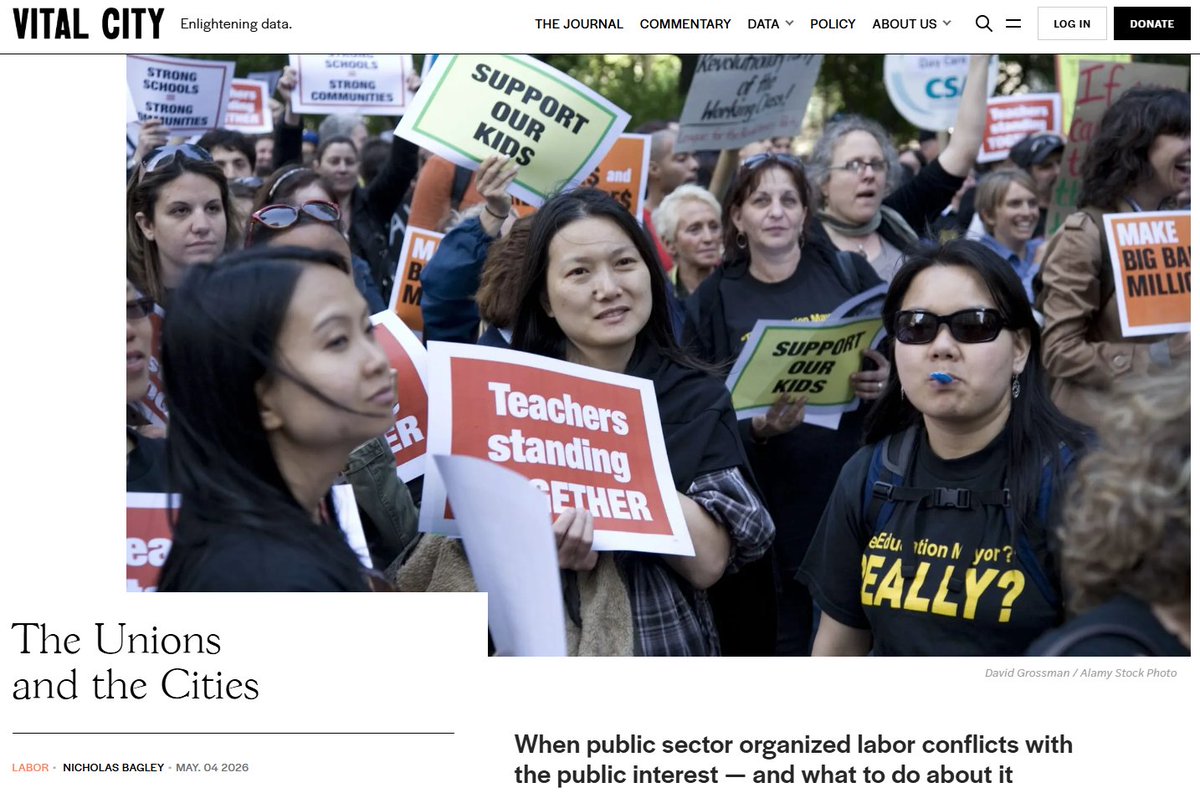
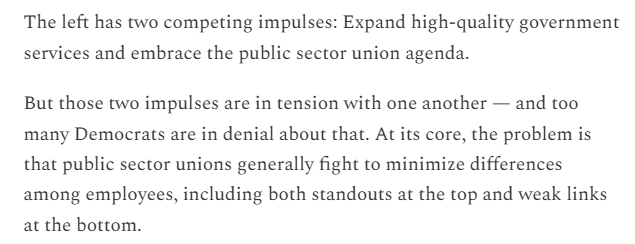
State worker unions threatening lawsuit under California Environmental Quality Act over the governor's return-to-office mandate: “Putting 90,000 people on the road and pumping that much carbon into the air has an environmental impact."
https://t.co/y5m509eVAX
What are public sector unions for, exactly? What problem are they trying to solve? And what does the evidence show about whether they solve it?
I dig into those question in my latest for @TheAtlantic (link below).
Our latest newsletter is a tribute to Nobel laureate and Common Good advisory board member Edmund Phelps, and applies his life's work to America’s current dilemma: https://t.co/s0R9sPJOEU
The LIRR strike -- the ridiculous overtime, the silly work rules, the bloated pensions -- is just business as usual in our biggest cities.
If you want to fix gov't services and restore fiscal sanity to city budgets, you've got to get a handle on public sector unions.
'The law affects the cost of bi-state projects done by the Port Authority, which saw liability claims double on the New York side of the Goethals Bridge project. Those claims were $22 million on the New York side, compared with $10 million on the New Jersey side.' HT @CraigMahoney https://t.co/U0hs3JECoM
FDR, 1937:
All Government employees should realize that the process of collective bargaining, as usually understood, cannot be transplanted into the public service. It has its distinct and insurmountable limitations when applied to public personnel management. The very nature and purposes of Government make it impossible for administrative officials to represent fully or to bind the employer in mutual discussions with Government employee organizations. The employer is the whole people, who speak by means of laws enacted by their representatives in Congress. Accordingly, administrative officials and employees alike are governed and guided, and in many instances restricted, by laws which establish policies, procedures, or rules in personnel matters.
Particularly, I want to emphasize my conviction that militant tactics have no place in the functions of any organization of Government employees. Upon employees in the Federal service rests the obligation to serve the whole people, whose interests and welfare require orderliness and continuity in the conduct of Government activities. This obligation is paramount. Since their own services have to do with the functioning of the Government, a strike of public employees manifests nothing less than an intent on their part to prevent or obstruct the operations of Government until their demands are satisfied. Such action, looking toward the paralysis of Government by those who have sworn to support it, is unthinkable and intolerable. It is, therefore, with a feeling of gratification that I have noted in the constitution of the National Federation of Federal Employees the provision that "under no circumstances shall this Federation engage in or support strikes against the United States Government."
https://t.co/VRQbDfdHue
Supporting great public servants--and removing lousy ones--matters for the quality of our schools, police & roads. In education, it also matters to swing voters, far more than many issues that obsess the commentariat. With @nicholas_bagley in @TheArgumentMag
If you want good schools and high-quality policing, we're going to have to change how we hire, retain, and discipline teachers and cops. Public sector unions aren't gonna like it.
With @robertmgordon at @TheArgumentMag (link below):
With the public sector unions attempting to elect a mayor in DC who will rubber stamp all of their demands, I am very much feeling this piece by @nicholas_bagley (even if I'm not sure I'd go as far as he does with his proposed solution) https://t.co/Ka8ef6zteY
"Why not limit public-sector unions to negotiating over wages?"
It's another installment of my quixotic attempt to confront some of the core core political challenges to the delivery of effective public services.
(links below)
How to spend more than $40,000 per pupil: diagnose 22% of the kids as disabled, get a 9:1 pupil-to-teacher ratio, make it illegal to cut the budget as enrollment swiftly declines, and stop anyone from changing the laws. Then, increase the budget.
https://t.co/0Ud5DmHuAJ
🚨 LIVE: "On The Right Side" Podcast with hosts former Suffolk County Executive @SteveLevyNY with special guest @PhilipKHoward, Executive Director of @CommonGood. Covering today’s key issues from a conservative perspective 🇺🇸https://t.co/EIDPRQLyQ4
It’s insane that it can take longer to permit a transmission project than to build it, not to mention the yearslong connectivity backlog.
Addressing rising energy costs doesn’t just mean more energy projects - we need a grid that can handle the future we’re trying to building.
"If blue state governors and mayors want to get serious about delivering excellent public services... They will have to push back against a core constituency within the Democratic Party that often makes government deliver less and cost more: unions representing teachers, police officers and transit workers.”
That's not an argument you typically hear from left-of-center commentators, even reform-minded, abundance-pilled ones, but that's the provocative argument that @nicholas_bagley and @robertmgordon made in a recent, much discussed NYT op ed titled, "Mamdani Will Need to Change How he Governs."
Both Bagley and Gordon are prominent Dems: Nicholas, now at the Univ of Michigan Law School, recently served as Chief Legal Counsel for Gov Gretchen Whitmer, while Gordon, now a Harvard fellow, served as a Deputy Assistant to the President on Biden's Domestic Policy Council.
So @hyded and I invited them on Blue City Blues (link in next tweet) to dig into why they believe Democratic politicians need to reset their relationship with public sector organized labor if they hope to reverse the loss of public confidence in blue governance that fed into Trump's ascendency.
"If we want blue cities to achieve their promise, and if we want to have a viable and effective alternative to what the Trump administration is giving us, this is a conversation we need to have,” Bagley told us over the course of our conversation about what really is a semi-verboten subject on the left.
This was a great discussion with @robertmgordon and the hosts for Blue City Blues about public sector unions, Democratic politics, and the future of our cities.