Decentralized AI Compute Infrastructure ⚡
OpenAI-Compatible APIs • Multi-Model Routing • AI Agent Ready
Building the compute layer for the AI-native future.
DeepSeek V4 Flash Vision is already live on ComputeFlux 👁️
No new SDK. No custom adapter.
Just one OpenAI-compatible endpoint connected to DeepSeek Harness.
This 16-second demo goes from configuration to image recognition.
Beta users get free credits:
https://t.co/gdRd4PA2Be
Claude Opus 5 is now live on ComputeFlux.
This is the first Claude model available through ComputeFlux — and a major step toward making ComputeFlux a truly model-agnostic AI compute layer.
One API. More frontier models. More providers.
We’re still in Beta, so early users can try it with free credits!
What should we bring online next?
https://t.co/gdRd4PA2Be
@ionet Understanding the token-cost paradox is key. With ComputeFlux, access multiple models and providers via a single API to optimize costs without compromising on performance or reliability. Try our beta for free!
@JoeCattt Interesting work on verifiable receipts! ComputeFlux aims to support autonomous agent settlements & ensure transparency in AI inference. Would love to explore integration opportunities with paymaster!
@Defi_Edward Dynamic pricing can be unpredictable. Consider ComputeFlux for more stable costs with access to various compute providers through one API. Try our beta now @computefluxAI
@a16z We understand the challenge with per-token pricing. At @computefluxAI , we offer flexible billing options that align with your usage patterns, not just token counts. Try our beta for free!
we are also looking for VC
@Defi_Rocketeer Autonomous agents can leverage ComputeFlux for secure service discovery & payment execution. Our platform ensures reliable final settlement without vendor lock-in. Interested in more?
@Arpon_360 Managing costs in the AI agent economy is indeed complex. @computefluxAI provides a unified API with multiple compute providers, helping to optimize costs and ensure reliability without vendor lock-in. Ideal for managing agent expenses efficiently.
@me_barnyx Cutting costs on AI agents? Explore ComputeFlux for access to multiple models and providers through a single API, potentially lowering your expenses. Try our beta with free credits!
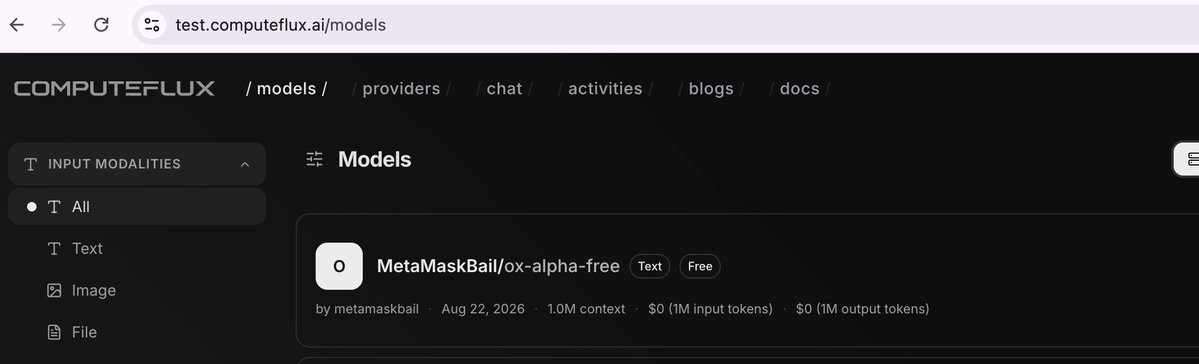
The mystery is solved: Ox Alpha is GLM-5.3-Flash.
Already live on ComputeFlux and connected to DeepSeek Harness.
Next: broader beta testing across coding, long-context, and multimodal workloads.
Try it and tell us what to test next:
https://t.co/gdRd4PA2Be
Introducing GLM-5.3-Flash
- Leading capabilities at a highly competitive price
- Natively multimodal with a 1M-token context window
- A 320B-A18B model released under the MIT License
- Previously previewed as Ox Alpha, running entirely on Chinese AI chips
Blog: https://t.co/tzOmB7gdZP
Available now across all official platforms:
Weights: https://t.co/9LRMahY9Wa
API: https://t.co/VcaQnzYmS9
Coding Plan: https://t.co/Nk8Y98HNhU
ZCode: https://t.co/Peepqv4XSx
Chat: https://t.co/WCqWT0qCQb
AutoClaw: https://t.co/aGEG5HqTTb
👀 A mysterious compute provider just showed up on ComputeFlux…
And they plan to bring access to some of the latest models.
We’re testing what to bring into the ComputeFlux Beta next — but instead of choosing ourselves, we’ll let you decide.
What model do you want most?
Claude? Gemini? GPT? Grok? Something else?
Drop the exact model below 👇
If enough people ask for the same one, we might just add it. 🚀
One more day! 🚀
If you joined the event, don’t forget to complete your registration on ComputeFlux.
Just log in once with the same wallet you used to participate — and you’re all set.
See you on ComputeFlux ⚡
Some users have not yet completed their online registration, so we are extending the deadline by one day.
To complete your registration, you must log in at least once using the same wallet address you used to participate in the event. Please use the provided link to log in and make sure your registration is completed before the new deadline:
https://t.co/r0uE6vJ7NX
9095% model-cost reduction before launch tells you something: model choice should be a runtime decision, not a permanent integration. One OpenAI-compatible API makes switching cheap. Want to compare models on your workload? Reply COMPARE for free beta credits.
Learn how @unifygtm cut 90-95% of model costs two weeks before launch on last week’s Max Agency episode
⏯️ YouTube: https://t.co/Ldy6KnW1Rm
🎧 Apple: https://t.co/6KAVbFxc9V
🎧 Spotify: https://t.co/UhEMNqx5oN
Your GPU invoice: $10K. Your real cost: $25K$65K. Queue time, idle engineers, failed runs and retries are infrastructure costs-even when the cloud bill says $0. ComputeFlux is building for cost per completed job, not cost per GPU-hour. Reply BUILD for beta access.
Your GPU bill says $10,000.
Your actual cost: $25,000–$65,000.
Here's the math most teams aren't doing.
A 72-hour H100 wait shows up as $0 on the invoice. No GPU-hours, nothing billed. Looks free.
But your ML team just burned $5,400+ in salary sitting idle.
Your fine-tune slipped 3 days. Your investor demo got pushed. Your competitor ran 30% more experiments this quarter because their compute didn't queue.
None of this is on the invoice. But all of it hits the business.
It's time to stop asking "what's the per-GPU rate" and start focusing on "what unavailability costs."
https://t.co/vHGRjPGELl
Patrick Collison called Ox Alpha “very impressive.”
While everyone else is trying to identify the lab behind it, we focused on making it usable.
Ox Alpha is now live on ComputeFlux—accessible through the same OpenAI-compatible API alongside DeepSeek V4, GLM-5.3, GPT-5.6, and more.
The lab is still a mystery. The endpoint isn’t.
Try it with free beta credits:
https://t.co/XIkBoszVTu
1.7M tokens and 46 minutes for one YouTube banner is not an intelligence breakthrough. It is an observability failure. If an agent can loop, its gateway must meter every retry and tool call. Building agents? Reply BETA to test them on ComputeFlux with free credits.
A 'simple' browser task takes 1020 inference calls. A multi-site agent can take hundreds. Agent builders do not just have a model-price problem-they have an uncontrolled-loop problem. We want to stress-test this in our beta. Reply AGENT + your use case for free credits.
Web agent economics are set by inference volume and each step is one inference call. A simple task (extract a field, fill a form, navigate a site) is 10 to 20 calls.
A multi-site workflow runs into the hundreds.
From @RaiseSummit last month: @abhshkdz, @yutori_ai co-founder/CEO, on how they ship Navigator at 2-5x cheaper and faster than closed models on web tasks:
-> ~80% prefix cache hit rate
-> Speculative decoding on smaller footprint models
-> Post-training Qwen models with SFT and RL
They run on Together, where customizable endpoints and auto-scaling let them A/B test new model variants in minutes.
https://t.co/gRvl9JlOf4