A well anticipated overview highlighting the first CACHE challenge, which brought together 23 research teams from 10 countries to collectively predict 1,955 compounds targeting LRRK2-a protein linked to #ParkinsonsDisease.
https://t.co/5P4SAMcmOy
Save the date for the second annual Conscience Symposium on Open Drug Discovery! Join us in Montreal on April 7-8, 2025, for two days dedicated to advancing open and AI-driven drug discovery. Learn more: https://t.co/JLBekkFFMG
We're excited see the #NobelPrize in chemistry and physics recognize advances crucial to our mission! These discoveries relied on high-quality, open data & exemplify the importance of quality and openness of data for the future of #AI in #DrugDiscovery https://t.co/XlcpblUX5I
This article features the top-performing Brazilian RFL-BAMBU team in our second CACHE Challenge. The team's outstanding success highlights why we actively encourage participation from teams in the Global South, bringing diverse perspectives and approaches to our Challenges.
How Can AI Help Discover ‘New’ Drugs Against COVID-19 In Brazil?
Brazilian researchers have topped a bioinformatics competition looking to find molecules that could one day function as treatments for Covid-19.
https://t.co/nNi8MqLE1z
📣 Our Developing Medicines through Open Science program is now accepting LOIs. DMOS will support open drug discovery in areas like orphan diseases and antimicrobial resistance. Submit by Sept 27! https://t.co/wBEJV6wN61 #OpenScience#DrugDiscovery
AI was supposed to revolutionize drug discovery—but it hasn’t. Yet. Hype, lack of data, and secrecy have hindered the progress many hoped for. We believe the key to unlocking AI's potential in drug discovery lies in #OpenScience and #RadicalCollaboration https://t.co/7hx3LbtEX3
Devrions-nous nous sacrifier pour une noble cause ? Notre responsable des partenariats, Lauriane, pense que non. Elle est l’invitée du @PapaPhDPodcast et y explique comment elle réconcilie emploi, impact sociétal et bonheur personnel. Bonne écoute ! https://t.co/LSaRk5sayZ
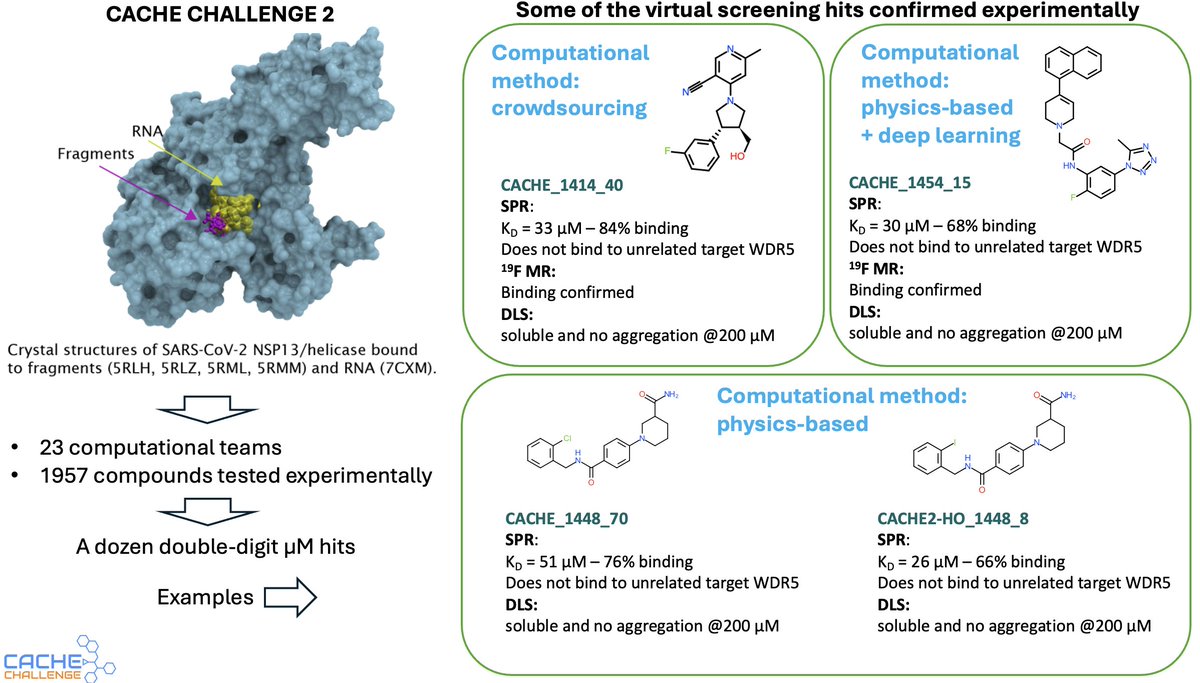
Announcing CACHE2 results! Crowdsourcing and conventional methods did as well as novel ML. Teams started from 4 fragments in the PDB. We tested their predictions and found double-digit µM hits. This is the state-of-the-art. @thesgconline@consciencemeds https://t.co/Fbut1xK0yQ
🎉 Results of CACHE Challenge #2 are out! Five top-scoring teams from around the 🌍 used #AI, #CitizenScience, and #OpenSource tools to identify 7 promising hits that could lead to a pan-coronavirus treatment. Dataset is now publicly available to all! https://t.co/zzOWefL3kg
📣 Our Developing Medicines through Open Science program is now accepting LOIs. DMOS will support open drug discovery in areas like orphan diseases and antimicrobial resistance. Submit by Sept 27! https://t.co/wBEJV6wN61 #OpenScience#DrugDiscovery
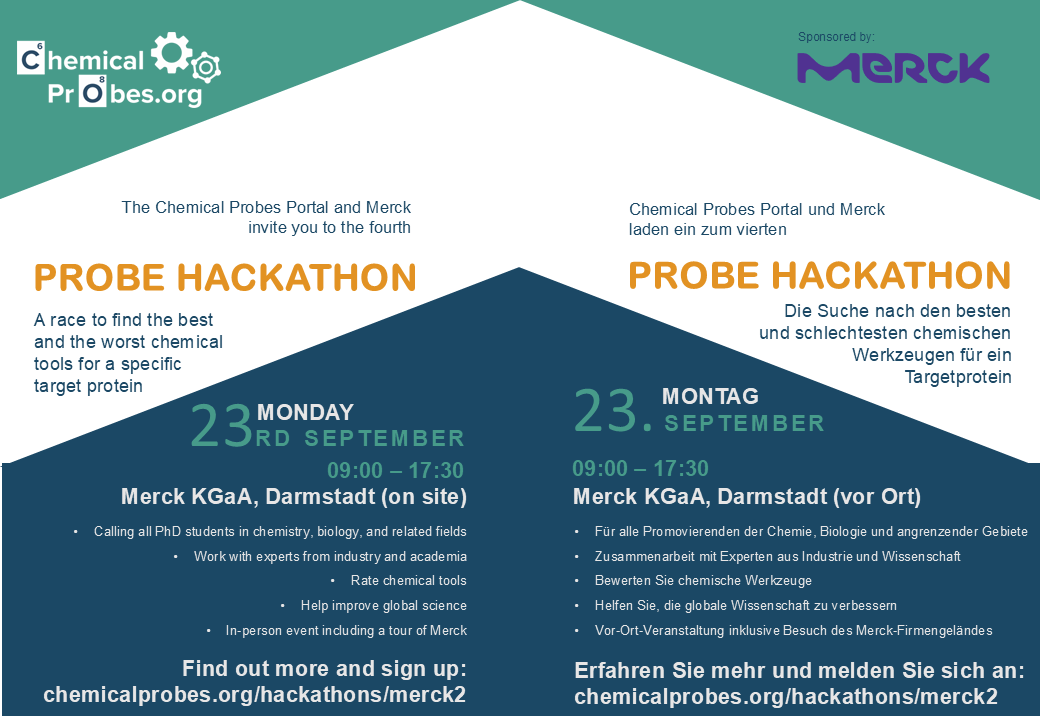
Get ready for the 4th Probe Hackathon! Graduate students will get the chance to collaborate with experts and assess chemical probes to identify the most and least effective compounds for use in biological research.
@Merck@Chemical_probes
https://t.co/4gk8A8x1Vu
📣 New Funding Opportunity! 📣 We’re launching our Developing Medicines through Open Science program, to support open drug discovery in areas of market failure. Visit our website for more info (aussi en français!) & check for more details Aug 15!
https://t.co/wBEJV6wfgt
In collaboration with @Boehringer, we present a comprehensive toolbox to support the generation of small molecule binders and chemical probes for the WWE domain-containing E3 ligases.
https://t.co/0gcwvPBH9M
Check out the preprint @biorxivpreprint detailing #CACHEChallenge 1!
The success of these challenges is powered by the always excellent work of Matthieu & the SGC, as well as invaluable expertise and support of CACHE Members from @Bayer and @Boehringer#CADD#OpenScience
All participants to CACHE #1 who agreed to be de-anonymized were invited to join the overview manuscript. The first of a long series to serve as a resource for future developments in virtual screening workflows. https://t.co/ZArbyTvIgi @thesgconline@consciencemeds#compchem
A report detailing the results of the first CACHE #1 challenge, in which 23 computational teams each selected up to 100 commercially available compounds that they predicted would bind to the WDR domain of the Parkinson’s disease target LRRK2.
https://t.co/4hmw1gRXln
Result of a few brainstorming sessions with data management and data science experts from the industry and academia. It was great to hear from this group as the SGC embarks on a new mission to generate big data for drug discovery @thesgconline
https://t.co/3ZfeP58qnC