Bill Ackman made the perfect bull case for Meta months before even Muse arrived.
At the time, the market looked at Meta’s massive AI spending and assumed Mark Zuckerberg was lighting money on fire.
However, @BillAckman argued that investors were asking the wrong question.
Investors should not focus only on how much Meta was spending but rather on why it was spending.
If Meta had doubled its capital expenditures simply to protect its existing business, then the stock deserved to fall.
But if the company was investing in AI infrastructure that could create new products and generate attractive returns, the spending was growth capex rather than maintenance capex.
But now Muse made that argument much easier to understand.
Meta used its AI infrastructure to launch a personal agent that could send emails, book travel, make purchases, and complete other tasks through its own app or WhatsApp.
Instead of building distribution from scratch, Meta could place Muse directly inside an ecosystem already used by billions of people.
Muse also introduced paid subscription tiers, giving Meta another potential revenue stream beyond advertising.
Muse may only be the beginning because if Meta can keep turning AI infrastructure into new products, that massive capex bill starts looking a lot more like an investment than an expense.
@MilkRoadAI@MelvinInvests@BillAckman Fundamentals of a company will not change materially by a qtr or two. The recent price action is solely driven by speculation.
@MilkRoadAI@MelvinInvests@BillAckman he made a good point of the differences of growth capex and maintenance capex. However, the magnitude of growth capex is whopping. It is too early to call that it will have a decent ROI or ROIC.
@THATSWHATSHESAI@dannyctkemp 😂 in Asian culture, everywhere is crowded. No one cares about personal space. Competition is intense. A person may get nowhere if that person does not push. Unfortunately Everything has two sides.
$AAOI has finished a $500m ATM In April.. $600m ATM in June. Then filed another $600m in August.
It's out of my control if management wants to abuse this trash repeated ATM structure. Instead following $AXTI like LTA prepayments and using that to fund buildout.
Or taking private placements like $NVDA + Nebius for $2B and using that to fund buildout.
Or convertible notes at 40% premiums.
It's really hard for the stock to break out of $100 or $150 or $200 if there's $600M of selling pressure at those levels (and maybe expectations of future ATMs).
I had the same criticism with $IREN with their $6B ATM, which is why it's been rangebound for half a year. And I'll say the same thing with my own thesis names too.
I see $AAOI operationally very bullish for 2027, with $471m/month transceiver revenue. 400k ELSFP units/month entering 2028.
The revenue ramp is absurd and can compress to single digit forward P/E.
But I find it hard to get excited over funding infinite ATMs during the buildout, when you're sacrificing opportunity cost with names currently profitable like $SNDK or Samsung.
I think a lot of retail investors conflate stock performance with how a company is doing operationally.
$AAOI is capitalizing on a bottleneck with high demand visibility, but stock has been going nowhere near-term with repeated ATMs.
I do expect AOI to strongly outperform (especially in 2027) if they stop issuing these stupid ATMs.
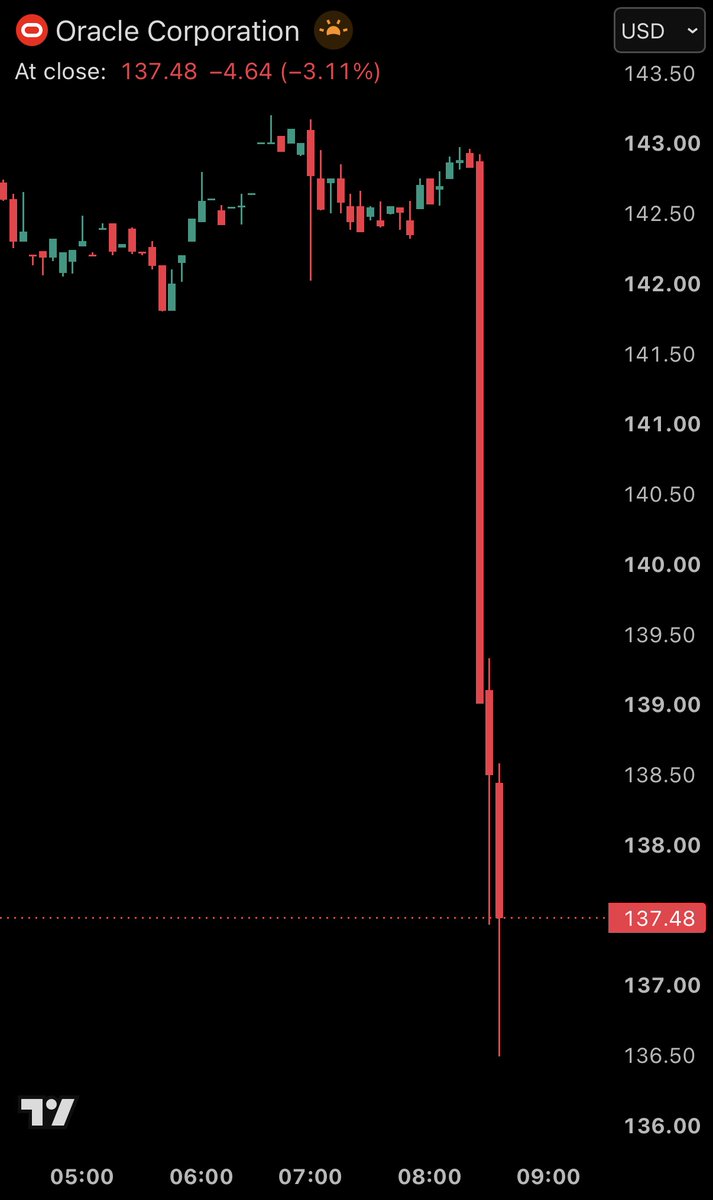
BREAKING: Oracle stock, $ORCL, falls -5% after declaring "force majeure" on a massive data center being built in New Mexico.
Oracle has reportedly made the move in order to shield itself from rapidly rising expenses on the project.
Howard Marks did the math out loud on why the next ten years of your stock returns are already mostly decided. It is not the economy. It is not earnings. It is not the news. It is one number you paid on the day you bought.
He co-founded Oaktree, manages around 190 billion dollars, and called the 2000 tech crash and the 2008 collapse before either one arrived.
His warning has nothing to do with the headlines. It is not about a recession, an election, or a war. It is about the price on the sticker the day you buy in.
Buy the S&P 500 at 23 times earnings, and history gives one answer. Your return over the next ten years lands near zero, somewhere between plus two and minus two percent a year, almost every time it has been this expensive.
Price is not what you get. It is what caps what you can get. A great company bought at a rich price is still a poor investment, because the good news was already paid for.
That is the part nobody wants to hear at the top. The number feels boring while the crowd feels rich. And feeling rich is what makes people pay any price right before the decade of nothing.
Most people do not lose because they picked the wrong stock. They lose because they paid too much for the right one.
The market today sits near 25 times. Marks did not call a crash. He just read the sticker, and the sticker already gave the answer.
The clip is 90 seconds, free, from a man who saw the last two crashes coming. Almost nobody wants to hear it at the top, and fewer still act on it.
U.S. billionaire Bill Ackman helped get a woman fired after she was harassed for wearing a keffiyeh.
Ackman previously pressured universities to crack down on pro-Palestine student activists using similar tactics.