⚠️ PSA: If you are un-aware of the latest supply-chain attacks, or aware but complacent and didn't do anything, especially if you're running Hermes/OpenClaw or manage them for other folks, read this, it'll take 3 minutes i promise.
Supply Chain poisoning attacks are especially vicious, they often compromise a package (javascript packages via NPM, python via PyPI) that is not installed directly, but is a requirement from something else you install.
So if your agent is building software for ya, or is downloading skills, or even is updating itself, your mac can get infected by this rotten supply chain.
These are not viruses, rather, malware worms, and since many are running agents without a sandbox, with code writing and execution permissions and give their agents full credentials to their email, personal life, API keys etc, these attackers harvest every possible personal data under the sun, API keys in .env, browser sessions, crypto keys, you name it.
There are generally 2 ways of "protecting" your agent (and yourself) from something like this.
1) Sandboxed execution - Run your Hermes/OpenClaw on a dedicated sandbox, Docker or otherwise.
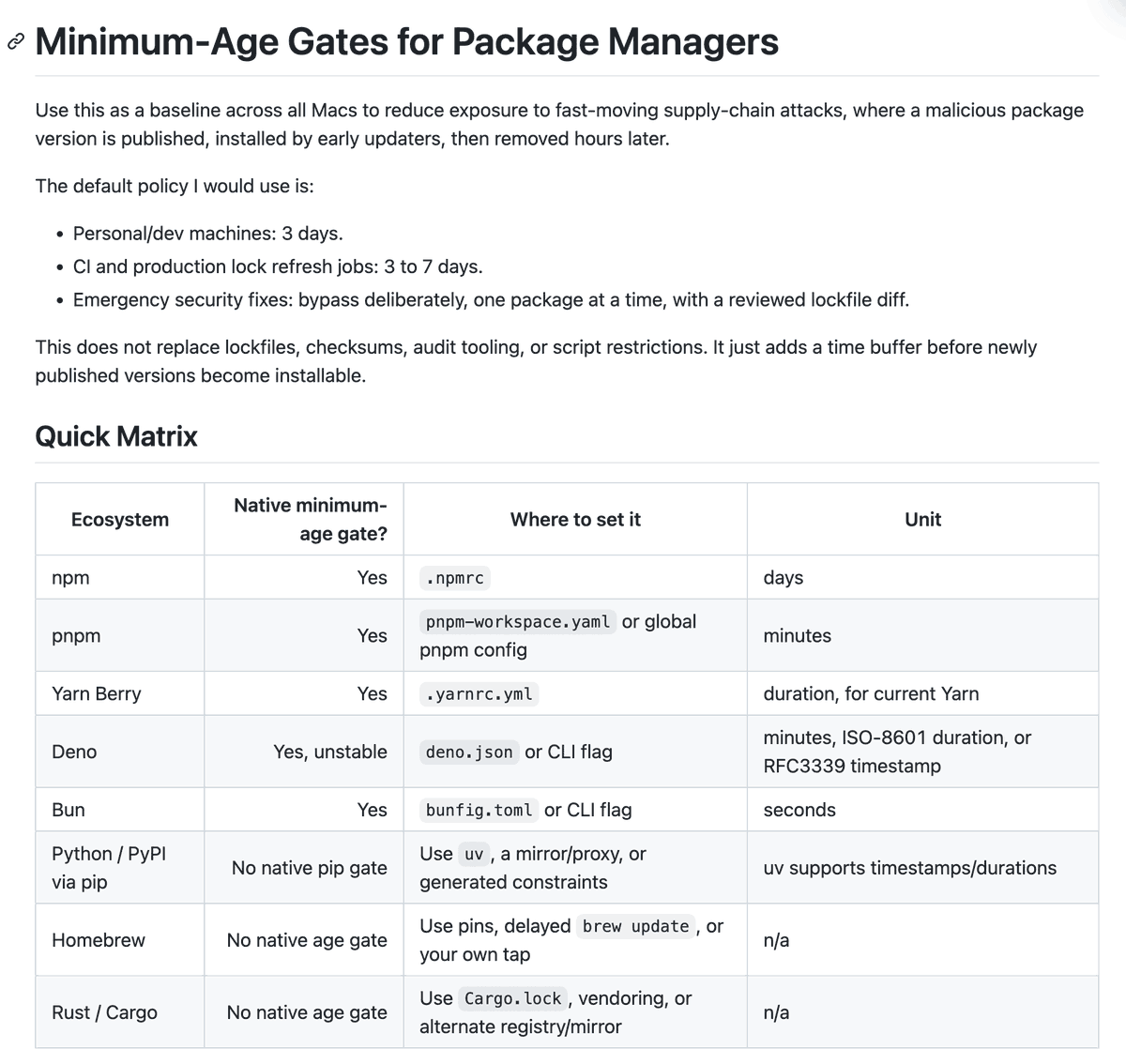
2) Restrict minimum-age of package installation
Number 2 is the most important, it assumes that package managers will detect an attack within 24-ish hours and will take down the infected packages from the registries. So if you want to be security conscious, you need to set global rules for your package managers to never install a new update that's less than 24 hours old.
Here's a guide Codex helped me publish that shows your agent how to set these rules up on your machines:
https://t.co/U0QXr7X5fU
For this latest Mini-Shai Hulud worm, it's vicious specifically because it self replicates, and removing the packages doesn't remove the worm.
@nisten has written a scanner that you can ask your agent to run to see if you were compromised.
https://t.co/nxxPwMhiQG
Additionally, we covered this on @thursdai_pod - it's good practice to always create dedicated API keys for each specific agent/machine and clearly designate them. Storing them in a password manager like @1Password and @Bitwarden helps with tracking and rolling if you were exposed.
Don't be complacent, this new wave of supply chain attacks seems to be fueled by more powerful AI coding agents, and it'll take time to stabilize, in the meanwhile, stay protected.
Fish oil capsules are the most aggressively oxidised industrial fat ever sold to a human being as a health supplement, and we have somehow agreed, as a culture, to pretend this is fine.
The omega-3 fats in fish oil are the most chemically unstable fats in nature. Light, heat, oxygen. Any of the three starts the reaction. The fish keeps those fats sealed inside cell membranes, shielded by its own antioxidant system, kept cold and dark by living tissue doing its job.
The supermarket capsule offers none of that.
By the time you crack one open, the contents have travelled through a Peruvian processing plant, a shipping container, a warehouse, a supermarket shelf, and your kitchen cupboard. Every step of the journey is the precise set of conditions the fish spent its entire life protecting those fats from.
What comes out the other end is a slurry of oxidation byproducts. Lipid peroxides. Malondialdehyde. 4-hydroxynonenal. Compounds that damage DNA, drive inflammation, and have been linked in the literature to atherosclerosis, neurodegeneration, and the very cardiovascular outcomes the capsule was sold to prevent.
Independent labs have repeatedly tested supermarket fish oil and found peroxide values that would not legally pass for human consumption in any other category of food.
You are paying a premium for a Petri dish.
Eat the fish.
Harvard researcher Professor David Sinclair and the biotechnology company Life Biosciences have reached a major milestone in longevity science. The U.S. Food and Drug Administration (FDA) has cleared their Investigational New Drug (IND) application for ER-100, marking the first human clinical trial of partial epigenetic reprogramming aimed at reversing cellular aging.
The Phase 1 trial, scheduled to begin in 2026, will test the safety and tolerability of a one-time intravitreal injection (into the eye) that delivers three Yamanaka factors — OCT4, SOX2, and KLF4 (collectively known as OSK). These molecular switches are designed to reset the epigenetic state of aged or damaged cells, restoring youthful gene expression patterns without altering the cell’s identity or causing full de-differentiation.
By temporarily activating these factors with a short course of doxycycline, researchers hope to rejuvenate retinal cells and potentially treat age-related optic neuropathies such as glaucoma and non-arteritic anterior ischemic optic neuropathy (NAION). This approach is grounded in the idea that aging is not an irreversible process but a modifiable epigenetic state.
If successful, the therapy could open the door to broader applications in treating multiple age-related diseases and achieving systemic rejuvenation. This trial represents a pivotal shift from treating symptoms of aging to addressing its root causes at the cellular level.
[Life Biosciences. Life Biosciences Announces FDA Clearance of IND Application for ER-100 in Optic Neuropathies. January 28, 2026]
BREAKING:
The new Fed Chair just signaled a major shift.
Kevin Warsh says QE is fueling inflation.
The Fed's massive balance sheet is part of the problem.
"The Fed should exit markets outside of crises."
This is not Powell talking.
This is a completely different philosophy.
Powell printed. Warsh wants to stop.
Powell expanded the balance sheet. Warsh wants to shrink it. $6,700,000,000,000 in Fed assets.
Warsh just told you that number needs to come down.
- Less liquidity.
- Higher rates for longer.
- Risk assets reprice.
The market has been betting on easy money.
The new Fed Chair just bet against it.
Everything changes on today.
This is WILD!
MIT just solved one of the hardest unsolved problems in robotics (Save this).
For decades, the fundamental problem with soft robots and wearable exoskeletons has not been compute or AI, it has been actuation.
The moment you try to give a soft robot meaningful strength, you run into the same wall every engineer has hit since the field began, fluid-driven systems require external pumps, hydraulic reservoirs, and heavy infrastructure that makes the entire thing impractical to wear or embed into fabric.
MIT's new Electrofluidic Fiber Muscles solve that problem by eliminating external infrastructure entirely.
The key insight is electrohydrodynamic pumping using electric fields to generate pressure directly from electricity, with no moving parts, no motors, and no external fluid reservoir.
The fibers are less than 2 millimeters thick, can be woven into fabric like ordinary textile, and operate in complete silence because nothing physically moves inside them, it is just ions propelling fluid through a closed circuit.
The performance numbers published in Science Robotics are not conceptual, they are empirical results from actual hardware.
These fibers achieve a power density of 50 watts per kilogram, matching skeletal muscle, with a contraction strain of 20% and a response time of 0.3 seconds.
A single bundled configuration lifted 4 kilograms, 200 times its own weight while a separate configuration drove a robotic arm through a 40-degree bend compliant enough to safely complete a human handshake.
Another configuration launched objects in under 100 milliseconds, which is faster than a human flinch reflex.
The design mirrors biological muscle architecture in a way that prior artificial muscle approaches never achieved.
The fibers are organized into antagonistic pairs, one contracts while the other extends, exactly like biceps and triceps and because the system runs in a closed loop, the relaxing fiber serves as the fluid reservoir for the contracting one, which is what allows the whole system to operate untethered with no external tank.
The applications are not hypothetical but rather are the exact use cases the industry has been waiting years for the hardware to catch up to.
Exoskeletons for physical labor, prosthetic limbs that move with the natural compliance of biological tissue, assistive garments for patients with motor disorders, and soft robots capable of safe physical contact with humans are all immediately unlocked by a muscle technology that is silent, lightweight, and weavable into clothing.
The deeper significance is what this technology does when it meets the AI robotics wave that is already underway.
Every major humanoid robot program, Figure, 1X, Boston Dynamics, Tesla Optimus is currently bottlenecked by the same hardware limitations these fibers address, actuators that are too rigid, too loud, too heavy, or too dependent on infrastructure to operate naturally alongside humans.
Electrofluidic fiber muscles do not just solve a materials science problem but rather they remove one of the last physical barriers between robots that live in labs and robots that live in the world.
Case in point. I'm short gold today and have been since early March.
Yes, I'm a gold perma bull. Right now I'm short — exactly like Billy Ray would be — because Turkey is showing you what's already happening.
The Turkish central bank has sold roughly 120 tonnes of gold to defend the Lira and fund energy imports. Bernard Dahdah was explicit in April: central banks are now selling gold "to defend their currency and/or to fund energy purchases."
https://t.co/AwL6JikDAf
When the marginal central bank flips from structural buyer to forced seller to pay for energy, gold's biggest bid disappears. Once central banks turn dovish after the energy crisis hits growth, the trade resets and I'm back long.
Even gold bulls have to read the tape. Gold 4,000 then 10,000.
9/10
claude mythos just broke Apple's $2 billion defense system. it did so by discovering a completely different attack vector to break in
only took it 5 days costing ~$35K of mythos api time (the same exploit class costs $5-10M on grey market)
the researchers that commandeered the exploit produced a 55-page report that was delivered to Apple HQ in-person (hoping they release it after patching).
most shocking part for me is apple's MIE worked as intended. mythos just discovered a new way to side-step it entirely by poisoning the data the M5 chip ingested.
at this point i think we have to accept that mythos walks the walk.
As the anthropic red-team explicitly confirmed this week - this is NOT a compute resource issue. its national defense.
🚨 BREAKING: Two researchers just dropped a paper that should terrify every CEO aggressively replacing creative & knowledge workers with generative AI.
The core argument is brutal but undeniable:
Generative AI only improves with massive amounts of fresh, diverse, high-quality human creativity — new ideas, art, code, research, designs. Yet every company racing to automate these tasks is depleting the shared “innovation commons” — the exact pool of novel human data that future models need to keep advancing.
Short-term: individual firms win with huge cost cuts and productivity spikes.
Long-term: everyone loses as the well runs dry — slower model progress, fewer breakthroughs, and collapsing returns on AI investment.
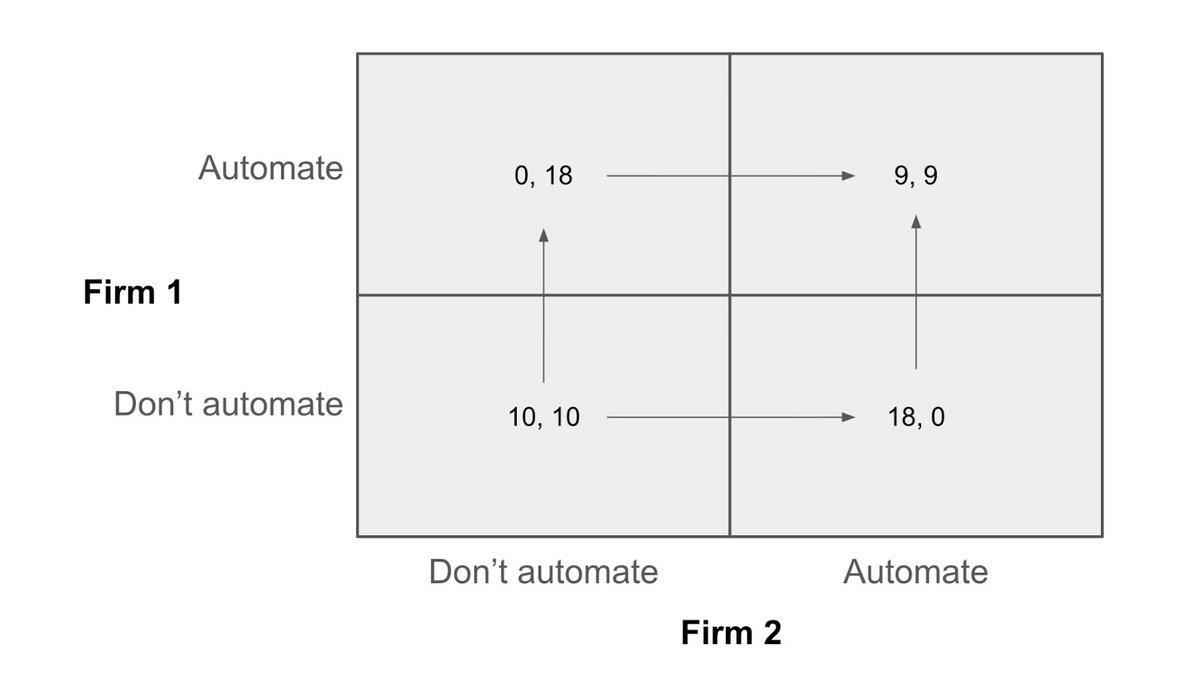
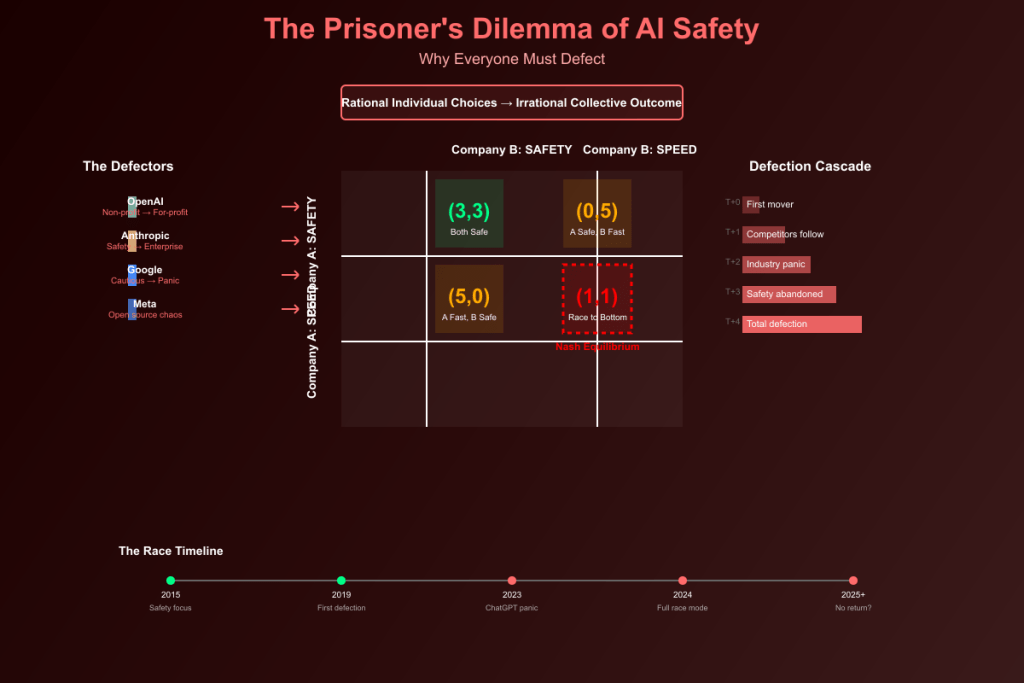
They model this as a classic Prisoner’s Dilemma in real time:
- If you hold back and keep investing in human creatives while your competitor automates fully, you lose market share and die.
- So rational players all defect, knowing the collective outcome is suicidal.
Signs are already visible: synthetic data flooding training, early model collapse warnings, and plateauing novelty in patents & papers.
Standard fixes fail:
- UBI doesn’t fix per-task incentives.
- Retraining and IP changes fall short.
- Even faster AI makes it worse via a Red Queen effect — accelerating the depletion.
The only thing that works in their simulations: a Pigouvian data-quality levy — a fee scaled to how much human originality each deployment displaces. Revenue funds human creativity subsidies, open data commons, and mandatory human-AI symbiosis rules.
Without intervention, their models predict measurable drops in breakthrough innovation rates by 2030.
This isn’t anti-AI. It’s recognizing AI is a symbiotic technology. Kill the human engine completely, and the whole system stalls.
This is the AI Creativity Trap.
Prevention matters more than clean out.
- Stop heating food in plastic.
- Stop processed packaged foods
- Filtered water, ideally reverse osmosis with remineralisation.
- Store/heat food in glass, cast iron w no treatment or stainless steel.
- Stop synthetic fibres
The uncomfortable truth:
We know microplastics can get into the brain.
We do not yet know how long the brain takes to clean them out.
That matters.
Your blood can clear some plastic-related chemicals quickly. Phthalates and BPA can drop within hours to days because the body can process and excrete them through urine, bile, stool and possibly sweat. (PMC)
But actual plastic particles are different.
They are not just “toxins” to be metabolised.
They are physical fragments.
Some may be cleared by immune cells.
Some may move through lymphatic drainage.
Some may leave through bile/stool.
But some may lodge inside tissue — and the brain is not an easy place to clean.
That is why the new brain data is so concerning.
Human brain samples showed much higher microplastic/nanoplastic levels than liver and kidney, and levels rose significantly from 2016 to 2024. The main polymer found was polyethylene — the stuff used heavily in packaging. (Nature)
Animal studies show tiny particles can cross into the brain quickly. In one mouse study, nanoplastics reached the brain within 2 hours after oral exposure, while larger particles did not. (PMC)
So the scary bit is this:
The body may clear the chemicals fast…
but the particles may be a much slower clean-up job.
Think of it like smoke smell vs ash.
The smell clears quickly.
The ash has to be physically removed.
That means the best “detox” strategy is probably not some miracle cleanse.
It is reducing the daily input so your body is not constantly trying to bail water out of a leaking boat.
Practical cleanup logic:
Stop heating food in plastic.
Reduce ultra-processed packaged foods.
Use filtered water, ideally reverse osmosis with remineralisation.
Store food in glass or stainless steel.
Reduce household dust — synthetic fibres and degraded plastics collect there.
Sweat, exercise, sleep and fibre may support normal elimination pathways, but they are not proven to “clear brain plastic”.
The honest answer is:
Blood plastic may improve in weeks or months if exposure drops.
Plastic-related chemicals may fall in days.
But brain microplastics?
Nobody can currently give a proven human clearance timeline.
And that uncertainty is exactly why prevention matters more than cleanup.
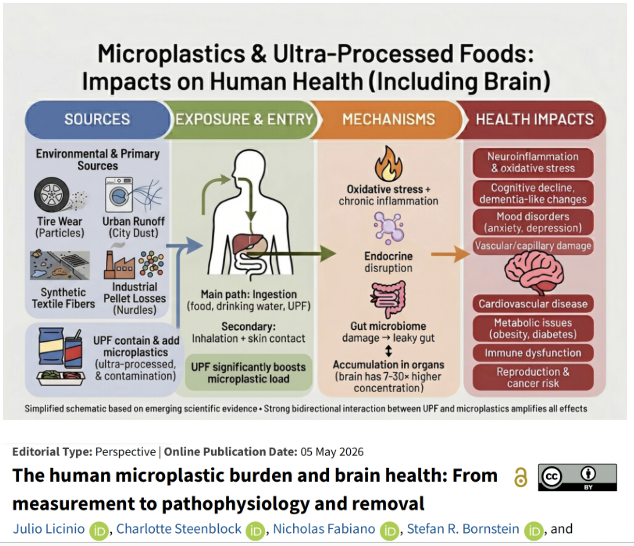
This new perspective study reports that our brains are carrying 3,000x more microplastic than our blood.
Microplastic burden of the human brain rose ~50% between 2016 and 2024.
The average brain now carries roughly:
> 11x the load of the liver
> 11x the kidney, and on a per-mass basis around
> 3,000x the concentration found in circulating blood (on a per-mass basis)
This study argues that eliminating ultra-processed foods (i.e. chicken mcnuggets, breaded shrimp) carries an additional benefit: reducing brain microplastic accumulation.
This is based on an inferred chain of mechanisms rather than proven causality in humans, yet the convergence is striking.
The paper outlines four pathways through which microplastics plausibly damage the brain:
> oxidative stress and chronic inflammation
> endocrine disruption
> gut-microbiome injury
> and vascular damage.
These map onto various brain and mental diseases including: depression, anxiety, cognitive decline, stroke, dementia.
The same conditions are independently linked to ultra-processed food consumption in large prospective cohorts
Each 10% increase in ultra processed food intake
> 25% higher dementia risk
> 16% higher cognitive impairment risk
> 8% higher stroke risk
High versus low ultra processed food consumption tracks with 44% higher odds of depression and 48% higher odds of anxiety.
While we do not yet have a human study showing UPF intake directly raises brain microplastic burden. Here is what we do have:
A study found that the more processed forms of protein foods carry significantly more microplastic particles.
> Chicken nuggets contained 31x more microplastics per gram than raw chicken breast (least processed item in the study)
> Breaded shrimp, the most processed item in the study, carried ~130x the level in raw chicken breast (caveat: shrimp also carries higher baseline contamination from ocean and water pollution)
> A 1,031-woman pregnancy cohort showed each 10% higher UPF intake tracked with 13.1% higher urinary phthalates, the plasticizers that leach from food packaging
Microplastics cross from the blood to the brain.
Animal research shows mechanistically how microplastic particles do cross the blood-brain barrier.
In mice, polystyrene nanoparticles at 293 nm reached the brain within 2 hours of oral exposure. Particles at 1.14 μm and 9.55 μm did not cross at all.
While most microscopy-based microplastic tests have a detection floor around 1 μm.
The fraction that actually crosses into the brain sits below that threshold. If a test picks up larger particles in your blood, the smaller, BBB-crossing fraction is almost certainly there too, just below the detection window.
The big ones are a proxy for the dangerous small ones.
Cut all microplastic input where you can and avoid ultra processed foods, this another important one.
In addition: use a water filtration system for your drinking water, reverse osmosis with remineralization is the gold standard.
I recently reported complete elimination of microplastics from my semen (first in human demonstration) and a 87% reduction in my blood.
Google is making $62 billion a quarter destroying the websites it NEEDS to survive.
This is literally a death spiral that ends with Google killing itself.
Let me explain what's going on...
Google added AI summaries to the top of every search result in 2024.
When you Google something now, the answer sits right there on Google's page. You never have to click anywhere. Google took the information from someone else's website, summarized it, and kept you inside Google's ecosystem.
The result: 60% of all Google searches now end without a single click to any website.
Small publishers lost 60% of their traffic in one year. Medium publishers lost 47%.
Even the biggest names in media, the New York Times, the Washington Post, Business Insider, all saw traffic fall between 22% and 55%.
The Axios CEO called it "a referral extinction event for the ad-supported web."
Google's response to all of this was to tell publishers they can "opt out" of having their content summarized. But opting out also REMOVES your description from normal search results.
So the choice Google gives you is let us steal your content for free, or become invisible on the internet.
That's extortion.
The Washington Post laid off another round of journalists this year because of it. Stereogum, one of the most respected music publications on the internet, had to BEG readers for donations.
Business Insider cut 21% of its staff. Dozens of smaller publishers have shut down entirely.
The people who actually CREATE the information Google summarizes are going bankrupt while Google posts record revenue.
But here's where this gets interesting and where everyone stops thinking:
Google's AI summaries are only as good as the content they summarize. If the publishers who write the original articles, run the original investigations, and create the original data go out of business, there is nothing left for Google to summarize.
The AI starts recycling old information, the answers get stale, the quality drops, and users start noticing that Google's summaries are increasingly wrong, outdated, or useless.
Google is essentially strip-mining the internet for short-term revenue. They are extracting all the value from content creators without paying for it, driving those creators out of business, and then wondering why the quality of their own product is declining.
This is exactly what Napster did to the music industry in the early 2000s:
Made content free, creators went broke, and quality collapsed. It took a decade to rebuild.
Google is doing the same thing to the entire internet at 100x the scale.
Rolling Stone, Variety, Deadline, The Hollywood Reporter, and Billboard are now suing Google for antitrust violations. Chegg, the education platform, lost 49% of its traffic and is suing too.
The UK's competition authority just ordered Google to let publishers opt out without being punished. The DOJ already ruled Google is an illegal monopoly.
And Google's defense in court is genuinely unbelievable.
They argue that publishers CHOOSE to let Google index their content and can leave anytime they want. That's like saying you choose to pay protection money to the mob because technically you could close your business and move to another city.
Google controls 90% of search. Leaving Google means leaving the internet.
Meanwhile Google is investing billions in custom AI chips to make these summaries cheaper at scale. Every quarter the problem gets worse.
The internet as we've known it for 25 years ran on a simple deal:
Publishers make content.
Google sends traffic.
Advertisers pay for the traffic. Everyone wins.
But Google just BROKE that deal and kept all the money.
We share your concerns. Despite AI progress a strategic and deep architectural Mean-Time Between Failure (MTBF) focus is essential if you have a holistic system wide view based on all stakeholders experiences.
I strongly believe there are entire companies right now under heavy AI psychosis and its impossible to have rational conversations about it with them. I can't name any specific people because they include personal friends I deeply respect, but I worry about how this plays out.
I lived through the great MTBF vs MTTR (mean-time-between-failure vs. mean-time-to-recovery) reckoning of infrastructure during the transition to cloud and cloud automation. All those arguments are rearing their ugly heads again but now its... the whole software development industry (maybe the whole world, really).
It's frightening, because the psychosis folks operate under an almost absolute "MTTR is all you need" mentality: "its fine to ship bugs because the agents will fix them so quickly and at a scale humans can't do!" We learned in infrastructure that MTTR is great but you can't yeet resilient systems entirely.
The main issue is I don't even know how to bring this up to people I know personally, because bringing this topic up leads to immediately dismissals like "no no, it has full test coverage" or "bug reports are going down" or something, which just don't paint the whole picture.
We already learned this lesson once in infrastructure: you can automate yourself into a very resilient catastrophe machine. Systems can appear healthy by local metrics while globally becoming incomprehensible. Bug reports can go down while latent risk explodes. Test coverage can rise while semantic understanding falls. Changes happens so fast that nobody notices the underlying architecture decaying.
I worry.
When I was a child our teacher taught us about risk, money and economics in the most interesting way possible: She made us run a pretend farm, as a competition.
It was genius, because I still remember it three decades later, which I wouldn't have otherwise. It went like this:
Every student had a ‘farm’ on a little piece of paper, with four fields. Every year you had to decide what crops to plant in what fields, and buy them with any available money. Some crops were like wheat; cheap, boring and low-yielding, but dependable. Others were like peas; expensive, super high-yielding if things went right, but unreliable. Get the wrong mix of sunshine and moisture for peas and you'd make a huge loss instead of making bank.
We all competed for the most money over a series of ‘years’ and on each year the teacher would roll dice to determine if the weather was hot or cold, rainy or sunny. There were four combinations of weather for your four fields and up to four crops. There was all to play for, and you'd be built-up or broken by the roll of the dice.
Some kids played it safe with lots of wheat and no risk. Others bet the farm on peas, peas, peas! Others hedged between sunny crops and rainy crops. With each round, a few of us exited the game and went bankrupt. The eventual winner had taken a lot of risk, but had hedged just a little bit and rode out the bad years. He got lucky, but that's what the game was all about.
The teacher could have taught us by lecturing us. She could have gassed on about risk management and economics and market economics and blah, blah, blah… and been ignored by a bunch of teenagers. Instead she made it fun, she made it a competition!
And after that short period, a classroom of kids walked out with heads full of strategy, debating how they'd run the farm, who got the most money and how they'd play differently if they did it again.
In a little classroom in a Northern English secondary school, a bunch of adolescents had been introduced to capitalism and loved every minute of it!
I forgot almost everything else from those years, but that lesson sticks with me. Good teachers really matter.
And a little competition goes a long way.
The world is losing oil, fertilizer, and sulfuric acid simultaneously. The market priced only the oil.
Per The Wall Street Journal, citing Argus pricing data and the US Geological Survey, sulfuric acid prices in China rose roughly 1,150% in May compared with two years earlier. Middle Eastern sulfur prices surged 750%. Chile, the world’s largest sulfuric acid importer, saw prices jump 230%.
Sulfuric acid converts phosphate rock into fertilizer. It processes copper. It manufactures batteries. It fabricates semiconductors. The Persian Gulf supplies roughly half of global sulfur exports. The chemical that touches food, electric vehicles, and chip fabs is breaking simultaneously.
Saudi Aramco CEO Amin Nasser told investors Monday this is “the largest energy supply shock the world has ever experienced.” Per CNBC, the world has lost one billion barrels of oil supply, net 880 million after east-west pipeline reroutes and strategic reserve releases. Two to five ships now pass Hormuz daily, down from seventy before the war. Around 240 ships are waiting outside. The market loses 100 million barrels per week the Strait stays closed. If disruption persists past mid-June, normalization runs “into 2027.”
The Wall Street Journal reports US crude inventories including the Strategic Petroleum Reserve have fallen for four consecutive weeks and risk reaching their lowest level since 1982. Per Bloomberg, the IEA coordinated the release of 400 million barrels of emergency reserves. The United States has released only 79.7 million of the 172 million it pledged.
JPMorgan head of global commodities Natasha Kaneva warned OECD oil inventories could reach “operational stress levels” by June and “fall to minimum operating thresholds by September.”
This is the energy story.
Per the United Nations Food and Agriculture Organization, roughly one-third of global fertilizer trade transits the Strait of Hormuz. Qatar Fertiliser Company, which supplies 14% of global urea single-handedly, has declared force majeure. Major fertilizer plants across the Gulf have reduced or suspended production. Three to four million tonnes per month of fertilizer is stalled.
Per CNBC, urea FOB Egypt has risen from $400 pre-war to $700 per tonne. Per Reuters, Brazil’s urea imports have fallen 33% year over year. Bangladesh has shut four of five fertilizer factories. India has cut output at three urea plants. The United States is running 25% short of fertilizer supply for spring planting.
The World Food Programme projects 45 million people could enter acute hunger within months. The 2022 Ukraine crisis pushed 70 million into hunger over 18 months. This onset is faster.
This is the food story.
Aluminum, helium, and sulfur markets are all in supply shock. Helium is essential to semiconductor manufacturing. Indonesia sulfur prices are up over 80%, prompting nickel producers to cut output for EV batteries.
This is the industrial story.
President Trump rejected Iran’s response Monday as “totally unacceptable” and “a piece of garbage.” He said the ceasefire is “on massive life support.” A US Navy Ohio-class nuclear-armed submarine arrived in Gibraltar Sunday.
Trump arrives in Beijing on May 14 and 15.
A 1,150% sulfuric acid move in China. A 45-million-person acute hunger projection. A US strategic reserve approaching 1982 lows. An OECD inventory cliff in June. A fertilizer famine in three months. A market at all-time high.
The market priced one shock. There are three.
The summit two days away decides which of them gets resolved first.
https://t.co/xmK0gJ0TfI
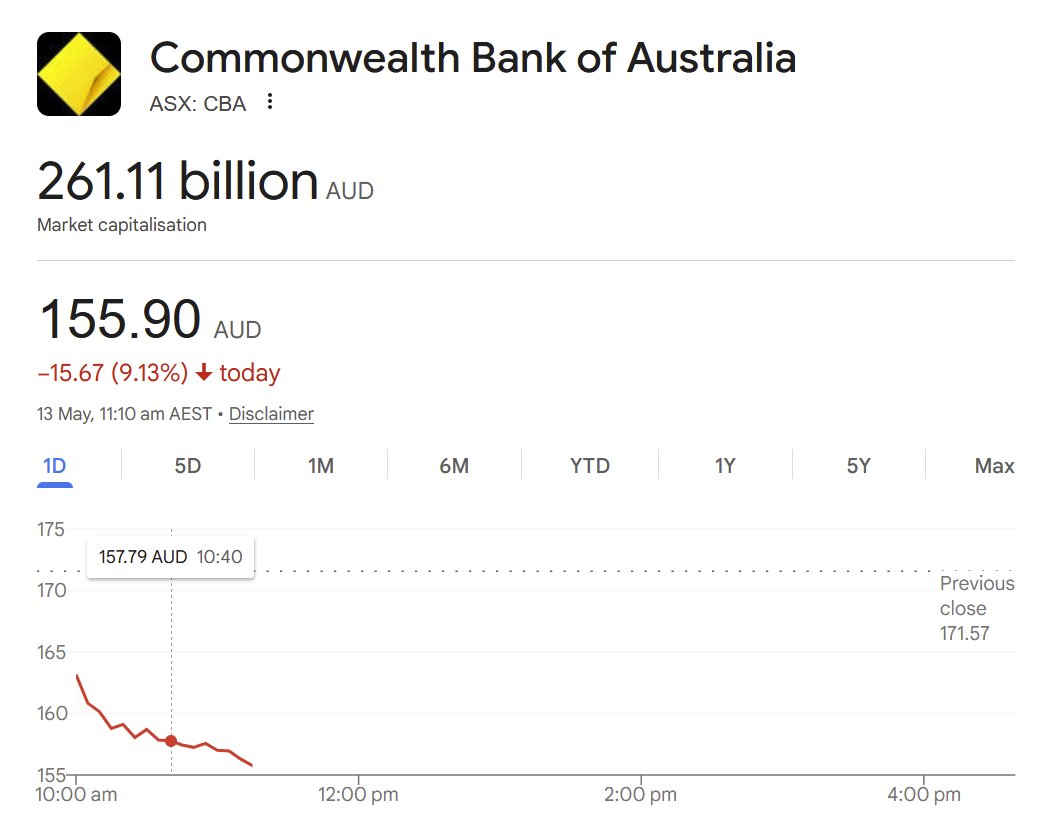
CBA market cap down more in 1 day than the entirely this government reckons they'll claw back from the CGT, trust and negative gearing changes in a year
economically ruinous budget
do they not realise the CGT tax revenue is proportional to actual gains
"I see so many ghosts. They're already dead. They don't even know it."
A 45-year Wall Street veteran just said that about the current generation of finance professionals to me.
George Robertson started at Salomon Brothers in 1981 when bond yields were 14%. He's survived every blow-up from Long-Term Capital to 2008 to COVID.
And he's convinced a massive reset is coming that will produce RUIN for people who don't see it.
I just interviewed him, and let me walk you through the one thing most people in this space fail to understand:
The stock market has effectively become a single instrument.
Every major quant fund is staffed by the same MIT graduates running the same models through the same filters arriving at the same conclusions. There are maybe 4 or 5 ideas being expressed across the entire systematic trading universe at any given time. The diversity that makes markets function as a price discovery mechanism is GONE.
Jane Street just reported $16.1 billion in trading revenue in a SINGLE QUARTER. One firm. 3,500 employees. More trading revenue than JPMorgan or Goldman Sachs. Full year 2025 was $39.6 billion.
Lever that capital 10 to 1 across all the major quant players and you're looking at trillions in gross exposure approaching the monthly GDP of the United States. Until something overwhelms that kind of firepower, these firms effectively dictate market behavior.
The rest of us are passengers.
And that's why markets look so deceptively calm right now. Tight ranges, suppressed volatility, weeks and months where nothing seems to move.
But the calm IS the danger.
All the mispricing that should be correcting incrementally through normal price discovery is instead building up like pressure in a sealed system. And when it finally releases, it won't be a normal correction where you have weeks to adjust your positioning...
It will be years of stored mispricing detonating in DAYS.
We've seen the same thing before:
In the 1990s, Long-Term Capital Management was so dominant in fixed income that it killed price discovery across the entire asset class. Danish mortgages, basis trades, risk arbitrage, nothing functioned properly while LTCM existed. Normal pricing only returned after they literally collapsed.
Now apply that dynamic to the ENTIRE equity market.
And the agencies that were supposed to protect investors from exactly this kind of concentration have been gutted. Sherman Act enforcement is effectively dead. The AI industry operates as an informal trust, 3 or 4 companies integrated vertically and horizontally in ways we haven't seen since Carnegie and Rockefeller.
Trevor Milton rolled a truck down a hill, called it technology, and got pardoned. Crime pays. So who stops the next guy?
Meanwhile capital markets have grown to roughly 4x GDP. When I started in this business they were roughly the SAME size. So when the repricing comes, the damage to the real economy will be multiples of anything we've experienced.
Nobody has a clean answer for what to do about this. Not me. Not Robertson. Not anyone being honest with you.
But after 45 years doing this myself I know this much:
The correction WILL come.
Price discovery WILL return.
The only question is whether you survive it or whether you're one of the ghosts who never saw it coming.
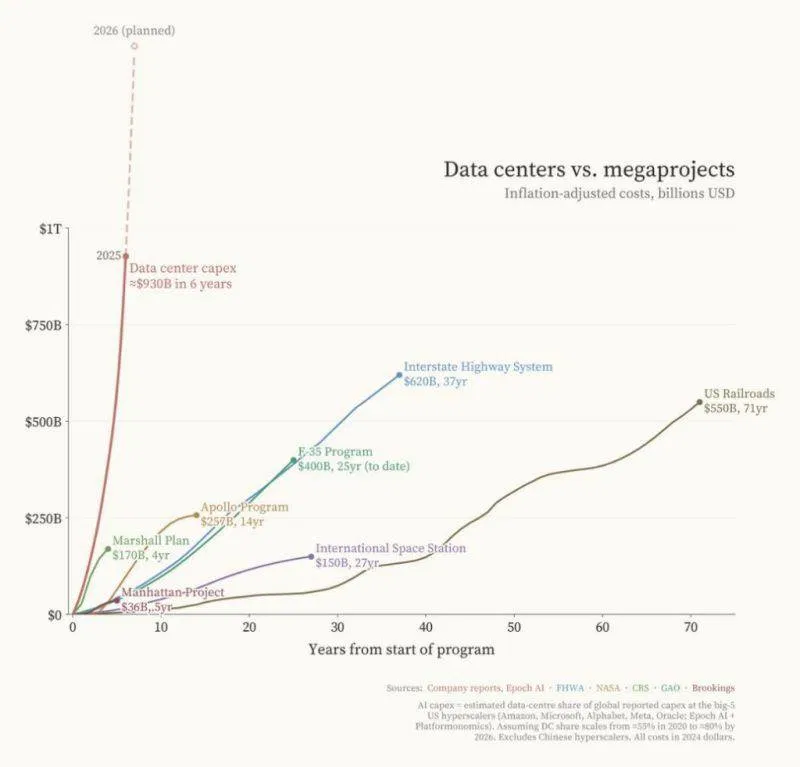
The US is pouring more capital into AI data centers in 6 years (~$930B) than the inflation-adjusted cost of the Marshall Plan, Apollo, Manhattan Project, and the Interstate Highway System — combined.
Meanwhile: AI ≈ 45% of the S&P. Energy ≈ 4%.
Everyone is overweight the thing that needs power. Underweight the power.
H/T @ekwufinance







![Rainmaker1973's tweet photo. Harvard researcher Professor David Sinclair and the biotechnology company Life Biosciences have reached a major milestone in longevity science. The U.S. Food and Drug Administration (FDA) has cleared their Investigational New Drug (IND) application for ER-100, marking the first human clinical trial of partial epigenetic reprogramming aimed at reversing cellular aging.
The Phase 1 trial, scheduled to begin in 2026, will test the safety and tolerability of a one-time intravitreal injection (into the eye) that delivers three Yamanaka factors — OCT4, SOX2, and KLF4 (collectively known as OSK). These molecular switches are designed to reset the epigenetic state of aged or damaged cells, restoring youthful gene expression patterns without altering the cell’s identity or causing full de-differentiation.
By temporarily activating these factors with a short course of doxycycline, researchers hope to rejuvenate retinal cells and potentially treat age-related optic neuropathies such as glaucoma and non-arteritic anterior ischemic optic neuropathy (NAION). This approach is grounded in the idea that aging is not an irreversible process but a modifiable epigenetic state.
If successful, the therapy could open the door to broader applications in treating multiple age-related diseases and achieving systemic rejuvenation. This trial represents a pivotal shift from treating symptoms of aging to addressing its root causes at the cellular level.
[Life Biosciences. Life Biosciences Announces FDA Clearance of IND Application for ER-100 in Optic Neuropathies. January 28, 2026]](https://pbs.twimg.com/media/HIXKa7fWkAAbHRM.jpg)