⚡ @typescript 7 is here!
Built with a native Go implementation, it brings up to 10× faster builds while maintaining compatibility with your existing TypeScript projects.
Read more: https://t.co/PbkiA47Sda
what is agent looping
for the last two years we prompted agents one task at a time. that is starting to change
instead of asking an agent to build the landing page and then driving every step yourself, you set up a loop that handles discovery, planning, the work, checking, and iterating until the goal is met
looping is a setup you build. almost any agent harness can run it, it just depends on how you wire it up
at its simplest, looping is one agent working on itself:
> researches
> drafts
> checks the draft against a goal
> fixes what is weak
> runs that cycle again until the work clears the requirements
you are not prompting each step anymore. the agent repeats the cycle for you
the bigger version is a fleet looping. you give an orchestrator agent a goal, it breaks the goal into pieces, hands each piece to a specialist agent, and those specialists hand smaller jobs to their own subagents
the whole tree keeps looping through discovery, planning, execution, and verification until the goal is met
one agent looping is like a person redoing their own draft. a fleet looping is a whole team running a project end-to-end
you create a goal, and the system runs the loop until it finishes within the reqs you set
open and closed looping:
OPEN LOOPING is exploratory. it still has conditions and a goal, but you give the agent or the fleet a wide space to move in. it can try different paths, discover things, build something you did not fully spec out
this is the exciting end, it is what Peter and others are doing, and tbh it is where I want to spend more time
the catch is cost, an open loop with real room to explore burns an insane amount of tokens. for the 90 percent of people without an unlimited budget it is not runnable yet, and pointed at projects with a loose standard it turns into a slop machine
CLOSED LOOPING is bounded. a human designs the end-to-end path first:
> clear goal
> defined steps
> an eval at each step
> a point where it stops or hands back to you (and feeds back performance data)
the agents still loop, but inside framework you built. it gets better every run because each pass feeds the next, and it runs on a normal budget because the path is tight.
for most marketing work, closed is the one that pays off today.
> the orchestrator owns the goal
> the specialists own the steps
> the subagents do the narrow work
> an eval gate make sure its not slop
⚕️ Just dropped a guide on how to set up a real grounded-research loop on @NousResearch Hermes Agent + @obsdmd + @NotebookLM.
Sources go in, grounded answers come out, every morning at 6:30am a @telegram briefing lands in my phone.
Bash, Python, two Hermes cron jobs.
Point your Hermes here:
🔗 https://t.co/vGNOSvS9bQ
It'll take care of the rest for you. 🤘
Anthropic engineer:
"You're not supposed to prompt Claude. You're supposed to build a system that prompts itself."
this is one of the best workflows I've seen in a long time
in this video he breaks down exactly how most people are using Claude:
- the 14% you lose to CLAUDE.md before typing a word
- the plugins that 95% of users have never installed
- the caching setup that keeps it at 95% hit rate and almost free
- why starting every chat from zero is the slowest way to use Claude
if you've been using Claude for more than a month and never left the chat window, you've been using one project when you could be running a team of them
instead of another show tonight, watch this
make sure to bookmark it before it gets lost in your feed
full guide in the article below
Introducing Mirage, a unified virtual filesystem for AI agents!
6 weeks. 1.1M+ lines of code. We rewrote bash from the ground up so cat, grep, head, and pipes work across heterogeneous services. S3, Google Drive, Slack, Gmail, GitHub, Linear, Notion, Postgres, MongoDB, SSH, and more, all mounted side-by-side as one filesystem.
Bash that AI agents already know works on every format! cat, grep, head, and wc parse .parquet, .csv, .json, .h5, even .wav! One pipe can stitch S3, Drive, GitHub, Slack, and Linear together, same Unix semantics throughout.
Workspaces are versioned too. Snapshot, clone, and roll back the whole thing with one API call. A two-layer cache turns repeated reads into local lookups, so agent loops stay fast and cheap.
Drop a Workspace into FastAPI, Express, or a browser app. Wire it into OpenAI Agents SDK, Vercel AI SDK, LangChain, Mastra, or Pi. Run it alongside Claude Code and Codex.
Site: https://t.co/zo1orc2wA9
GitHub: https://t.co/zeRAKri7I9
#AIAgents #OpenSource #AgenticAI #Strukto #Filesystem #VFS
𝚗𝚙𝚡 𝚍𝚎𝚎𝚙𝚜𝚎𝚌
We're introducing an open-source agent orchestrator for deep security reviews.
We built it for internal use, and after running it against some major OSS projects, we gained conviction to share it with the world.
Coding agents can now find critical vulnerabilities in minutes that would take teams of people months (if they can spot them at all). Since 𝚍𝚎𝚎𝚙𝚜𝚎𝚌 is optimized to work with Vercel Sandbox, you can effectively harness the power of thousands of agents scrutinizing your codebase in parallel.
I encourage you to try this on your repositories. BTW: If you run an OSS project and want us to sponsor a run, my DMs are open.
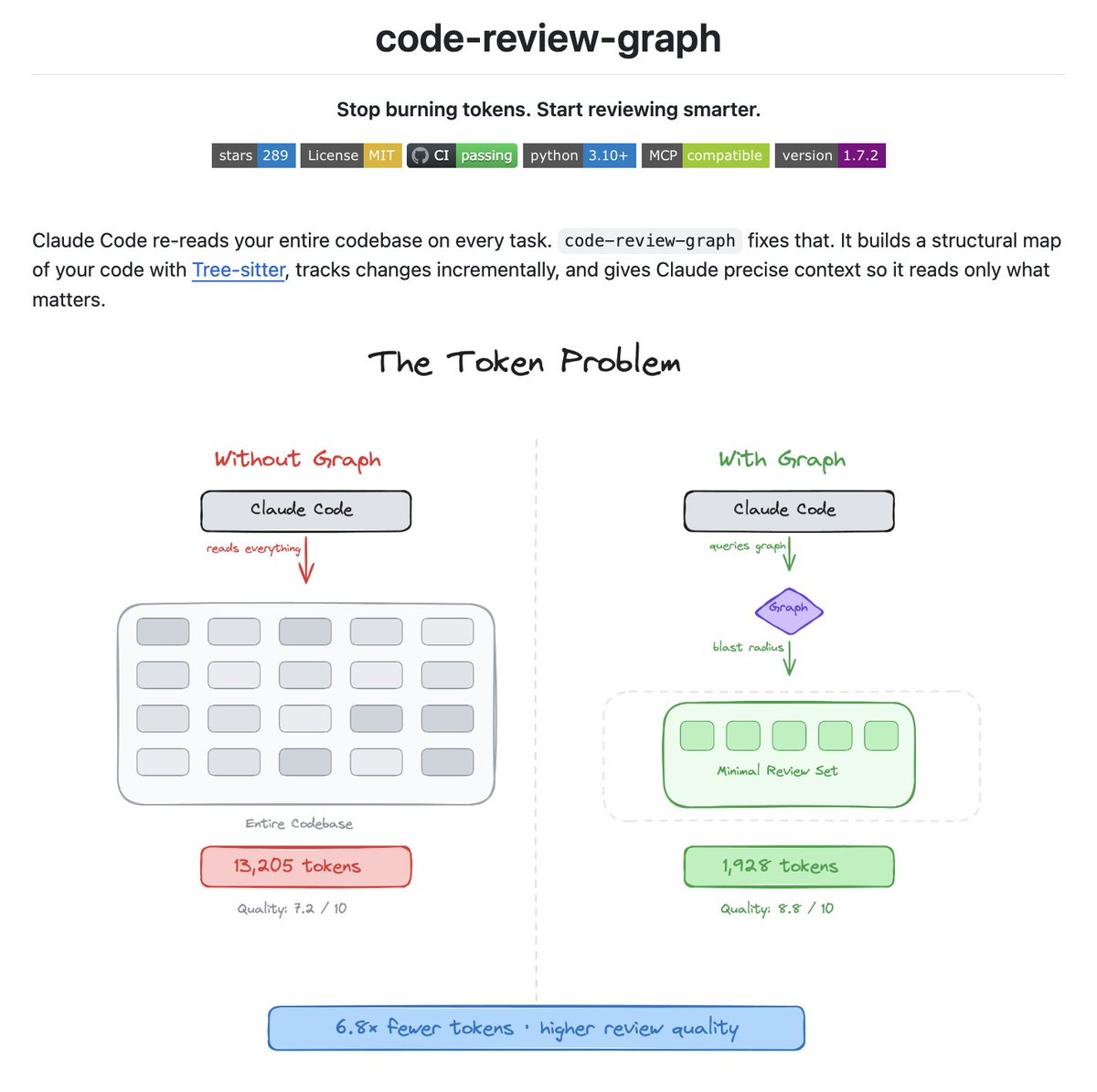
You can now give Claude Code a visual map of your entire codebase 🤯
Someone just open-sourced a tool that builds a local graph of your entire project so Claude instantly knows how every file is wired together.
- Runs 100% locally on your machine.
- Maps out your entire repository structure automatically.
- Gives Claude Code the exact context it needs to build without hallucinating.
100% open source.