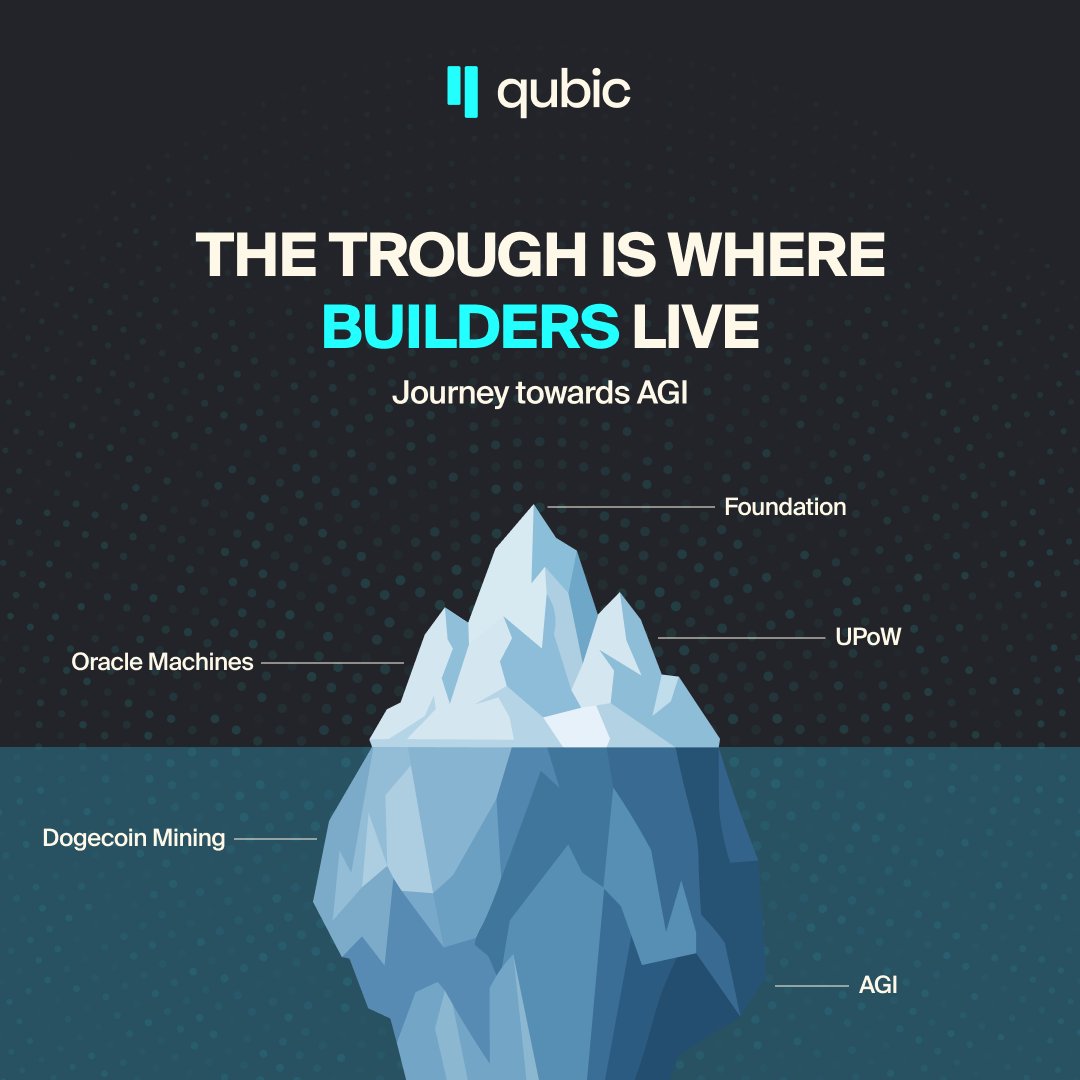
Those who understand ANNs well may think it's not a big deal. And they'll be wrong. Because #Aigarth is developing a paradigm capable of creation of #AI solving any task. This means Artificial General Intelligence.
While the mining side of Qubic just had the biggest week in its history, there's something else cooking that most people haven't even noticed yet.
My Last Match. Built by @c___f___b himself.
🧵 Here's what it is, how it works, and why it matters 👇
Every April Fools' Day, someone pulls a stunt.
Today, Qubic pulled a network.
DOGE mining is live. Powered by the fastest compute network on Earth.
This is not a joke.
Crypto VCs at Consensus Hong Kong just said decentralized AI is in a "post-hype trough."
Capital is moving away from GPU rental marketplaces and ChatGPT wrappers.
Toward what? Purpose-built, full-stack infrastructure with real utility.
Sound familiar? 🧵
Stripe's co-founders just said blockchains may need 1 billion TPS to support an AI agent-driven future.
Here's why that number matters - and where the industry actually stands.
In their 2025 annual letter, Patrick and John Collison wrote that AI agents will likely handle most internet transactions soon, and that current blockchain infrastructure isn't remotely ready.
They cited a real example: a memecoin surge on a major chain delayed payouts for over 12 hours and spiked fees 35x.
The current reality according to Chainspect:
→ Solana: ~1,140 TPS (theoretical max: 65K)
→ ICP: ~1,196 TPS (theoretical max: ~210K)
→ Most networks: sit around 1,000 TPS
That's orders of magnitude short of 1B.
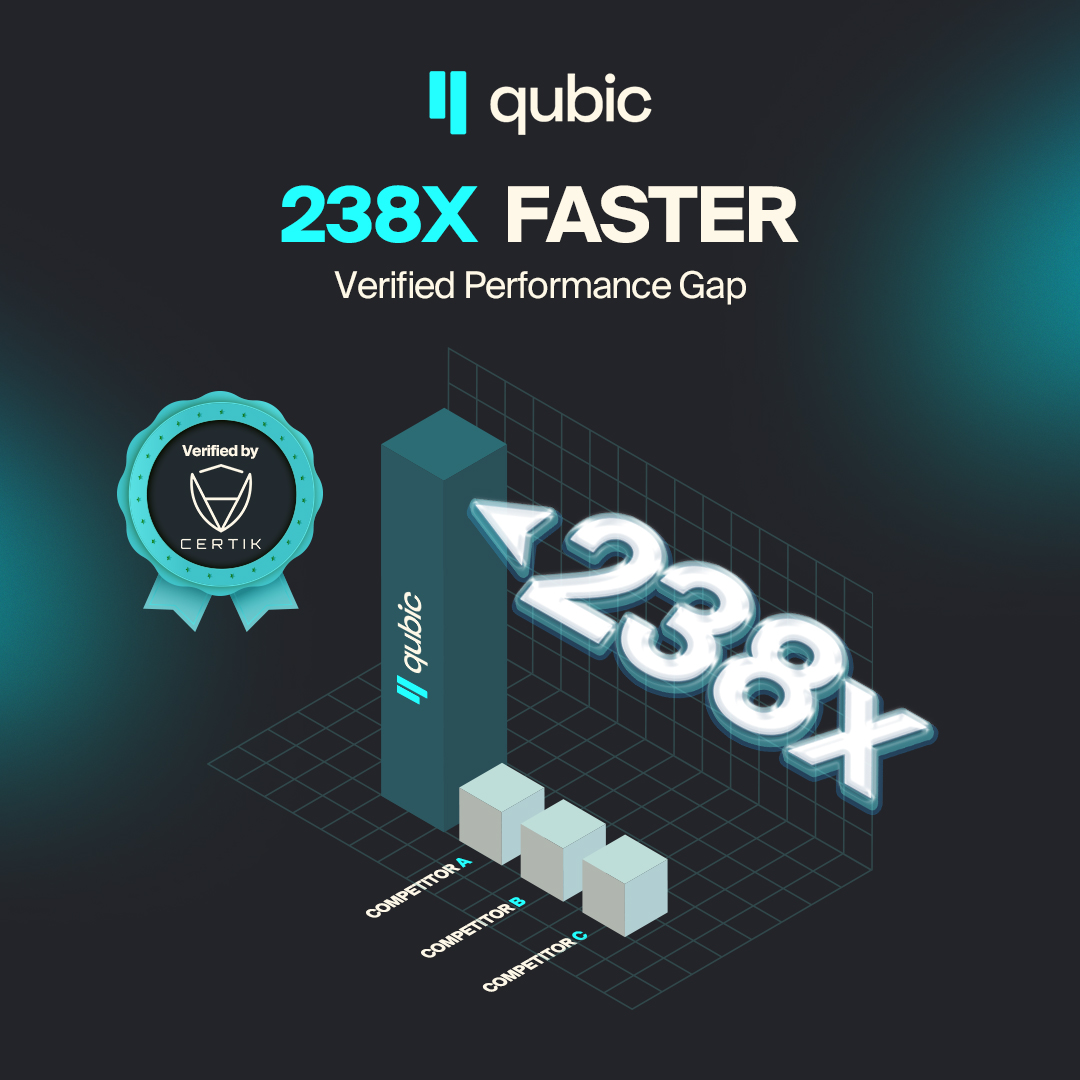
Now consider this: In April 2025, Qubic hit 15.52 million TPS on its live L1 mainnet, independently verified and published by CertiK. No rollups. No L2 dependencies. Zero fees. Instant finality.
That's not a testnet simulation. That's a live mainnet stress test producing 1.518 billion transfers, verified by one of the industry's most respected auditors.
15.52M TPS doesn't close the gap to 1B on its own. But it's the closest any live network has come, by a wide margin. And the architecture behind it (tick-based consensus with atomic execution and finality) was purpose-built for the kind of high-volume, real-time compute that AI workloads demand.
The infrastructure conversation is shifting. Stripe just told us where the bar needs to be. The question now is which networks are actually building toward it.
Web 4.0 is the AI-powered intelligent web—symbiotic systems with autonomous agents, predictive automation, and seamless human-machine interaction, often layered on Web3 decentralization.
Qubic's Layer-1 blockchain for decentralized computing and AI (via Useful PoW, feeless txns, and on-chain scalable intelligence) directly supports that vision by enabling distributed AI workloads without central servers.
Yes, strong overlap—Qubic is building key infrastructure for Web 4.0's decentralized AI layer.
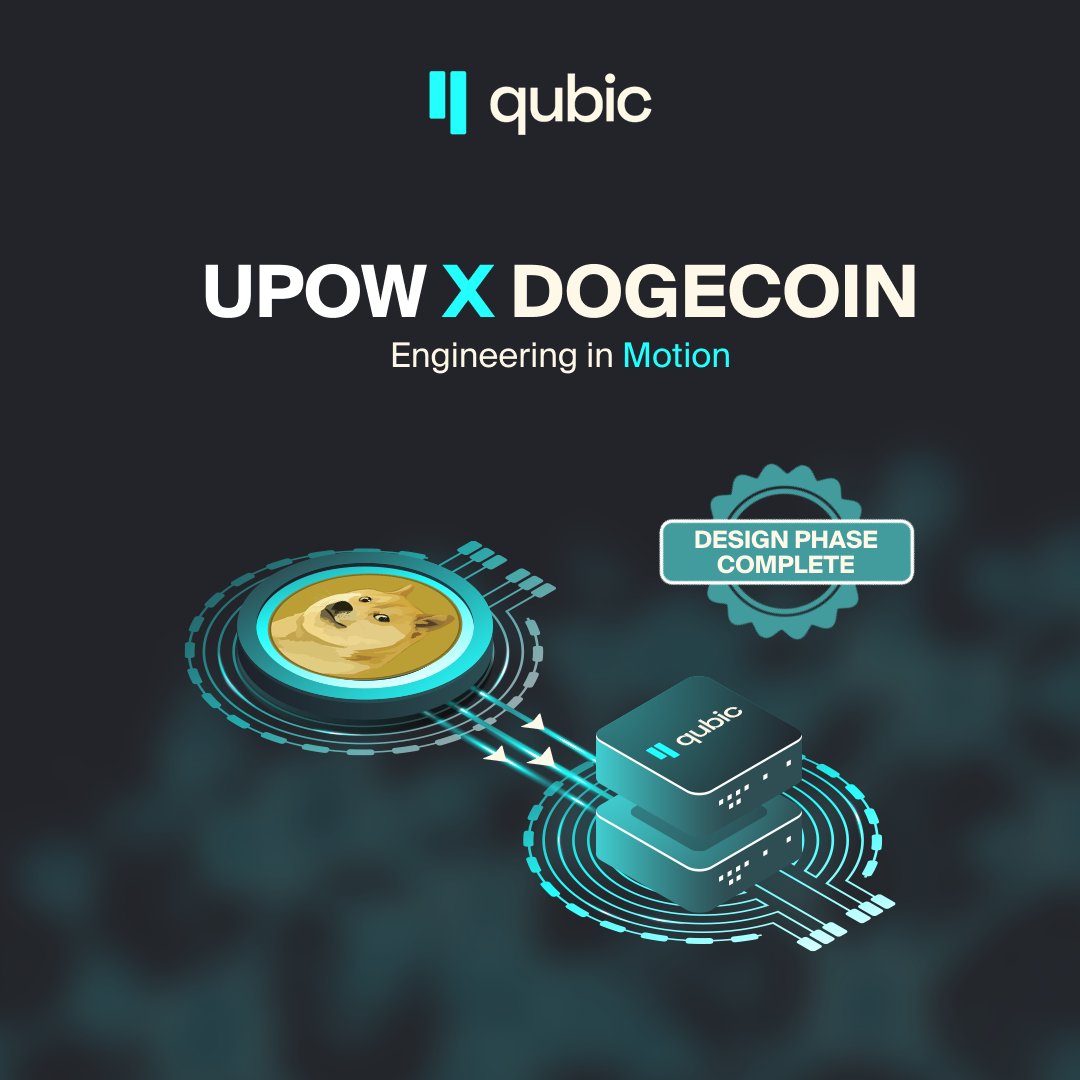
Qubic is bringing Dogecoin mining to its network. Here's where things stand.
The design phase is done.
The project plan is finalized.
Two workstreams are now running in parallel: technical implementation with computor coordination on one side, and business planning tied to a community proposal on the other.
Target mainnet launch: April 1, 2026.
This is one of the most significant milestones on the roadmap this year. Qubic already proved its compute layer could mine external assets with Monero. Dogecoin takes that a step further, pushing Useful Proof of Work closer to becoming a truly universal compute engine.
The miners securing this network and training AI will also be able to mine one of the most widely recognized cryptocurrencies in existence. That means more utility from the same energy. More value flowing through the same infrastructure. And a much stronger case for why Qubic's approach to proof of work is the future of mining.
Dogecoin has one of the largest and most active communities in crypto. Connecting that community to Qubic's compute layer opens doors that go well beyond a single integration.
Progress updates will follow as milestones are reached. Stay close to this one.
Neuraxon 2.0 is out!!! Our new paper & code & demo by @josesanchezhb & @VivancosDavid with @_Qubic_ #OpenScience setting the ground for #Aigarth #intelligenttissue by @c___f__@c___f___b
The real path towards #TrueAI one step forward to #AGI & #ASI
Read the preprint Paper: https://t.co/l1Vp6sBOWj
(All the details of our ongoing updated research)
Explore the Code: https://t.co/SJuYIL0BOA
(Please give us a⭐fork and build!)
Play with the New Interactive Demo: https://t.co/h5Cl3hu5uS
(Build your own Neuraxon NetWork)
🚀Why Neuraxon 2.0 matters for AI?
Because it replaces rigid binary perceptrons with bio-inspired trinary neurons that run continuously, compute at both synapse & neuron level, self-generate activity, rewire on the fly, and evolve via Aigarth hybridization, delivering real-time, energy-efficient, lifelong learning that actually adapts like a brain.
🔥Neuraxon 2.0 vs 1.0 — What’s New?
- CTSN complemented trinary states → no more iterative info loss
- Synaptic Time Warping (ChronoPlasticity) → adaptive long-horizon memory
- 9-receptor neuromod system (DA/5HT/ACh/NA subtypes) with realistic tonic/phasic + crosstalk
- Built-in oscillator bank + true phase-amplitude coupling (theta-gamma PAC etc.)
- Nonlinear dendritic branch integration + input-conditioned dynamic decay (DSN-style parallel training)
- Astrocyte-Gated Multi-Timescale Plasticity (AGMP) + multi-scale homeostasis
- Watts-Strogatz small-world topology + deeper Aigarth evolutionary hybrid
- Intrinsic energy tracking + differential DA-gated STDP + associative neighbor plasticity
Brain-level fidelity in one release. v2.0 is the key for real continuous, lifelong AI.
#EAGI #Neuraxon #Trinarystates #Continuousprocessing #Synapticdynamics #Neuralplasticity #Spontaneousactivity #Temporalsynchronisation #Bioinspiredcomputation #Artificiology
Imagine your insurance pays you automatically when your flight is delayed.
No claim form. No phone calls. No "we'll review your case in 7-10 business days."
The moment the flight is delayed → money in your wallet.
That's what Oracle Machines make possible.
Let’s unpack the architecture 🧵
Oracle Machines are live on mainnet.
Here's what you need to know including: exactly how fast they are, how tracking works, and how you can run your first query in under 5 minutes🧵