Bengaluru-based space startup @astrobase_space Astrobase Space Technologies has announced that it will "reveal India’s first fully integrated 80-tonne-class FFSC rocket engine" on Friday. This is being viewed as a very significant development not only for India's private space sector ecosystem but also for India's wider space ambitions. So, here is what this development means:
🧵 (1/10) @indiaBUILDwiki
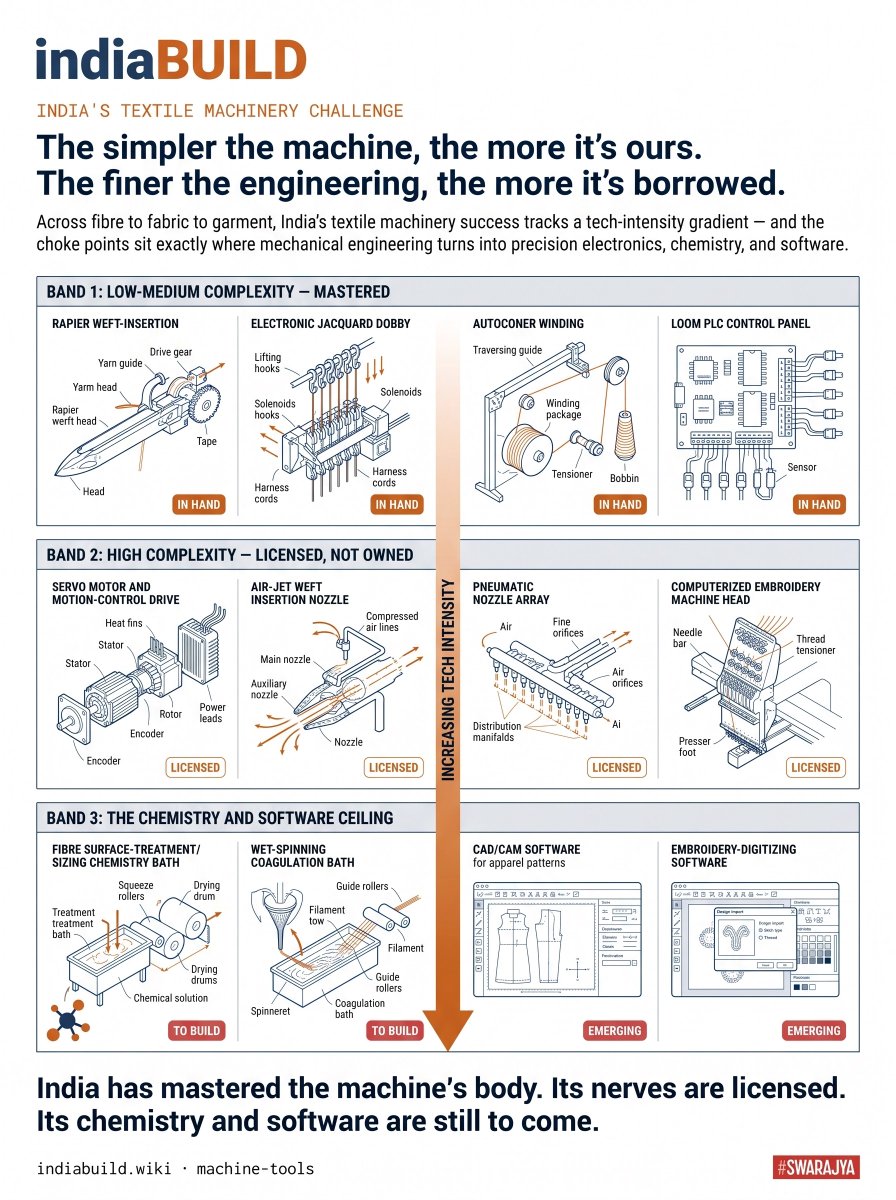
India's textile machinery tells a clean story once you plot it on a tech-intensity gradient rather than asking a flat "does India make this or not."
On the low-to-medium complexity end, India is genuinely strong.
-It builds its own rapier and jacquard weaving mechanisms, dobby systems, PLC loom controllers, sensors and firmware, autoconers, and its own synthetic and viscose/rayon fibre — real mechanical and electromechanical engineering, owned outright, not licensed, not imported.
-This is the base of the pyramid, and it's solid.
The lag shows up cleanly once you move up the gradient into high-complexity territory.
-Servo drives and precision motion-control systems — the components that let a loom run fast and stay tuned to load — are built in India only under foreign licence, not owned technology.
-That's also why India's loom fleet clusters at standard speeds while the high-speed and air-jet/water-jet tier stays imported.
-Push further up the gradient into chemistry and software and the gaps get more basic still: fibre surface-treatment chemistry (dye and coating chemistry) is barely started, wet-spinning process control and draw-texturing are still emerging, and apparel CAD/CAM and embroidery-digitizing software are still maturing.
So the real arc for understanding India's technology sovereignty in textiles isn't fibre vs fabric, or import vs domestic. It's the tech-intensity gradient itself — and the choke points sit exactly where mechanical engineering turns into precision electronics, chemistry, and software. That's where the self-sufficiency question actually gets decided.
IndiaBUILD is a public, evidence-verified map of exactly these gradients — every capability, company, and government scheme sourced and checked, so instead of guessing where a sector's dependence really sits, you can see the choke points, capability by capability, across every industrial sector.
India's textile mills operate many imported high-speed shuttleless looms, but India's indigenous loom manufacturing capability lags the global frontier.
The government's customs notifications define high-speed shuttleless looms as rapier above 650 rpm, water-jet above 800 rpm, and air-jet above 1000 rpm.
While Indian firms such as Laxmi Shuttleless, Alidhra, and Palod Himson manufacture rapier looms domestically, publicly documented indigenous R&D efforts such as the TIFAC–SITRA–Sree Andal programme reportedly achieved around 250 rpm—well below the benchmark for modern high-speed shuttleless weaving.
India does not currently have an established domestic industry manufacturing high-speed air-jet or water-jet looms, and major weaving clusters such as Bhiwandi rely heavily on imported shuttleless machines, including many from China.
The gap is what's inside the looms - the servo drives, electronic shedding systems, and precision motion control that let a loom run four times faster without tearing the yarn. That's the part still being licensed in or imported, not built.
@indiaBUILDwiki tracks capability gaps like this one - precisely, against real thresholds, with the builders and the policy landscape mapped alongside them.