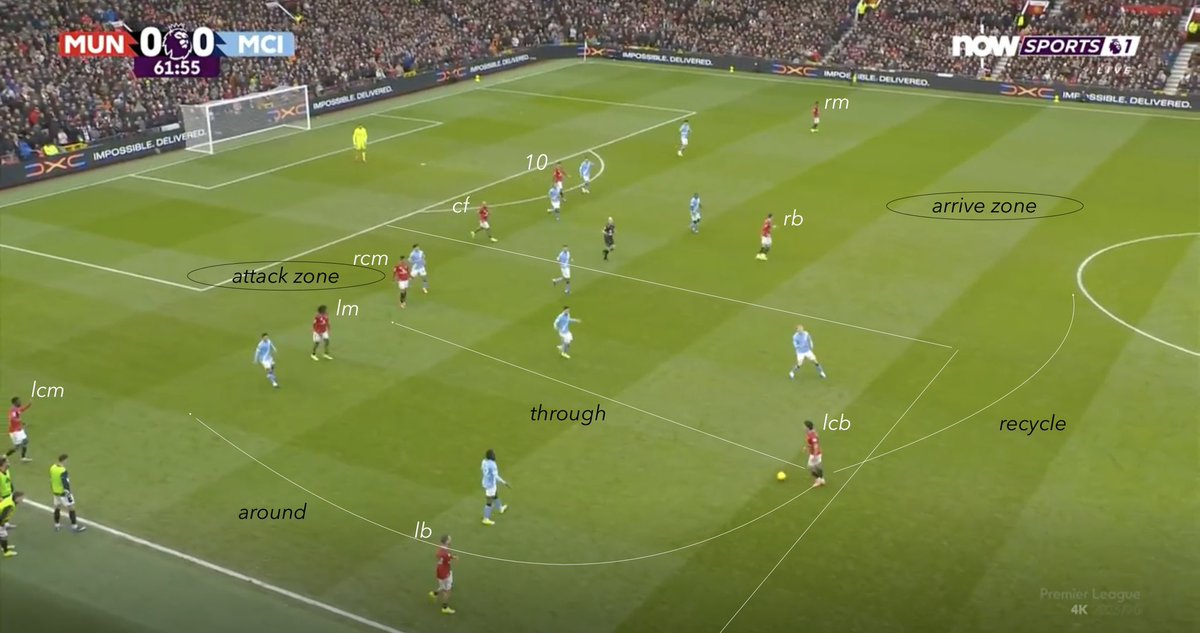
Tobias Strobl’s Wolfsburg is another team to follow this season. 3-2-5 base with four fixed players and six central ‘floaters’ converging around the ball looking to play through pressure and offer inside diagonal options
The role of a single pivot in build-up.
Rodri has been the master of this in the World Cup. Recognising the opponent's pressing patterns and moving to exploit them.
The average La Liga forward pressed 42 times per 90 last season. The second least frequent, Rashford, pressed 22.5. Mbappe? 16.99.
He ended the season with fewer interceptions than Joan Garcia. He says he will change. Tonight we might see if that's true.
https://t.co/O1Cwr5vY5z
Japan's use of "False FB" concepts to create space against man-to-man marking - Nice wrinkle to allow 10s & CMs to create width:
- Importance of using ball recirculation as a trigger
- Complementary players (WBs high/wide) to leave space free
- Manipulating CHs tendencies OOP
There is already enough analysis about achieving collective organisation through positional principles: depth, width, half-spaces, 4-2-4s, 3-2-5s, 3-1-6s, and many other concepts that are now common knowledge. Using these principles, it becomes relatively easy to build a squad with a clear structural idea.
What we still do not have enough understanding of is how to achieve collective organisation in a functional attack/relational approach. Yes, concepts like diagonals, one-twos, tilting, and proximity are essential, but how do you sustain collective organisation on a macro scale while building a squad and maintaining long-term alignment?
For me, the best answer is the 4-midfielder approach that originally came from Brazil.
Do not think of the midfielders here as positions, but as functions. That is why the original name of the relational approach was Jogo Funcional, or Functional Play in English. The idea is exactly what it sounds like: you need four midfielders on the pitch.
Usually, the division of functions between these midfielders works like this:
The Primeiro Volante functions as the 6, providing the deeper circulation and control. The Segundo Volante functions as the connective 8, linking phases and sustaining circulation. The Ponta-Armador can start from the wing or centrally, but fundamentally functions as an associative midfielder within the structure. And the Meia-Armador functions as the primary creative organiser.
So what is a midfielder from this perspective?
A player who is comfortable on the ball under pressure, can operate in short spaces, can associate with teammates, and primarily plays in front of the opposition’s midfield and defensive lines.
What the 4-midfielder approach creates is a technical floor. It uses individual tendencies to facilitate the team’s intentions, creating team-level tendencies that maximise the relational idea and emphasise diagonals, one-twos, tilting, and proximity.
It is no surprise that Madrid, Argentina, and the great Brazil and Milan sides all utilised this concept. Naturally, the base structures these teams used, yes relational teams still have structures, were usually variations of a 4-diamond-2, 4-3-1-2, or 4-2-2-2, all of which created a four-man midfield.
And from this, we also understand why these structures have become so rare in possession at the elite level in European football.
Written by @MeiaArmador__
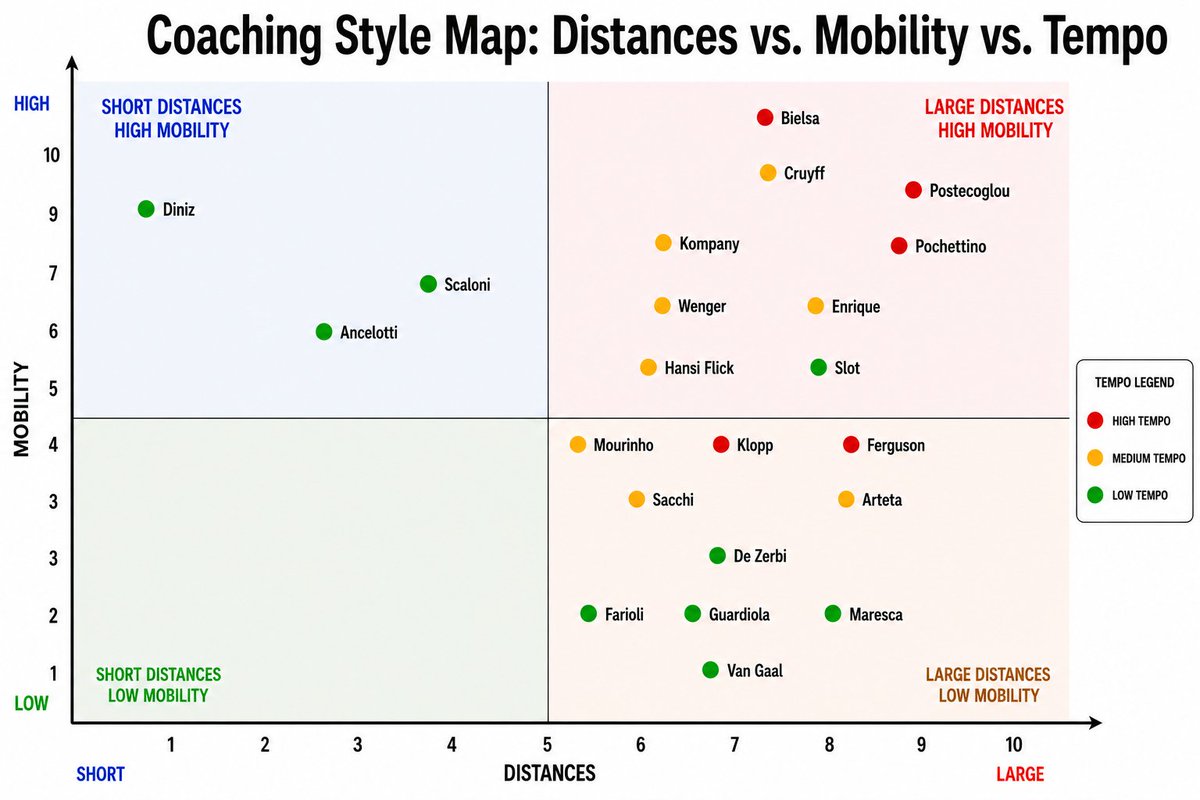
Every approach is ultimately built on balancing three core concepts: distances, mobility, and tempo.
How a coach thinks about these three variables dictates everything, from strategy and tactics down to player profiling and individual coaching. What kind of distances he wants the team to play with, how much mobility he wants within the structure, and the tempo he wants the game to be played at will shape the entire identity of the team. It even reflects in the personalities of the coaches themselves, and the type of personalities they prefer in players.
Every elite coach accepts certain risks in order to minimise others. An effective team-level strategy cannot exist without balancing these trade-offs. Coaches who try to maximise all three simultaneously struggle to consistently dominate at elite level. There has to be a mechanism that allows the team to control the game, whether through shorter distances, lower mobility, lower tempo, or a balance between them.
As distances, mobility, and tempo all increase simultaneously, the game naturally becomes more chaotic. Players have fewer stable references while making decisions, structural compactness lowers, and the physical demands placed on the team are unreasonable across a full season, especially with European football. This explains a lot about the careers of coaches like Bielsa, Postecoglou, and Pochettino.
Strategically, it becomes almost impossible to sustain a coherent in-possession model and control defensive transitions without balancing these concepts properly. On a team level everything is a trade-off between distances, mobility, and tempo.
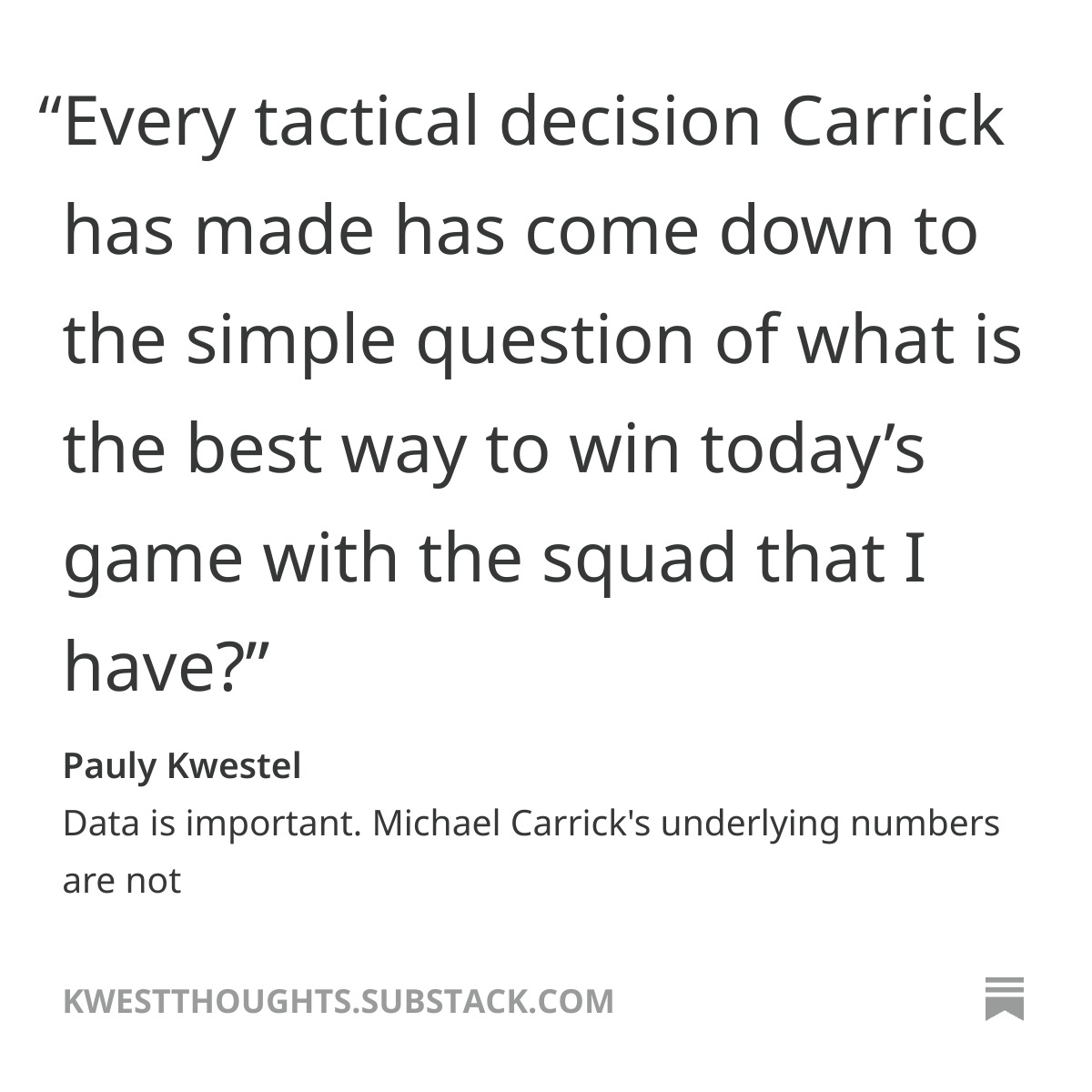
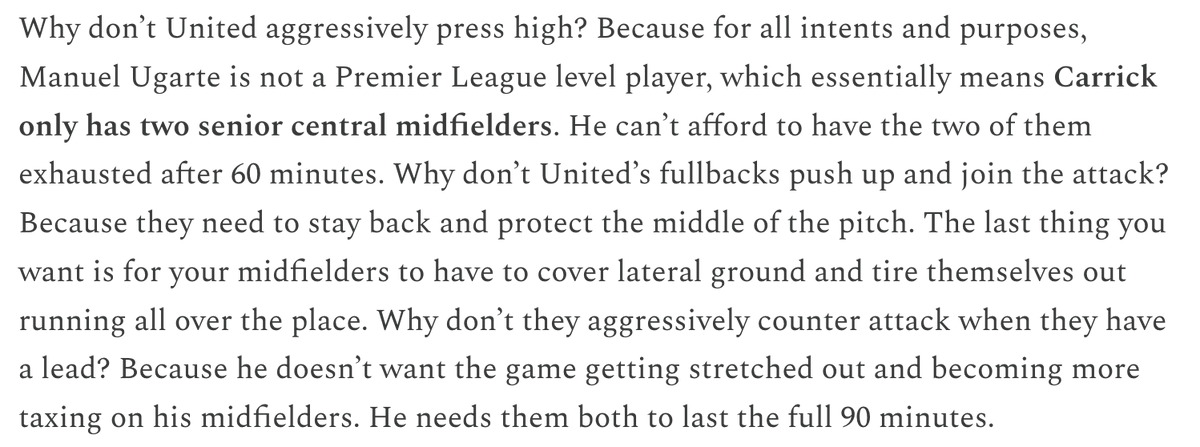
United's entire tactical plan under Carrick has been about being able to keep Casemiro on the pitch for 90 minutes
He won't be here next year. So obviously the plan will be different, and it will be based on the strengths of whomever Utd sign this summer
https://t.co/OOBDrwb8V5
PSG’s fascinating system.
The right side builds (Hakimi–Doué–Vitinha).
Doué connects between the lines.
Kvaratskhelia as left-sided outlet.
Dembélé floats high and finishes.
This 3 minute breakfast got me to 12% body fat
At 46, I got my abs back and this breakfast is the biggest reason why.
Here's what's in it and why it works:
Vincent Kompany.
• 3-1-3-3 build-up
• 4v2 first phase
• 2v1 wide
• Both FBs inverting
• Overload to isolate
• Minimum width
• Diaz isolated for 1v1s with Trent
Enrique’s anchors & floaters
player’s can personalise with instinct within a framework where the coach gets their share of control through continuous positional occupation
- always width
- always depth
- always 3 central behind the ball
As long as there’s occupation, you can arrive anywhere
Diagonal runs across the defender will always be a pathway to space because whilst you keep moving wider they have to stay in the middle. They can't track the run because of the distance it creates and the space it exposes.
Daniel Kanu scores goals because of top 'IQ' details
ON SPECIALISTS & DYNAMOS.
Fowards need to be categorized in terms of how they influence dynamics for their teams, separately from their G/A
—Haaland makes City effective when they are camping in the opposition box. He turns every cross and cutback into a chance.
—Haaland also makes City effective when they are defending low, because he has the power to run in behind opposition lines.
So, even when he is not scoring, Haaland makes City a more effective football team.
Players like him, Saka and Salah are Dynamos: they influence the dynamics of how their teams play.
Without them, their teams often have to play differently & worse.
Dynamos influence how a team attacks. Their teams are visibly worse when they are not on the pitch. Entire teams can be changed by the availability of one single Dynamo.
Some other players are Specialists. They have the quality to contribute & capitalize if their team is in a specific situation.
Think about Leandro Trossard at Arsenal. His superpower is that he is extremely dangerous when he is receiving the ball in and around the penalty area.
However, a Dynamo like Saka can be why Arsenal are in the opponent's penalty area in the first place. So, if Saka is not playing, a Specialist like Trossard can suddenly look ineffective.
In other words, a Dynamo can singlehandedly create the conditions a Specialist needs to thrive.
So, even without G/A, a Dynamo is already contributing a lot to their team. Finding a Dynamo with very strong G/A capacity like Erling Haaland is extremely rare.
Good teams are often a combination of Specialists and maybe a Dynamo. Great teams are combinations of several Dynamos.
You build a team and your tactics around your Dynamo. Specialists are sprinkled in to add something missing in the final recipe.
Fans however get beguiled by Specialists contributions and think a team should be built around them. But good managers always know better.