Roth bags clients again on $TE
We did a zoom w/ the Roth research team a couple weeks ago explaining our work
The lead analyst did NOT understand the in's & out's of FEOC compliance at all. He hadn't even read the Feb-2026 IRS Guidance
Roth still haven't figured it out
$TOYO
TOYO Co., Ltd., a Tokyo-headquartered solar manufacturing company, has announced the agreements on June 10, 2026. The company signed two master supply agreements with two major US solar energy developers. The agreements cover cumulative purchase orders of approximately $185.6 million. TOYO will supply high-efficiency solar modules for commercial and utility-scale projects. The modules will be deployed across project sites in Texas, New York and Maine. TOYO said the supply will use non-Chinese wafer sourcing channels and FEOC-compliant (Foreign Entity of Concern) manufacturing.
@Yeah_Dave@miscomputate@MyQuant_um I think quantum sensing and computing get assigned different multiples. Strictly speaking, their respective TAMs are quite different
To my fellow memory bulls: I am going to share a perspective that is contrary to what many of you may think as it relates to the scarcity of supply.
The whole memory bull case/'this time is different' pitch revolves around the fact that memory (and particularly HBM/DRAM) directly enables the viability and completion of longer-running/higher-token agentic jobs. If you want an agent to go out and actually do something complex for you, whether it be coding or a large-scale web task, you fundamentally need more HBM/DRAM (and even NAND), because at the center of that job is a large and growing KV Cache which stores much of the tokens' context up to that point and helps to generate the next token, and so on. A long job like this can't complete with lots of memory. The last page in the @Nvidia paper on 'Trigonometric KV Compression' showcases this directly.
And since there is potential demand for jobs that run for many hours or even days/weeks/months over time, there is clear line of sight for any incremental memory capacity to be digested quite quickly by the marketplace. Until we hit some sort of wall in the amount or duration of the jobs that can be completed, which at this point is not visible whatsoever, then demand is no longer cyclical. It has become secular as long as the scaling trends hold. And this is why you're seeing LTA's and the large, extremely knowledgeable Hyperscalers locking up memory supply years in advance even at high prices. They clearly understand this dynamic.
So if you believe this is no longer cyclical (which I do, absent a scaling wall or a completely new architecture that displaces the autoregressive transformer), stop treating DRAM as cyclical.
And through that lens, we need MUCH MORE supply than is currently forecast to come online, NOT less. The dynamic has become so extreme that the tightness is no longer good for anyone, not even the memory suppliers. The tightness has become such that in face of exponentially growing bit demand, the biggest problem I see now is the potential inability to serve it. Supply is now the primary constraint to the level of through-cycle earnings.
If we're going to claim this time is different, then our framework of analysis must change as well. Bottleneck bros be damned.
Memory has entered into a new era and it's time to treat it as such.
$MU $SKHynix $Samsung
As the recently expanded partnership with @AnthropicAI demonstrates, @SpaceX is offering AI compute as a service at significant scale.
We are in discussions with other companies to do the same.
Over time, especially with orbital data centers, we expect to serve AI at extremely high scale.
Semianalysis published a table last night that does more for the demand side narrative than 6 months of analyst commentary lol.
Token cost vs human labor cost on 9 real internal workflows. and EVERY SINGLE ONE had ROI over 10x (most landed between 60 and 90x)
The workflow that stuck was an initiation note on $HPE, covering roadmap, balance sheet, and capex sustainability. The cost in tokens was 21,33$.
The cost in analyst time, at 20 hours and 50 dollars an hour, was 2k dollars (so ROI of 93x)
You can argue about how generalizable a single workflow is but it's hard to argue with the moment the analyst sees the receipt. The workflow does not go back. The senior analyst will not return to a process that costs 90 times more, and the junior will not be allowed to.
The reason this is not cyclical demand is the reason the cotton gin did not roll back. Once the labor cost of a task drops by 90 plus percent, the unit of work changes.
The old workflow is not slow, its gone.
The buyers of intelligence at every desk in finance, law, consulting, and biotech are about to spend the next 2 years rediscovering that they have been paying 100x more than the new floor for the same answer.
The other line in the SemiAnalysis post that stuck out was that banks are not using this yet. Most enterprises are not. The token bill of the next 24 months is going to be funded by people who saw a 21 dollar receipt and could not unsee it.
The demand curve does not bend until the supply curve does
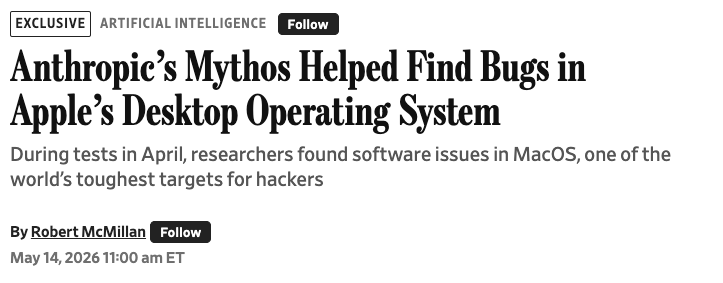
ANTHROPIC’S MYTHOS HELPED RESEARCHERS FIND MACOS BUGS
WSJ reports Calif researchers used techniques from Anthropic’s Mythos AI testing to find two macOS bugs.
The bugs were linked into a privilege escalation exploit.
Apple is reviewing a 55-page report and details are expected after patches.
Calif says Claude helped build the exploit code in five days, but human researchers were still needed to make the chain work.
Mozilla’s recent Mythos results were also notable:
271 Firefox bugs identified for Firefox 150
180 rated high severity
80 moderate
11 low
423 total Firefox security bugs fixed in April
Watch a team of humanoid robots running a full 8-hr shift at human performance levels. This is fully autonomous running Helix-02 https://t.co/IdZR0T1F5I
Taiwanese media reports that Foxconn has begun early shipments of all-optical CPO switch racks to NVIDIA, with shipment forecasts revised upward from the prior 10,000+ units in 2026 to 50,000+ units across 2026–2027.
According to industry sources, Hon Hai Group is producing the all-optical CPO switch racks at its Vietnam plant and has already begun early shipments to NVIDIA. Supply is reportedly extremely tight — even the units originally allocated for demo purposes have been diverted to NVIDIA, leaving "not a single rack to spare."