The Young Scientists Group is having it's first physical meeting at @FAO today....Later I will present on why it is important to increase research on marginalised groups.
Wir stärken die 🇩🇪-🇳🇿 Partnerschaft im Agrar-#Klimaschutz. Heute startet unser gemeinsames Projekt Agri-DENZ zur Vernetzung von Forschung, Politik und Drittländern.
Mehr ➡️ https://t.co/pjncMe4Pxl
🔊 Exciting times in Barcelona as the #aWISH project kicks off its 3rd annual meeting! We covered key data insights, challenges, and pilot updates.
💡 Stay tuned for more progress!
👀 Learn more: https://t.co/tVRCK39oFs
#Innovation#Sustainability#aWISH#Barcelona
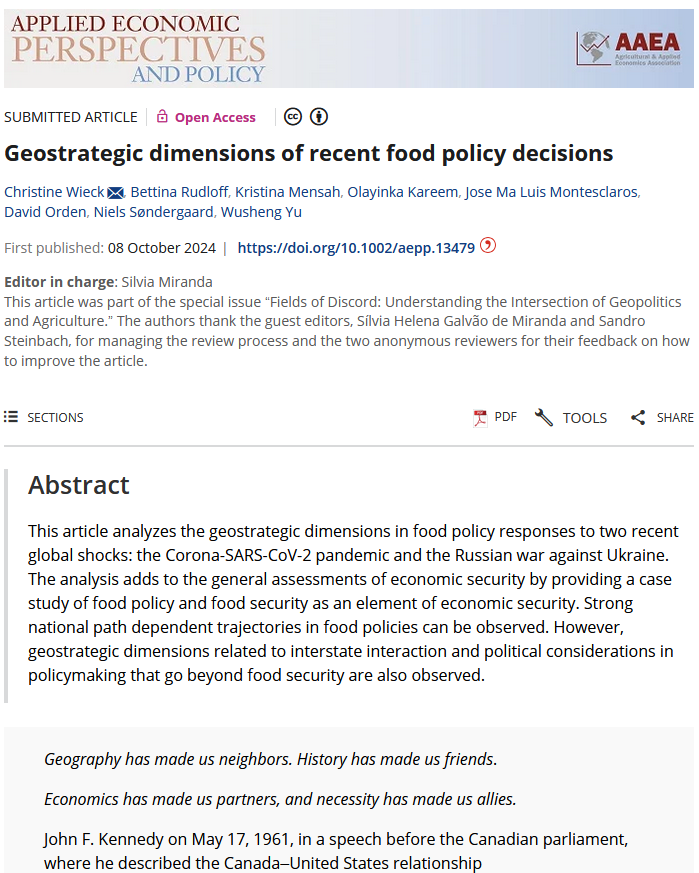
Happy to finally see this published, together with @BettinaRudloff and colleagues from across the globe. A lot talked about the "new" geostrategic dimension of food, but ag and food policy was most often of high national and strategic importance. Recent events amplified this.
📌 From 16 to 19 September 2024, #aWISH partners conducted data collection at pig finisher farms, a transporter, and a slaughterhouse in Spain.
👉 The individuals involved in the data collection, include Josep Reixach, Petra Thobe, Craig Chibanda, and Angela Ramon.
@jahman_adamski Farm competitiveness = 1. farm performance (FCR, mortality rates, labour productivity) + 2. production costs....this means farms that are competitive have a good balance of 1. farm performance and 2. production costs. I explain this in detail in my paper: https://t.co/ck8SpHi5X9
@jahman_adamski I am saying farms in Brazil and USA have no reason to invest in high tech barns/coops because it makes no financial sense for them.
As a poultry Economist I work daily on EU farms and understand very well the benefits of closed-systems.
@jahman_adamski You are right in terms of performance, but performance is just one part of "competiveness". Farms that are able to balance performance and production costs are more economically sustainable. That is why it makes no sense for these farms to invest in high-tech coops.
@jahman_adamski The chart below shows the biggest exporters of chicken meat. The issues I raised explain why Brazil and the US are FAR ahead of other countries in terms of chicken meat exports. Most countries simply can't compete with them in terms of costs of production.
@jahman_adamski EU farms have are slightly better in terms of feed-use efficiency measured through FCR but that advantage is just marginal. Even if you compare the mortality rates of typical farms in Brazil and USA they are not high despite the poor biosecurity measures you outline.
@jahman_adamski Therefore, before we even consider huge investments in the latest coop, we need to push for more production in soya and maize. Due to our climatic conditions, investments in "climate controlled" coops is not a priority. We can become very competitive if we get the feed right
@jahman_adamski When we compare poultry farm economics (production costs, feed conversion ratios, etc) you will find that mainly 3 issues are important: 1. Availability of low cost and high quality feed, 2. High quality chicks, 3. Husbandry. Before investing in coops, we need to get this right.
@jahman_adamski In fact, farms in Brazil and US which mostly don't have closed coops outperform European farms in terms of costs of production because they have access to affordable feed. Based on my research, the competitive advantage is associated with minimising the feed costs.
🎉 The wait is over, join us for the launch of #aWISH, #HEurope's 2nd Annual Meeting video!
🌟 Celebrate a year of groundbreaking progress in animal welfare monitoring, featuring tech advancements and project milestones.
📽️ Click on the link to watch it: https://t.co/FoW2s0fhIc
@drDendere That sounds like a good idea but we will have to compete with the tonnes of milk powder that is exported from the EU. The milk powder is often used to make a lot of the dairy products in Ghana and there have been a lot of debates abt fat filled milk powder exports to West Africa.
@drDendere@naunihalpublic I conducted a lot of research on dairy production in Ghana. Another issue is the type of breeds that are reared in Ghana. Due to the harsh climatic conditions, high milk producing breeds are not well adapted to the high temperatures. Availability of feed is also a big problem.
@jahman_adamski Good questions. I am a Poultry Economist and will be happy to give advice to anyone on the issues stated above, or you can check out my publications on broiler production in Ghana, Senegal, and Germany.