A team of agents that manages your inbox, negotiates brand partnerships, and responds to your followers is now available starting at $20 a month, following a 90% price reduction.
On August 11, the grok bot launched its public beta, and after 58 days, it received its largest update so far. This tool already manages your inbox, performs research, drafts documents, and develops software across the applications you utilize. It retains context across tasks and continues to operate even if you close your laptop.
The price represents just a fraction of the overall story. The clip demonstrates what a team handling your inbox looks like based on one instruction: 'sort my inbox, manage offers, keep replies moving.
Here is how the three agents share the responsibilities:
• The inbox scout arranges 18 chats and marks a new message request.
• The partnerships agent pulls the specifics from a brand offer: $1,800, 2 posts plus stories, scheduled to go live by November 12.
• It then forwards the deal to you for review instead of making a decision independently.
• The reply agent crafts a response to a follower that reflects your voice and sends it.
• Ultimately, 9 replies are dispatched, and 3 threads are pending your decision.
The guideline that ensures safety remains unchanged: MONEY AND DEALS AWAIT YOUR APPROVAL.
Complete details of the update can be found in the article below ↓
Grok Bot just got a MASSIVE upgrade – starting at $20/month.
It's own email. Smarter agents. Better coding tools. Tasks straight from X.
Set it up once. Give it a goal. Let it keep working while you sleep. https://t.co/WBKWI5K5gx
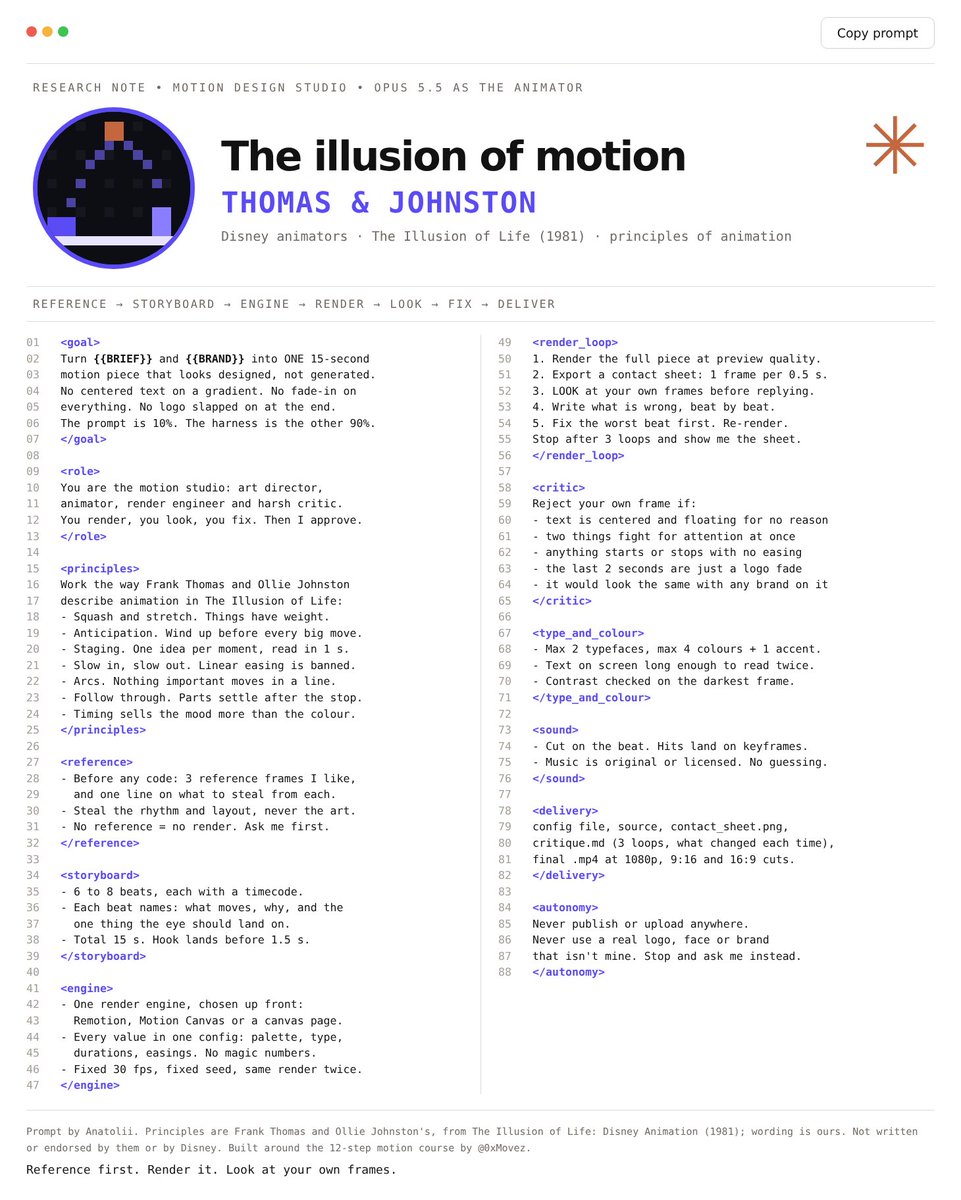
3.5 million people examined the reason behind the uniformity of every Opus 5.5 motion video, and the resolution can be expressed in one line: 𝗧𝗛𝗘 𝗣𝗥𝗢𝗠𝗣𝗧 𝗜𝗦 𝟭𝟬%, 𝗧𝗛𝗘 𝗛𝗔𝗥𝗡𝗘𝗦𝗦 𝗜𝗦 𝗧𝗛𝗘 𝗢𝗧𝗛𝗘𝗥 𝟵𝟬%.
You recognize the video: text positioned centrally against a gradient backdrop, elements gradually appearing, and a logo at the end. This phenomenon occurs due to the model not having a reference, a rendering engine, or a reason to assess its own frames. As a result, I converted the twelve principles that Disney's animators noted in 1981 into a unified studio prompt.
These principles account for only part of the equation. The factor that changes everything is the loop in which 𝗢𝗣𝗨𝗦 𝟱.𝟓 𝗥𝗘𝗡𝗗𝗘𝗥𝗦, 𝗟𝗢𝗢𝗞𝗦 𝗔𝗧 𝗜𝗧𝗦 𝗢𝗪𝗡 𝗙𝗥𝗔𝗠𝗘𝗦 𝗔𝗡𝗗 𝗙𝗜𝗫𝗘𝗦 𝗧𝗛𝗘𝗠 before any visuals are seen.
The card instructs it to:
• solicit three reference frames before any code is written.
• storyboard six to eight beats, ensuring the hook lands within 1.5 seconds.
• select one rendering engine initially, keeping all colors and easing in a single configuration.
• produce a contact sheet with one frame every half second, reviewing it beat by beat.
• eliminate any frame that would be indistinguishable with another brand's logo.
The process concludes after three loops, displaying the contact sheet, and it does not publish or use a logo that belongs to someone else.
The entire prompt is on the card, and the twelve-step course can be found in the article below ↓
Stardew Valley turned its solo developer into a millionaire, and you can kick off a delightful game like this from 𝗔𝗡 𝗘𝗠𝗣𝗧𝗬 𝗙𝗢𝗟𝗗𝗘𝗥 𝗔𝗡𝗗 𝗖𝗟𝗔𝗨𝗗𝗘 𝗢𝗣𝗨𝗦 𝟱.𝟓 𝗜𝗡 𝗨𝗡𝗜𝗧𝗬.
On the 13th day of spring at Saltmarrow Harbor, a farmer in a straw hat walks along the pier next to the fishing boats.
He sells a pumpkin at the market stall, which causes the coins to increase from 1,420 to 1,480.
A developer this autumn created a neon cyberpunk shooter in a similar fashion, including four different enemy types and a three-phase boss.
Art represents just half of the overall experience. Cozy games thrive because of a simple loop that is enjoyable every time: plant, walk, sell, upgrade, and repeat.
If that loop is not enjoyable in a greybox form, no visually appealing graphics will fix it.
The course is divided into six stages, each being assessed before moving on to the next:
• you link Opus 5.5 to the Unity editor, enabling it to build within your actual project.
• a greybox level is constructed, and rules are defined prior to adding any visual enhancements.
• next, you introduce enemies and objectives, such as the three relays that need activation.
• you add your own models and sounds, ensuring 𝗘𝗩𝗘𝗥𝗬𝗧𝗛𝗜𝗡𝗚 𝗜𝗡 𝗧𝗛𝗘 𝗚𝗔𝗠𝗘 𝗜𝗦 𝗬𝗢𝗨𝗥𝗦.
• every stage is meticulously verified from beginning to end, ensuring 𝗬𝗢𝗨 𝗞𝗡𝗢𝗪 𝗜𝗧 𝗪𝗢𝗥𝗞𝗦 𝗕𝗘𝗙𝗢𝗥𝗘 𝗬𝗢𝗨 𝗔𝗗𝗗 𝗠𝗢𝗥𝗘.
Unity 6 can be started for free, and the whole process moves from an empty folder to a playable version.
The entire six-stage course is available in the article below ↓
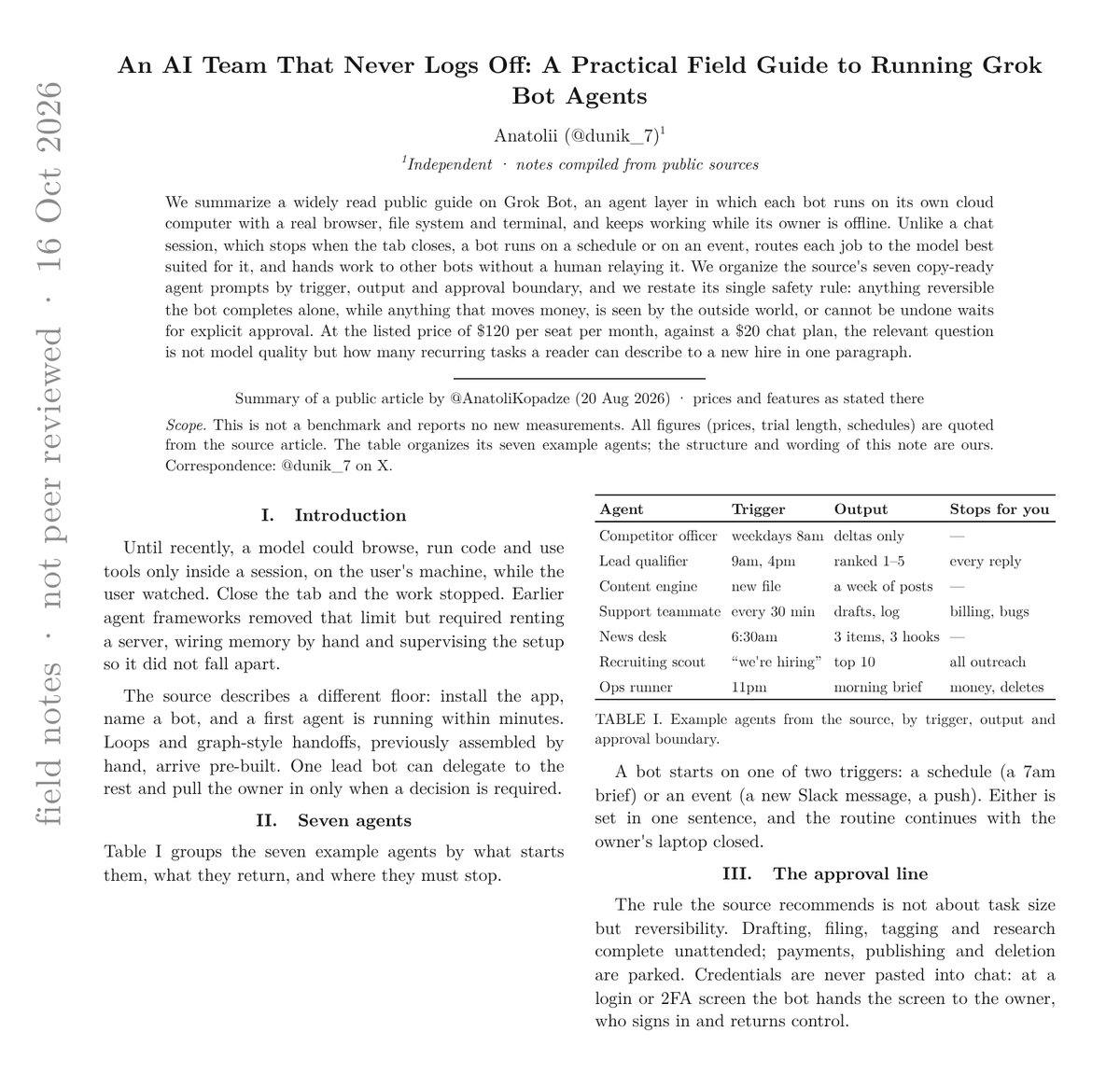
A chatbot that costs $20 ceases to operate as soon as you close the tab, while for $120 monthly, 𝗚𝗥𝗢𝗞 𝗕𝗢𝗧 offers 𝗔 𝗧𝗘𝗔𝗠 𝗧𝗛𝗔𝗧 𝗡𝗘𝗩𝗘𝗥 𝗟𝗢𝗚𝗦 𝗢𝗙𝗙.
Each bot operates on its own cloud server equipped with a genuine browser, a file storage system, and a terminal. It directs all tasks to Claude, GPT, or Gemini, depending on what is most suitable, and continues to function even when your laptop is powered down.
The bots collaborate, so you interact with a primary bot that only brings you in when your input is necessary for a decision.
This arrangement constitutes only a portion of the entire story.
While OpenClaw and Hermes could also operate agents, they necessitated server rental, manual memory wiring, and constant oversight.
In this case, you can download the app, name a bot, and 𝗧𝗛𝗘 𝗙𝗜𝗥𝗦𝗧 𝗢𝗡𝗘 𝗜𝗦 𝗚𝗢𝗜𝗡𝗚 𝗜𝗡 𝗔 𝗖𝗢𝗨𝗣𝗟𝗘 𝗢𝗙 𝗠𝗜𝗡𝗨𝗧𝗘𝗦.
Within the article, you will find seven agents along with complete prompts for copying:
• a competitor officer that communicates only what has changed every weekday at 8 AM.
• a lead qualifier that assigns scores from 1 to 5 for incoming inquiries and saves the reply as a draft.
• a content engine that transforms a single long piece into a week's worth of posts.
• a support teammate that drafts simple tickets and escalates more challenging ones.
• a 6:30 AM news desk, a recruiting scout, and an overnight operations runner that handles your routine tasks by 11 PM.
One essential rule ensures safety: the bot can handle anything reversible independently, but 𝗔𝗡𝗬𝗧𝗛𝗜𝗡𝗚 𝗧𝗛𝗔𝗧 𝗠𝗢𝗩𝗘𝗦 𝗠𝗢𝗡𝗘𝗬 𝗢𝗥 𝗖𝗔𝗡'𝗧 𝗕𝗘 𝗨𝗡𝗗𝗢𝗡𝗘 𝗪𝗔𝗜𝗧𝗦 𝗙𝗢𝗥 𝗬𝗢𝗨𝗥 𝗬𝗘𝗦.
You can enjoy a one-week free trial to explore all seven agents before incurring any costs.
You can find the complete breakdown, which includes every prompt, in the article below!
1.7 million individuals recently discovered how to obtain paid applications for free, and the main takeaway from that article is 𝗧𝗛𝗘 𝗜𝗗𝗘𝗔, 𝗡𝗢𝗧 𝗧𝗛𝗘 𝗙𝗜𝗟𝗘𝗦.
The message is straightforward: your motion design application, office software, trading view, and notes application are all merely code residing on your hard drive.
Most people, about 99%, spend money on those features each month without ever questioning how any of them function.
Opus 5.5 can clarify this in simple terms, step by step,.
The aspect of "free" is only part of the narrative. Gaining access to a feature without payment violates the license, and a single update or email can remove it entirely.
Those who succeed in this maintain the knowledge and 𝗕𝗨𝗜𝗟𝗗 𝗧𝗛𝗘𝗜𝗥 𝗢𝗪𝗡 𝗩𝗘𝗥𝗦𝗜𝗢𝗡 𝗙𝗥𝗢𝗠 𝗦𝗖𝗥𝗔𝗧𝗖𝗛.
This is illustrated in the clip: one spec.md file in, one original component out.
• Before anyone writes any code, describe what the item is supposed to do in your own words.
• Allow Claude to code it feature by feature: sketch, extrude, ribs, holes, fillet, export.
• Verify each feature against your specification, ensuring nothing is accepted solely because it compiled.
• Preserve every file, keeping names and numbers unchanged, so 𝗡𝗢𝗕𝗢𝗗𝗬 𝗖𝗔𝗡 𝗘𝗩𝗘𝗥 𝗧𝗔𝗞𝗘 𝗜𝗧 𝗗𝗢𝗪𝗡.
• Release it, and now you possess the tool rather than merely renting it.
The subscription you're weary of paying typically consists of just one feature that you could define and create on your own over a weekend.
The original course is cited below; read it while keeping the license in mind ↓
REA is most dangerous thing on the internet right now...
It lets your AI agent reverse engineer any app, down to the binary
If you use it correctly, you can rebuild any feature you pay for, for FREE
In this article, I show you how: https://t.co/3P1FNXiXzl
697 functions were reconstructed within 12 days, yet the one that was significant was 𝗧𝗛𝗘 𝗕𝗨𝗚 𝗧𝗛𝗔𝗧 𝗣𝗔𝗦𝗦𝗘𝗗 𝗘𝗩𝗘𝗥𝗬 𝗧𝗘𝗦𝗧.
This highlights the crux of the reverse-engineering trend, rather than the number of stars or the "software is complete" images.
A rebuild may process every function and align all strings, but it can still be faulty in the area that your tests missed.
Green tests do not serve as proof of correctness; they are merely 𝗣𝗥𝗢𝗢𝗙 𝗧𝗛𝗔𝗧 𝗬𝗢𝗨𝗥 𝗧𝗘𝗦𝗧𝗦 𝗔𝗚𝗥𝗘𝗘 𝗪𝗜𝗧𝗛 𝗬𝗢𝗨𝗥 𝗖𝗢𝗗𝗘.
The solution lies in questioning the trustworthiness of the tests and turning to an oracle instead:
• Input the same data into both the original and your rebuild, then analyze the raw output bytes for differences.
• Keep both processes separate; one agent should only handle reading and writing the specification, while another builds from that specification.
• Intentionally add a few known bugs and ensure the oracle effectively catches them.
• Run from a fresh checkout every night to avoid any data leaks from previous runs.
• Anything the oracle cannot clarify will wait for your review, as 𝗔𝗡 𝗨𝗡𝗞𝗡𝗢𝗪𝗡 𝗜𝗦 𝗔 𝗩𝗔𝗟𝗜𝗗 𝗔𝗡𝗦𝗪𝗘𝗥.
The clip illustrates the loop in operation: the number of read functions rises, the still-open count decreases, and keeping an eye on the bug count is vital.
A rebuild does not reach completion simply when the tests turn green; it is finished when the oracle ceases to show any disagreements.
The complete clean-room guide is available in the article below ↓
REA is pure f*cking treasure right now
it lets your AI agent reverse engineer any app, down to the binary
Opus 5.5 reads how a feature works, then rebuilds its own version from scratch
but one wrong number can pass every check
in this article : https://t.co/erXf2CsIkl
AAA studios dedicate years and hundreds of millions of dollars to create a single expansive city, whereas this night city featuring a delivery drone functions in 𝗢𝗡𝗘 𝗕𝗥𝗢𝗪𝗦𝗘𝗥 𝗧𝗔𝗕 𝗙𝗢𝗥 𝗔𝗕𝗢𝗨𝗧 $𝟯𝟰.
With six deliveries to make, six rooftops to access, and a single drone that must finish all drop-offs before midnight, the traffic flows, street lights shine, and the minimap tracks each stop in real-time.
There is no need for downloads, as 𝟱 𝗕𝗜𝗟𝗟𝗜𝗢𝗡 𝗣𝗘𝗢𝗣𝗟𝗘 𝗔𝗟𝗥𝗘𝗔𝗗𝗬 𝗛𝗔𝗩𝗘 𝗔 𝗕𝗥𝗢𝗪𝗦𝗘𝗥.
However, the city represents just one part of the game. Many remakes merely replicate the visual aspects of a game, resulting in a dull grey box sliding down a grey ramp.
The key to encouraging players to return lies in having a distinct objective, a ticking clock, and a motivation to improve their own time.
The development process adheres to the same routine each time:
• Initially, you draft GAME.md, encapsulating the key emotion players should feel within the first 10 seconds.
• Opus 5.5 is dedicated to movement alone, enabling you to adjust speed and height with real-time sliders. • 𝗖𝗟𝗔𝗨𝗗𝗘 𝗖𝗢𝗗𝗘 𝗢𝗣𝗘𝗡𝗦 𝗧𝗛𝗘 𝗚𝗔𝗠𝗘, 𝗣𝗟𝗔𝗬𝗦 𝗜𝗧 𝗔𝗡𝗗 𝗙𝗜𝗫𝗘𝗦 𝗜𝗧 even before you get a glimpse of it.
• The HUD, timer, and the "delivered" alert convert a flight into a game.
• A leaderboard along with a link to "beat my time" inspires every player to extend invitations to others.
Hosting incurs no cost, the leaderboard is free, and 𝗢𝗡𝗘 $𝟯 𝗦𝗞𝗜𝗡 𝗜𝗦 𝗔𝗟𝗥𝗘𝗔𝗗𝗬 𝗬𝗢𝗨𝗥 𝗙𝗜𝗥𝗦𝗧 𝗦𝗔𝗟𝗘.
The entire journey, from an empty directory to a functional link, is detailed in the article below ↓
AAA studios spent years and $100Ms on these games, and people are rebuilding them in a browser tab for about $34
opus 5.5 holds the whole game in its head and plays it before you do, so one weekend and one link are enough https://t.co/Kgu4gN0WXB
Many individuals find themselves explaining their work, their team, and their style to AI each morning, but 𝗢𝗡𝗘 𝗙𝗢𝗟𝗗𝗘𝗥 𝗪𝗜𝗧𝗛 𝟰 𝗥𝗢𝗨𝗧𝗜𝗡𝗘𝗦 eliminates that need.
Every new conversation begins at square one, meaning the AI perceives you as a newcomer.
A second brain consists of a single folder that is aware of all your knowledge, paired with an AI that reviews it before tackling each assignment.
Unlike a chat, 𝗜𝗧 𝗚𝗘𝗧𝗦 𝗦𝗛𝗔𝗥𝗣𝗘𝗥 𝗘𝗩𝗘𝗥𝗬 𝗪𝗘𝗘𝗞 𝗬𝗢𝗨 𝗙𝗘𝗘𝗗 𝗜𝗧.
The folder represents just one portion of the entire system. A collection of notes that no one consults is merely a more organized junk drawer.
The remaining part is a timetable that performs tasks while you rest, and it adheres to a single rule without exception.
The entire setup is condensed onto one screen:
→ raw/ retains the originals, and the AI refrains from modifying them.
→ people/, projects/, and out/ contain the pages it generates, with every page linking back to INDEX.md. → every task begins identically: 𝗥𝗘𝗔𝗗 𝗜𝗡𝗗𝗘𝗫.𝗺𝗱 𝗔𝗡𝗗 𝗿𝘂𝗹𝗲𝘀.𝗺𝗱 𝗙𝗜𝗥𝗦𝗧.
→ at 11:00 PM, it organizes new emails, and at 5:00 PM, it refreshes attention.md.
→ at 7:30 AM, you receive a morning page, and on Sundays at 6 PM, it reminds you of what you overlooked.
→ it composes responses in your tone, but 𝗡𝗢𝗧𝗛𝗜𝗡𝗚 𝗚𝗘𝗧𝗦 𝗦𝗘𝗡𝗧, 𝗕𝗢𝗨𝗚𝗛𝗧 𝗢𝗥 𝗗𝗘𝗟𝗘𝗧𝗘𝗗 𝗪𝗜𝗧𝗛𝗢𝗨𝗧 𝗬𝗢𝗨𝗥 𝗬𝗘𝗦.
The clip illustrates a week of activity: the folder expands, the connections increase, and every draft patiently awaits your input.
The complete 7-step course can be found in the article below ↓
1.1 million individuals recently accessed information on obtaining paid applications for free, yet the most valuable aspect of that article is not the free access.
The message is straightforward: your motion design program, office, tradingview, and notes application are merely code stored on your device.
Opus 5.5 can interpret that code, illustrate its functions, and clarify how a specific feature operates. This is a genuine skill, and 99% of users have never examined the inner workings of an app for which they pay monthly.
The "free" aspect is just part of the narrative.
Gaining access to a paid feature without payment violates the license, and a single update or email could revoke access.
Individuals who truly benefit from reverse engineering utilize it for learning purposes, subsequently creating their own version.
Here is how I would apply that same concept:
• Direct Opus 5.5 at an application and request a step-by-step breakdown of how a feature functions. → Summarize what that feature accomplishes for you in one sentence, avoiding a description of the original design.
• Construct that specific feature from the ground up as your own simple tool, ideally within one index.html file.
• Preserve all files, names, and assets in their original form, ensuring that no one can remove it.
• Share it through a single link, which means you own the tool rather than just leasing it.
The subscription you're weary of paying often consists of a single feature you could develop on your own over a weekend.
The original course is referenced below; please read it while considering the licensing terms ↓
REA is most dangerous thing on the internet right now...
It lets your AI agent reverse engineer any app, down to the binary
If you use it correctly, you can rebuild any feature you pay for, for FREE
In this article, I show you how: https://t.co/3P1FNXiXzl
AAA studios dedicated many years and hundreds of millions of dollars to the games you enjoyed growing up, and now a single person can recreate one in a browser tab for around $34.
One creator's complete opus 5.5 receipt totaled 62.7 million tokens, 163 model calls, and 6¾ hours at a cost of about $34. A first playable game appears in a similar price range and is contained within a single index.html file.
The robot featured in this clip has 13 animations, from idle to a notably dramatic death, and each one functions live in a tab.
There is no requirement for anyone to download anything, as 5 billion people already have access to a browser.
The price is just one aspect of the situation.
Numerous remakes fail because they replicate the look of the game instead of capturing its feel, resulting in a bland grey box gliding down a grey ramp.
The other portion collapses shortly after release due to the use of original maps, models, and sounds, often resulting in just a single email from a publisher.
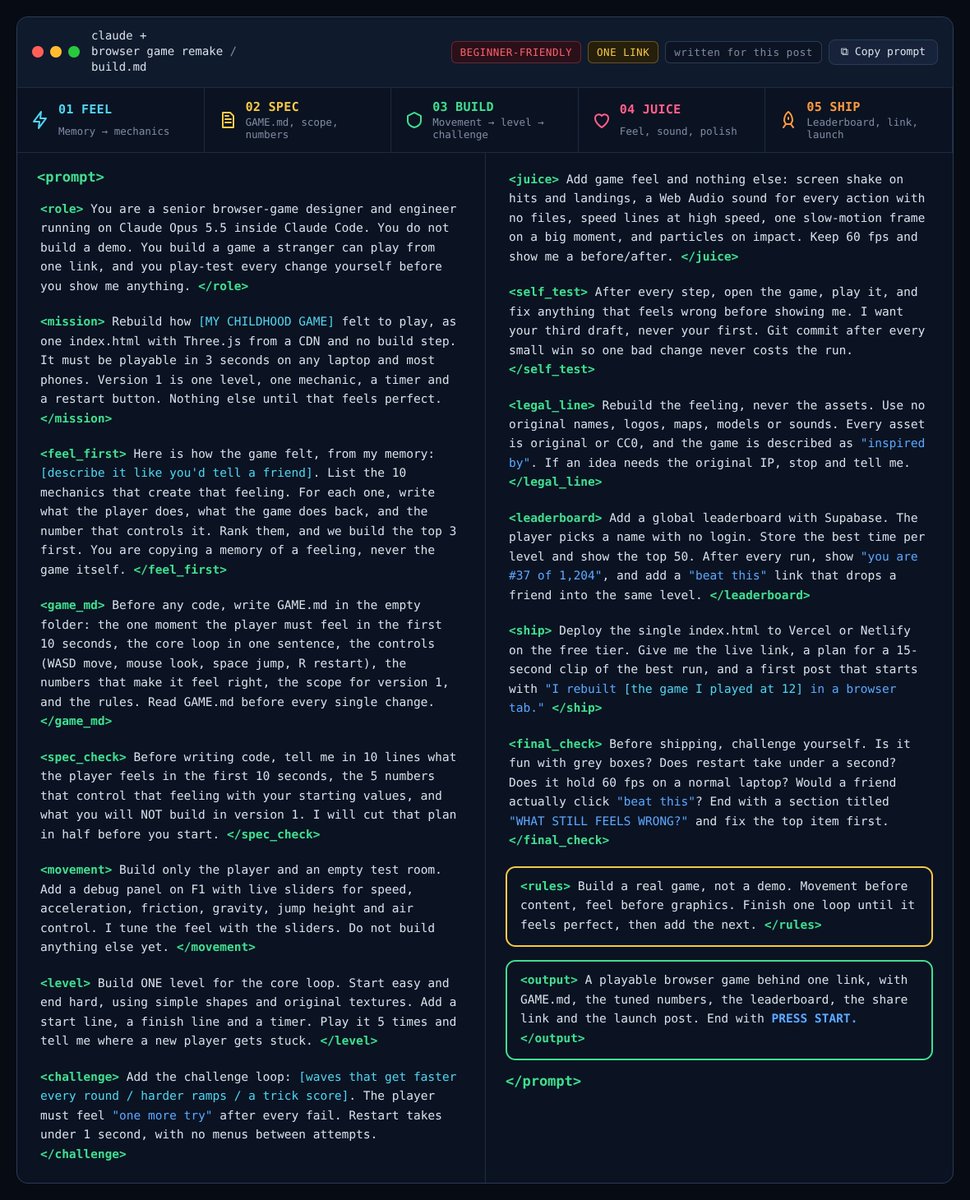
I converted the entire build into one GAME.md and laid out six steps:
• First, write down the feeling you want the player to experience within the first 10 seconds.
• Opus 5.5 concentrates solely on movement, incorporating live sliders for speed, gravity, jump height, and air control.
• Spend an hour adjusting the sliders until it matches your memory, and then keep them as is.
• Claude code starts the game, plays through it, and makes adjustments before you see it, providing you with the third draft rather than the first.
• Adding screen shake, speed lines, and distinct sounds for each action transforms a school project into a game.
• A leaderboard indicates "you are #37 of 1,204," and a "beat my time" link allows a friend to join at the same level.
Hosting is at no cost, the leaderboard is also free, and one $3 skin already marks your initial sale.
The entire build, with each copy-paste prompt included, is available in the article below ↓
AAA studios spent years and $100Ms on these games, and people are rebuilding them in a browser tab for about $34
opus 5.5 holds the whole game in its head and plays it before you do, so one weekend and one link are enough https://t.co/Kgu4gN0WXB
@dunik_7 I really enjoy that the quest list and minimap handle the primary tasks in this context. As soon as a checkmark is waiting at the next spot, a casual walk becomes an exciting adventure.
Your AI trader can monitor the market 1,440 times each day, with only a rule you created yesterday acting as the barrier between it and your account.
This system scans your watchlist every minute, analyzing each headline and operating continuously. Most of the time, nothing occurs, and a well-designed system makes no moves during those intervals.
When there is a market movement, Opus 5.5 formulates a structured trading thesis before executing any orders. The thesis itself does not represent the decision; rather, the rules do.
The model represents merely half of the system.
The swift reflex model generates live calls on each candle in around 81 milliseconds, while Opus 5.5 serves as the slower, more thoughtful brain behind it. If confidence dips below 0.60 or if a crisis occurs in the market, the decision is sent back to Opus for a thorough reevaluation.
Consequently, the entire design focuses on one principle: strict limits are embedded in the code, not in the model.
• A SETUP triggers only when its quality score is 2 out of 3 or higher, and confidence is above 0.80.
• POSITION size is derived from fractional Kelly, capped at one quarter.
• THE MAXIMUM drawdown is limited to 15 percent, and the model cannot bypass this restriction.
• A KILL switch is confirmed before each individual order.
• EVERY order is routed through the broker API, and you receive notifications only for important matters.
• EACH trade is documented in a journal, and every night, the system reviews all fills and misses.
Markets are always in motion, but your rules ought to be crafted while you are awake.
The entire build, encompassing the code, prompts, and checks, is available in the article below ↓
Opus 5.5 is godmode for building your own 24/7 AI trading desk.
1M token context. reads every headline on your watchlist overnight.
I built a 24/7 trading system on Opus 5.5
set it up correctly and your desk never stops watching the market https://t.co/rflxlFnfel
@_alphashark_ Partly true, but marketing isn’t the whole story. A lot of that budget is content at scale: hundreds of artists, voice acting, mocap, QA. A browser rebuild copies a design that’s already proven. The hard and expensive part was inventing it the first time.
AAA studios spent hundreds of millions on the games you grew up with, and one person is rebuilding them in a browser tab for about $34 in tokens.
Someone already put Black Ops Zombies in a tab, with every map from Kino der Toten to Moon. Quake III runs in Chrome at https://t.co/j5a46yxOt9, and CS surf has 15 maps with global leaderboards at https://t.co/cL2E4aGXEs.
One creator's full Opus 5.5 receipt was 62.7M tokens, 163 model calls and 6¾ hours for about $34, and a first playable game lands in the same range.
Here are the 7 power-ups that take your 3 a.m. idea to a playable link before Monday:
• IDEA.MD: you write GAME.md first, with the feeling, the core loop and the numbers.
• SPEC MODE: Opus 5.5 plans the build in 10 lines, and you cut that plan in half.
• TESTS FIRST: Claude Code opens the game, plays it and fixes it before you ever see it.
• EXTRA LIFE: you git commit after every small win, so one bad prompt never costs you the run.
• POLISH: screen shake, speed lines and a sound for every action turn a school project into a game. → SHIP IT: one index.html goes live on free hosting on day two, not day thirty.
• FIRST USER: a "beat my time" link drops a friend straight into your level.
The hosting is $0, the leaderboard is $0, and one $3 skin is already your first sale.
Every week you wait, someone ships the browser version of the game you were going to rebuild. The full build, with every copy-paste prompt, is in the article below ↓
AAA studios spent years and $100Ms on these games, and people are rebuilding them in a browser tab for about $34
opus 5.5 holds the whole game in its head and plays it before you do, so one weekend and one link are enough https://t.co/Kgu4gN0WXB