To mark the publication of Sunak at 10 I've written a piece which takes you inside the process of writing contemporary political history, its challenges and its joys.
Have a read on the link below⬇️
+ a revelatory extract which most of the media have missed👀
🚨NEW: Sunak at 10's first serialization - several revelations in the extract:
- Farage's decision to comeback early
- The leaking of his comeback to No.10 influencing Sunak's early election call
- Harborne's influence and tensions within Reform
- Sunak's abandoned ECHR policy
One of the assumptions underpinning England's devolution agenda is that there is broad political support for transferring power out of Westminster.
Dylan Cridland and I explore the politics of devolution in @Prospect_UK:
https://t.co/1eIi2PeA2l
Andy Burnham could soon discover that not all MPs are as keen on devolving power as he is, write @cridland_dylan and @JackTShaw
https://t.co/SQ1X1WQlan
hello there the jacobian conjecture is false thanx to my close friend akhil for asking about it and my other close friend fable for working during the world cup final
((1+xy)^3 z + y^2 (1+xy) (4+3xy), y + 3 x (1+xy)^2 z + 3 x y^2 (4+3xy), 2 x - 3 x^2 y - x^3 z): \C^3\to \C^3, has jacobian determinant -2, and sends (0, 0, -1/4), (1, -3/2, 13/2), and (-1, 3/2, 13/2) to (-1/4, 0, 0)
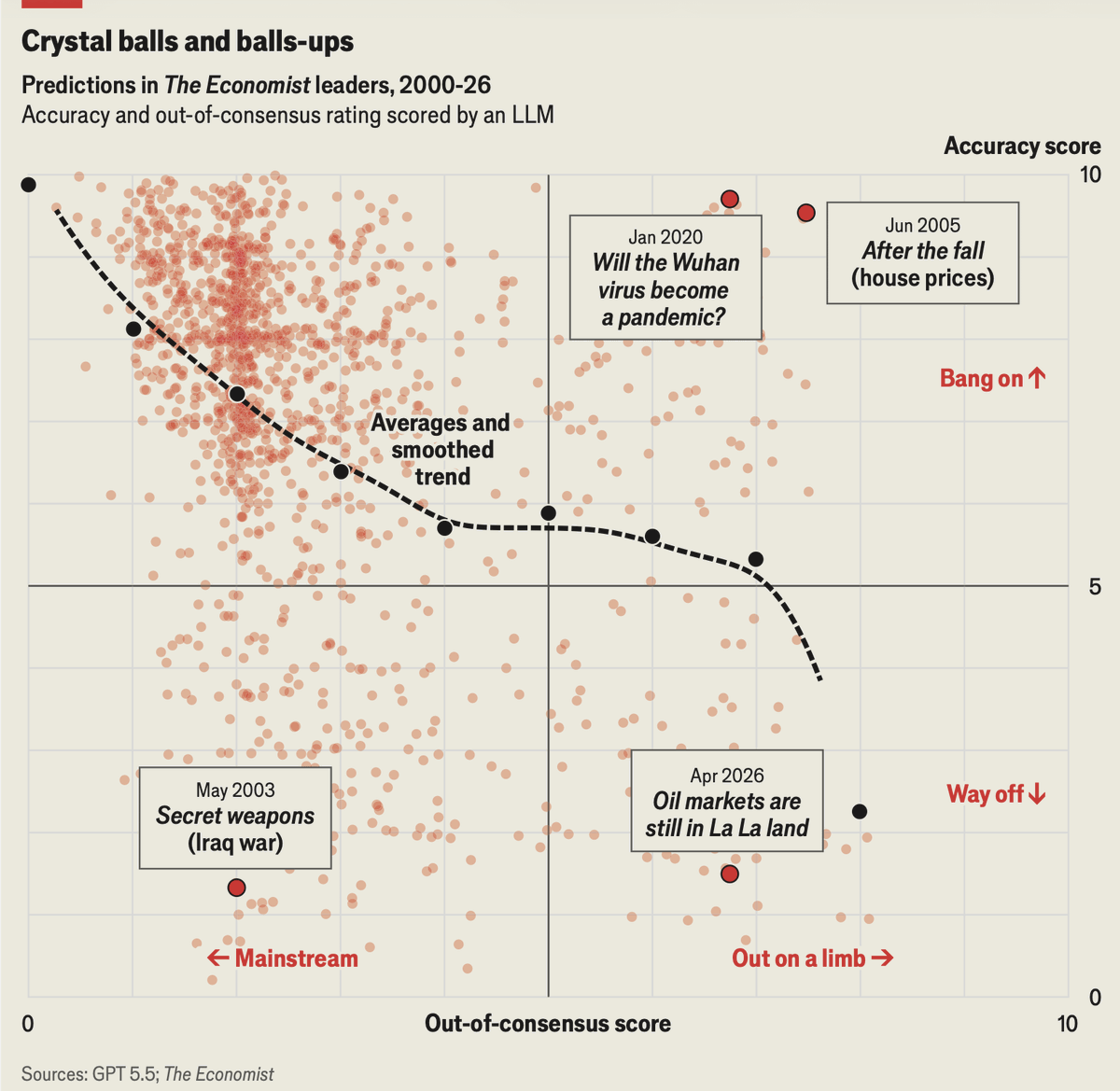
IS THE ECONOMIST ALWAYS WRONG?
Scandalously, in some circles @TheEconomist has a reputation as a contrarian indicator. This week we fessed up to getting a big call on oil prices from April wrong.
Obviously our goal is not perfectly-hedged (and perfectly boring) predictive accuracy: often it is to stimulate, provoke, and challenge. But I did want to test that wider allegation, so I ran a series of LLM scorers across our full leader database since 2000 (7,000 leaders in all.)
You can see the results in the chart below: each dot is one of the 1,400 leaders where we identified concrete and falsifiable predictions that were central to the argument. Higher = more accurate, further to the right = more contrarian.
We do well, unsurprisingly, when aligned with conventional wisdom. We often do worse when truly out on a limb. But actually, on average, we are a bit likelier to be right than wrong on our somewhat-out-of-consensus calls. All round, a respectable performance.
And as @ecurrnomics points out an accompanying leader, there is no shame at all in being beaten by the market: as good free-marketers we believe deeply in the aggregated wisdom of prices.
Take a look at my piece here, which includes a canter through our best and worst calls of the last quarter-century: https://t.co/WyKqangFrE
Only 14% of the public believe Keir Starmer was born into a working-class family.
In fact, our latest research suggests that voters often assume politicians come from more privileged backgrounds than they really do.
For politicians seeking to use their origins as proof of their connection to ordinary voters, the challenge is not just telling that story - it's persuading people to believe it.
Read our Director of Research, Christabel Cooper's, analysis in our latest substack: https://t.co/CjMBL4oV66
Tony Blair is right that technology can save social democracy, but he's light on how to spread the benefits. His critics are more focused on the distributional politics than the plan to pay for it.
Our new paper on Labour's political economy tries to bridge the divide.
1/n
New analysis by @JackTShaw and @cridland_dylan shows that, for the first time since 1973, more than half of Britain's councils are being run by minority administrations.
Is local government becoming unworkable? 👇
https://t.co/XP6M6JtP2C
Today marks the launch of ThinkLabour! 🌹We are a unique political organisation dedicated to helping Labour govern confidently, win elections, and deliver lasting change. Here is what we are building 👇
Reclaiming the Future – the founding essay of @ArguablyMag.
To defy the twin foes of populism and fatalism, progressives must put ideas back at the centre of their politics and draw on the greatest thinkers from their past: Keynes, Crosland and Rawls. https://t.co/6odREjri92
Smart idea here for turning Nimbys into Yimbys: “street votes” that allow communities to design and then agree on new development rules.
Based on models in South Korea, Tel Aviv and Houston, this could deliver an extra 30,000 homes a year – govt should take it up now.
Another thing captured here. There’s the woke stuff (white liberals are culturally to the left of ethnic minorities which is obvious). But also the point about “feeling valued” and “social mobility” is an under-appreciated aspect.
This is correct. Extraordinary that we have this game changing moment unfolding in front of us and most elite discourse is still fake news about AI water usage or three-year-old angst about hallucinations.
This is one of the most important dials that affects our success as a country. Productivity. But what does it really mean, and what are we doing about it?
Let me explain 👇🏻