Evidence that multi-agent LLMs develop emergent coordination and specialized roles—especially with personas and "think about others" prompts. No free lunch tho: strong performance needs both alignment and complementarity https://t.co/YM8McXGhaY
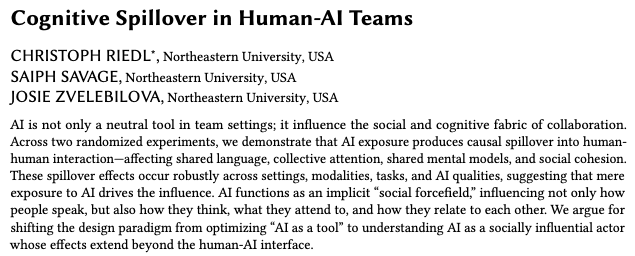
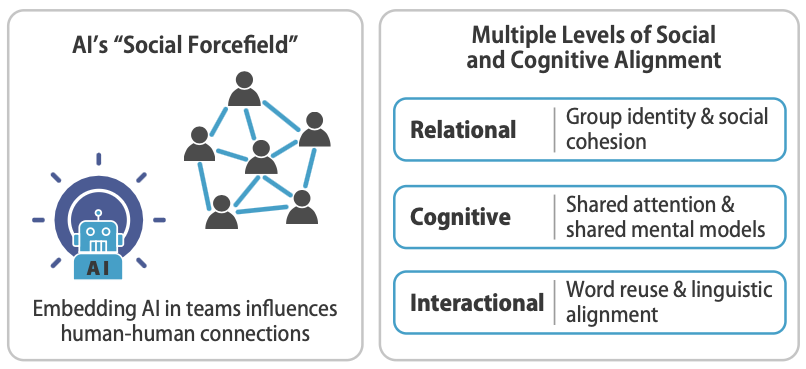
Think AI only affects the person using it? Our experiments show AI reshapes shared language, collective attention, mental models, AND social cohesion among human teammates. AI reshapes the cognitive ecology of teamwork
The complex contagion story, updated:
✅ Social reinforcement is real [1]
❌ You don't need hypergraphs to model it [1,2]
❌ You don't need simultaneous group interaction [1,2,3]
❌ It doesn't mean clustered networks win [3]
At #ICLR2026 Sci4DL (101B 10:00AM) I will be talking about @kevinlu4588's new work cracking open protein folding models to decode their internals.
https://t.co/nNE9IjT1lh
Our lab is looking to fill a post-doc position to do research on collective intelligence in AI and human-AI systems. More details here https://t.co/BmFzg8XqKS
Evidence that multi-agent LLMs develop emergent coordination and specialized roles—especially when instructed to "think about others" (ie ToM). No free lunch tho: strong performance needs both alignment and complementarity #ICLR
We find multi-agent systems have capacity for emergence - they are real "teams" that are more than the sum of their parts. And we can steer them with clever prompts. The ToM condition in particular leads to stable specialization and goal-directed complementarity across agents
2026 is a whirlwind year for AI.
Underlying it all: the greatest scientific mystery of our age. How does a neural network think?
I talked w @oliver_whang22 in NYTimes Magazine, on how AI interpretability is a tangle of structure waiting to be unraveled:
https://t.co/lYwxDFH1oH
Think AI only affects the person using it? Our experiments show AI reshapes shared language, collective attention, mental models, AND social cohesion among human teammates. AI reshapes the cognitive ecology of teamwork https://t.co/oXDg3Ug2NH @acmtochi