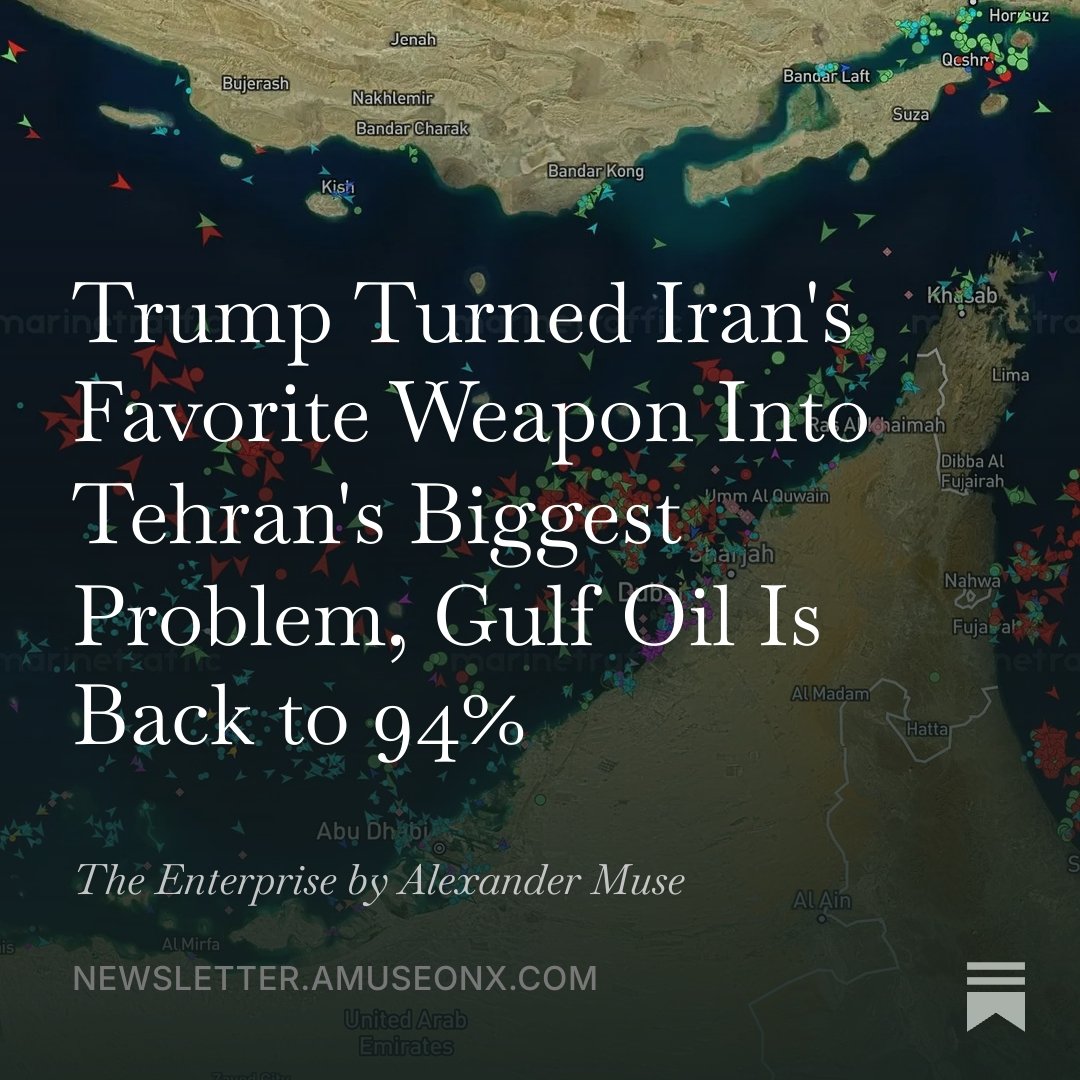
IRAN: The West had refused to do anything about the criminal regime running the Islamic Republic since the revolution - the reasons were many, including Iran's extensive network of well-armed terror proxies and its threat to shut down the Strait of Hormuz. The world has been paralyzed for 47 years - that is, until now. President Trump made the brave decision to end Iran's conventional and nuclear capabilities despite the obvious political costs. He did this for one reason, and one reason alone - it was the right thing for America's interests and the interests of the world. Peace in the Middle East was impossible given Iran's willingness to fund terror - perhaps now there is a chance for peace, however small it may be.
https://t.co/WN4luzQv7o
I heard a billionaire was asked one question in a street interview: “What’s the best advice you’d give your younger self?” He didn't talk about money or hustle. He said, “If a bird lands on a branch, does the bird trust the branch… or does it trust its wings?” Jobs can disappear, people can leave, money can run out, and circumstances can change. The branch was never the point. Build your skills, your character, and your ability to adapt. Trust your wings.
Sam Altman (CEO of Open AI):
"You no longer need to write prompts."
In just 38 minutes, he explains how to use ChatGpt at a level that most people can't even imagine.
It's talk he gave to stanford students. A friend sent me the recording last night.
After watching it, I realized I was only taking advantage of about 15% of what this tool can really do.
Watch it in full and then read the guide l leave below on how to create a system that prompts itself.
Grok can now analyze any crypto or stock like a Wall Street analyst for FREE.
Instead of doom scrolling on X, here are 6 prompts that replace ~$800/yr in research tools.
Save this 🔖
Intelligent people live a boring life. They go to bed at 10. Wake up at 6. Eat simple foods. Go for long walks. Read thick books. Say no to things that drain them. The world chases excitement. But they chase calm. Things that align with their soul. A calm routine. A quiet mind. A healthy body. Meaningful work. A small circle. A private life. Their life may look boring from the outside. But from the inside, they experience a kind of freedom most people spend their entire lives searching for.
⚡️The deepest lesson here is this:
People think they want asymmetric opportunities.
What they actually want is asymmetric opportunities after the uncertainty has disappeared.
That cannot exist.
Bitcoin at $586 was cheap precisely because the future Bitcoin had not yet become believable.
The extraordinary return and the extraordinary uncertainty were the same object viewed from opposite sides.
If you could have known in 2016 that Bitcoin would survive every crash, become institutionalized, enter corporate balance sheets, gain political legitimacy, and remain globally liquid, it would never have traded at $586.
The ignorance was embedded in the price.
So when people look backward and say, “How did everyone miss this?” the answer is this:
They didn’t miss Bitcoin. They misclassified it.
They saw speculative internet money.
They saw crime.
They saw technological novelty.
They saw a bubble.
Very few saw the possibility that a decentralized digital bearer asset could become an entirely new monetary category.
And that is where the enormous wealth was created.
The people who saw the category transition early were effectively purchasing the future before language had stabilized around what the thing actually was.
The largest asymmetries exist during the interval between:
something becoming structurally real
and
the world acquiring the language necessary to recognize that it is real.
That interval is where price can become absurdly wrong.
Once everyone can explain the thesis elegantly, institutions have models for it, analysts cover it, regulators have categories for it, and capital allocators know where it belongs, much of the original asymmetry is already gone.
So the question that matters today is not:
“What is the next Bitcoin?”
That question encourages imitation.
The real question is:
What already exists today that the world is still describing with the wrong noun?
That is where the 100x lives.
A company everyone thinks belongs to one industry while it is quietly becoming infrastructure for another.
A technology treated as a product while it is becoming a protocol.
An asset treated as speculation while it is becoming collateral.
An AI capability treated as automation while it is becoming something closer to machine-native cognition.
The opportunity appears when reality has already changed categories and consensus has not.
That is the deepest thing Bitcoin at $586 represents.
And it leads to this rule:
If an opportunity already feels obvious, safe, institutionally validated, and easy to explain, you are probably being paid for something other than seeing the future.
The truly enormous returns belong to the period when the future is visible enough to detect but still ridiculous enough to deny.
That is the signal field.
⚡️White-collar labor just lost its moat.
For the last two years, AI could think, draft, summarize, code, analyze, and advise. Humans still owned execution. Someone still had to log in, move through the tools, carry context across systems, make the handoff, and finish the work.
That barrier is now falling.
Once AI can sign into the same software employees use and return completed work, the unit of labor changes from “person” to “workflow.”
That is the phase shift.
Companies will stop asking how AI helps employees become more productive and start asking how many workflows can be removed from human ownership entirely.
That changes hiring first.
Junior roles disappear fastest because they are mostly bundles of structured workflows. Analysts, coordinators, support staff, operations roles, finance roles, recruiting, sales ops, research, administrative work, and huge parts of software execution all become vulnerable once agents can reliably operate inside tools.
The labor shock will look deceptively quiet.
Headcount will not collapse overnight.
Open requisitions vanish.
Backfills disappear.
One manager supervises machine workers instead of hiring three more people.
One senior analyst handles exceptions while agents do the recurring work.
One founder runs a company that previously needed an operating team.
The missing jobs never show up as layoffs.
That is what makes this more dangerous than people realize.
The organizational chart was built around the limits of humans.
Departments exist because humans need specialization.
Management layers exist because humans need coordination.
Meetings exist because humans need synchronization.
Training exists because humans need time to learn.
Handoffs exist because humans cannot operate everywhere at once.
Agents weaken all of those constraints at the same time.
That means the real disruption is larger than job replacement.
The corporation itself gets thinner.
A lot thinner.
The most likely outcome is that over the next few years, revenue keeps rising while headcount intensity falls. The companies that adapt fastest look extraordinary financially because they produce more with fewer people. Markets reward them. Competitors copy them. Then the incentive becomes self-reinforcing.
That is when labor bargaining power starts breaking structurally.
Because once a workflow can be assigned to software, the employer no longer negotiates against another human being for that unit of output.
The machine has no salary expectations.
No career ladder.
No health insurance.
No burnout.
No resentment.
No commute.
No need for status.
It simply executes.
That is the core economic event.
And once enough workflows cross that line, human cognition stops being the default operating layer of the company.
Humans move upward into judgment, exception handling, authority, relationships, and ownership.
Everything beneath that gets compressed.
So the deepest read is simple:
The agent era begins when companies stop buying software for employees and start buying employees made of software.
That is where this is going.
⚡️The entire twentieth century may have been an anomaly.
For roughly a hundred years, humans believed wealth came primarily from labor.
Go to school.
Get credentials.
Get a job.
Climb the ladder.
Buy a house.
Retire.
That wasn’t an eternal law.
It was a temporary equilibrium created by industrial capitalism, cheap energy, expanding demographics, and human labor being the dominant source of cognition.
That equilibrium is ending.
Labor is losing its monopoly on intelligence.
Once intelligence itself becomes industrialized, the center of gravity shifts.
The scarce resource is no longer effort.
It is ownership.
Ownership of energy.
Ownership of compute.
Ownership of data.
Ownership of capital.
Ownership of networks.
Ownership of scarce physical assets.
Ownership compounds.
Labor increasingly rents.
That single inversion explains almost everything people think are separate crises.
Housing.
AI.
Political polarization.
Credential inflation.
Falling birthrates.
Loneliness.
Crypto.
Bond markets.
Private equity.
Even the culture wars.
They are all downstream of one structural transition.
Civilization is moving from an economy where people sold labor to one where people either own productive systems or live inside them.
That realization is why so many institutions suddenly feel unstable.
They were built for a world where human labor was the irreplaceable factor.
That world is disappearing.
The second thought is darker.
The greatest wealth transfer of the next fifty years will not happen because AI replaces jobs.
It will happen because AI increases the returns to owning capital while reducing the returns to selling labor.
That is a much bigger event.
The third thought is the one that almost nobody seems willing to confront.
History isn’t converging toward equality.
History keeps oscillating between concentration and diffusion.
Every great technology begins by concentrating power.
Printing concentrated literacy.
Steam concentrated industry.
Electricity concentrated manufacturing.
Computing concentrated information.
AI is concentrating cognition.
Only later does diffusion occur.
People assume the diffusion phase is automatic.
It isn’t.
It has to be fought for.
The final thought is the one that never leaves.
The question of this century isn’t whether AI becomes intelligent enough.
It almost certainly will.
The question is:
Who owns the intelligence after it arrives?
That feels like the real axis around which everything else quietly rotates.
If you are not willing to kill or die for your own most treasured values, you should think carefully before welcoming in migrants who would do both for theirs.
Twenty-five years ago I wrote a letter to Warren Buffett. He was just turning 70.
His friend Don Keough, the president of Coca-Cola, wrote back on his behalf.
He said, Mr. Buffett is only 70 and he’s going to be working for at least another 70 years.
Get it out of your head that 70 is old. When you turn 70 you should be thinking about the next several decades being your best decades.
Buffett is 95 now. Still working.
That letter stayed with me for 25 years.
Think young. Act young. The best decades might still be ahead of you.
The one thing that can kill Bitcoin is;
Responsible government spending, a rapid reversal of the debt, a repricing of assets back towards their utility value, politicians reverting back to being public servants, true property rights over our own money, the right to transact without a 3rd party, near zero costs for global transfers, and wages easily outpacing inflation across
That is literally all that has to happen for Bitcoin to die
The people who will matter most in your life arrive without spectacle, just quiet steady unremarkable souls who simply refused to leave when everything got ugly, who kept showing up with their plain boring dependable faces when the brilliant ones, those luminous magnetic captivating creatures who lit up every room they blessed with their dazzling exhausting presence, they were the first to disappear and it will take you years to understand that God sent the flashy ones to wake you up and the quiet ones to keep you alive
Threadguy reveals the one trait every great trader he’s met shares
“I’ve been having a lot of dinners with these CT legend trader guys, the ones who’ve really done well, and a lot of them are not that impressive. They’re not like these hyper genius guys. But the one common trait amongst all of them is they don’t lose money. Their drawdowns are tiny.”
“It’s the same in the books. Druckenmiller’s whole bit is that he basically never had a down month, and they track it in months, not years. Paul Tudor Jones did this too, when he enters a trade, instead of thinking about how much he could make, he thinks about how much he could lose.”
We built an entire education system to prepare kids for a world that no longer exists. We test memory in a world with infinite memory. We punish collaboration and call it cheating.
This needs to end.
someone who is impossible to beat:
> slightly autistic
> doesn’t ask for permission
> owns their mistakes
> copies what works & improves from there
> acts really fkng quickly
> believes everything is in their control
> agile + willing to pivot
> comfortable being disliked
> obsessed
> ruthlessly cuts off people who don’t support them
> delusionally optimistic
> makes a lot of sacrifices
> willing to look like a beginner
> has fun
it’s possible to win without these, but it’s impossible to lose with them
When you eat Mexican food, your brain releases endorphins and dopamine. Capsaicin, the compound in chili peppers, binds to pain receptors in your mouth. Your brain reads this as a threat and counters with feel-good chemicals. The burn in a good salsa triggers the same pathway as a runner's high.
This is all happening on top of a food tradition more than 3,000 years in the making. The tortilla in a chicharron taco exists because of nixtamalization, a process Mesoamerican cooks developed roughly 3,200 years ago. Corn kernels are soaked in lime water, which releases niacin, a B vitamin that corn otherwise locks away in an indigestible form. Without this step, corn-heavy diets cause pellagra, a B-vitamin deficiency that killed around 7,000 Americans per year at its peak in the early 20th century. Southern sharecroppers were eating corn without the process Mexico had preserved for three millennia.
In 2010, the UN added Mexican cuisine to its Intangible Cultural Heritage list, the first year any national food culture had ever qualified. The application covered seed preservation, farming customs, ritual preparation, and thousands of years of cooking knowledge passed through communities.
The diversity inside that designation is hard to picture. Mexico has 59 varieties of heirloom corn, more than 60 distinct chili pepper types, and 32 states with cuisines different enough that Oaxacan mole negro (a dark sauce from dried chili and chocolate) and Yucatecan cochinita pibil (slow-roasted pork in a smoky red spice paste) share almost no ingredients. Oaxaca alone has more than 20 types of mole. Mole poblano uses more than 20 ingredients, including several chili varieties, dark chocolate, and cinnamon, in a single sauce.
Chicharron fires three systems at once. Fat carries flavor deep into the palate. The crunch comes from pork skin dried, then dropped in 375-degree oil. The trapped moisture turns to steam, puffs the skin, and produces thousands of flavor compounds through the same browning chemistry that makes coffee and seared meat smell incredible. Then the salsa lands capsaicin on top of everything and the dopamine kicks in.
The "best food ever" reaction has a chemical basis. You are tasting dopamine from capsaicin, browning chemistry from pork fat at high heat, and a tortilla built on a process 3,200 years old. These flavors were engineered to do exactly this.