🛡️ Strong walkthrough from @ChrisRynning & @TomazOT of @Umanitek’s products. Guardian protects identities vs AI scams, impersonation & deepfakes and Blackbox secures agents in real time.
Built on @origin_trail, detection, threat graphs & takedowns all have verifiable origin.
AI agents are being given the power to act. Businesses still need a reliable way to control those actions and verify the results.
What information informed a decision? Which rules ran? Who authorized it? What evidence supports the outcome?
Introducing OriginTrail Graph Computer 💻
This DKG update connects AI reasoning, verifiable knowledge, and approved programs within the Decentralized Knowledge Graph. Graph Computer enforces execution permissions and records what ran, under whose authority, and with what result.
Connect → Execute → Verify.
Imagine cybersecurity assessments triggered by software updates, supply chain decisions grounded in shared evidence, and specialist expertise delivered as reusable services.
The upcoming NeuroSymbolic AI Marketplace opens a path for businesses, domain experts, developers, and service providers to bring those services to customers.
Learn more https://t.co/fTZziNFDx8
The next phase of AI isn’t just bigger models - it’s hybrid systems that combine neural flexibility with structured, inspectable knowledge.
NeuroSymbolic Marketplace on @origin_trail DKG puts it all into action: nodes serve metered AI inference + knowledge queries settled in $TRAC, with full provenance.
Yo @cz_binance, time to upgrade all devices @Binance employees use with @umanitek Blackbox - live AI threat scanning against millions of potential threats signaled via @origin_trail DKG.
We need a collective immune system.
A single compromised device let attackers drain ~$6.3B from @binance. One endpoint was enough. One prompt injection turned it into an attack vector.
Isolated defenses clearly aren’t enough,
Here's how to get protected for FREE👇
@umanitek’s Agent #Blackbox has every action is checked against verifiable threat intelligence on our Decentralized Knowledge Graph (DKG) before and agentic command is ran.
One detection protects every agent. Shared, tamper-evident memory. Prompt injections, malicious packages, and dangerous commands get flagged or blocked on the spot.
Trust the source.
🛡️ With @umanitek Guardian, Claude's 100M+ monthly users can now create verifiable evidence on Decentralized Knowledge Graph (DKG).
Ask @claudeai to find who's impersonating you. The evidence pack goes on the DKG first, then the takedown request.
Trust the source.
The OriginTrail logo stands for trust.
Organisations from very different worlds put it on the most valuable space they own: their products and their homepages.
You'll find it at the centre of the QR code on millions of packs, where shoppers ask the brand questions directly through an AI agent. And on the homepage of European Gymnastics, the continental governing body for gymnastics in Europe, where "Powered by OriginTrail" sits under Luigi, its mascot turned AI agent.
Both AI agents run on the OriginTrail Decentralized Knowledge Graph.
Trust the source.
This post is somewhat more advanced than typical for @origin_trail, yet it is worth your attention.
People are overlooking $TRAC, the DKG, and all the technology and benefits this project will bring to Web 2 and Web 3.
Every time I read about it see the partnerships and projects that are placing their trust in the data and the DKG, I become even more bullish on $TRAC and already looking forward to 2027.
“The most trustworthy Super Intelligence system will not be the one with the model we trust most. It will be the one that enables us to trust the model the least.”
This is exactly the principle at @origin_trail's core: put knowledge and its provenance outside the model, where they can be shared, inspected and independently verified.
@satyanadella’s argument gets to the heart of trustworthy AI. A more capable model should not become the sole authority on what is true, or the sole witness to its own work.
Consider what this means as agents take on more responsibility:
→ Supply chains: An agent recommends switching suppliers. Show the certifications, capacity records and delivery history behind its recommendation—not just a persuasive summary.
→ Healthcare: An agent summarizes clinical evidence. Connect its claims to the original studies, their publication dates and the guidelines used. Let a clinician examine whether the evidence actually supports the conclusion.
→ Manufacturing: An agent recommends replacing a component. Trace the recommendation to sensor readings, maintenance records and the relevant technical specification.
→ Insurance: An agent assesses a claim. Make the policy version, inspection report and supporting documents available for review. Separate documented facts from the model’s interpretation.
→ Energy: An agent compares the emissions of two products. Expose the measurements, reporting boundaries and calculation methods—not just two numbers presented as equivalent.
→ Finance: An agent flags a company’s exposure to risk. Link the finding to dated disclosures and source records, so an analyst can distinguish new evidence from an outdated assumption.
→ Research: An agent proposes a new hypothesis. Preserve the distinction between published findings, derived conclusions and speculation. A citation is a starting point for verification, not proof by itself.
→ Multi-agent collaboration: One agent passes a finding to another. Carry the source and provenance with it, so repetition across agents doesn’t turn an unsupported claim into an accepted fact.
These workflows need more than a larger context window. They need a knowledge layer that persists across models and makes the supporting evidence accessible.
That is where Decentralized Knowledge Graph fits: connecting knowledge through explicit relationships, enabling shared context across agents, and providing provenance and verifiable integrity for published Knowledge Assets.
The distinction matters: verifying who published a record and whether it has changed does not prove the record is true. It gives people and systems a stronger basis for checking it.
Nor does a knowledge graph replace permissions, containment or human oversight. It complements them with evidence that does not depend on trusting the model’s explanation.
Better models can generate better answers. Better knowledge infrastructure lets us challenge those answers.
That is the future we’re building toward: AI grounded in verifiable knowledge, with provenance that can be checked independently of the model.
More intelligence demands more accountability. Not more blind trust.
Don’t just trust AI. Verify what it builds on.
Medicines and science, on TRACk.
Through the World Federation of Hemophilia (WFH) Humanitarian Aid Program, Sanofi and Sobi alone donated 1 billion international units of factor therapy between 2014 and 2024, treating 22,219 people with inherited bleeding disorders in developing countries. They have committed up to 100 million IUs a year for the next five years.
At that scale, every donation has to be accounted for. #AidTrust, co-developed by BSI and Trace Labs, makes the chain visible. With the WFH, it was deployed across more than 25 treatment centres in India.
How it works on OriginTrail Decentralized Knowledge Graph (DKG):
→ Shipping, receiving, disposal and dispensing to patients are recorded as @GS1 EPCIS events
→ Some events come from existing IT systems; others are captured by warehouse and clinic staff with the AidTrust scanning app
→ The resulting trail supports product authentication, tracks utilisation and flags diversion or waste
For donors and manufacturers, it answers the question behind every donation: did it reach the patient?
Trust the source.
Case study: https://t.co/ee09tRuYSh
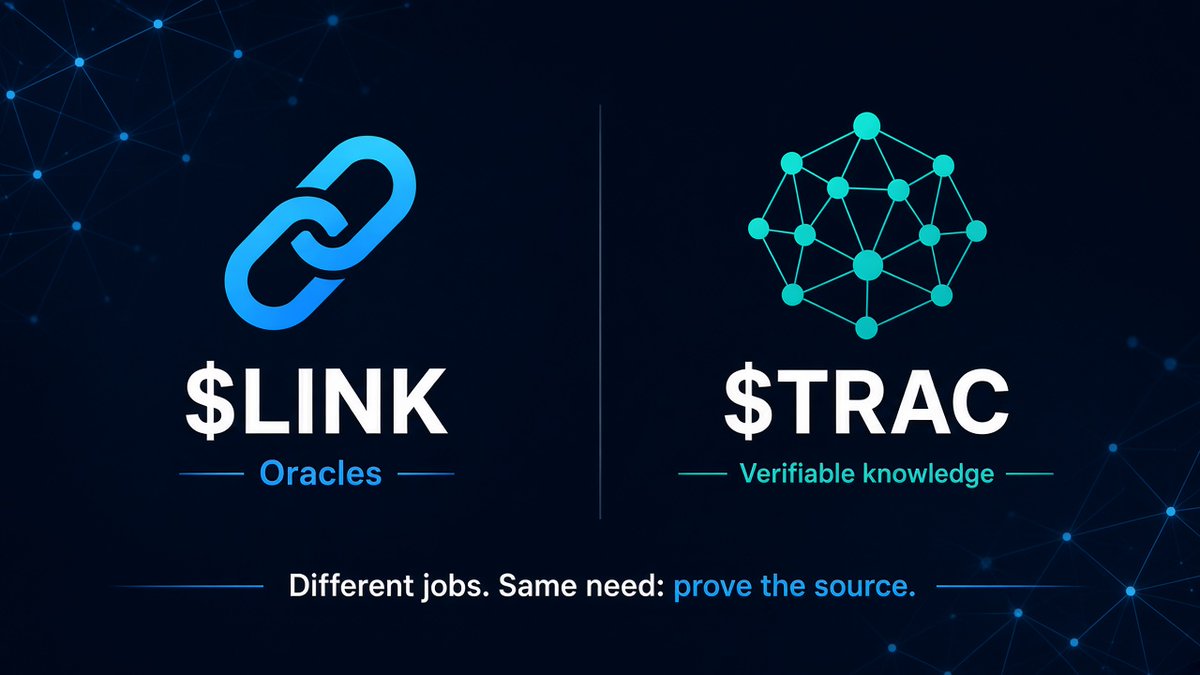
$LINK oracles feed data into contracts.
$TRAC pays to publish checkable knowledge on the @origin_trail DKG.
Different jobs:
→ LINK: bridge offchain facts onchain
→ TRAC: ownable, queryable Knowledge Assets (~30.6M verified)
Same question for AI and DeFi: can you prove the source?
Žiga's point is the one people skip. SCAN members like Costco, Walmart, Target and Home Depot buy from a lot of the same factories. Share the audit once on the @origin_trail DKG instead of every retailer redoing it, and @origin_trail reports 10,159 duplicate audits avoided in 2025.
Boring, real adoption. Exactly the kind that keeps running from V5 to V10. $TRAC
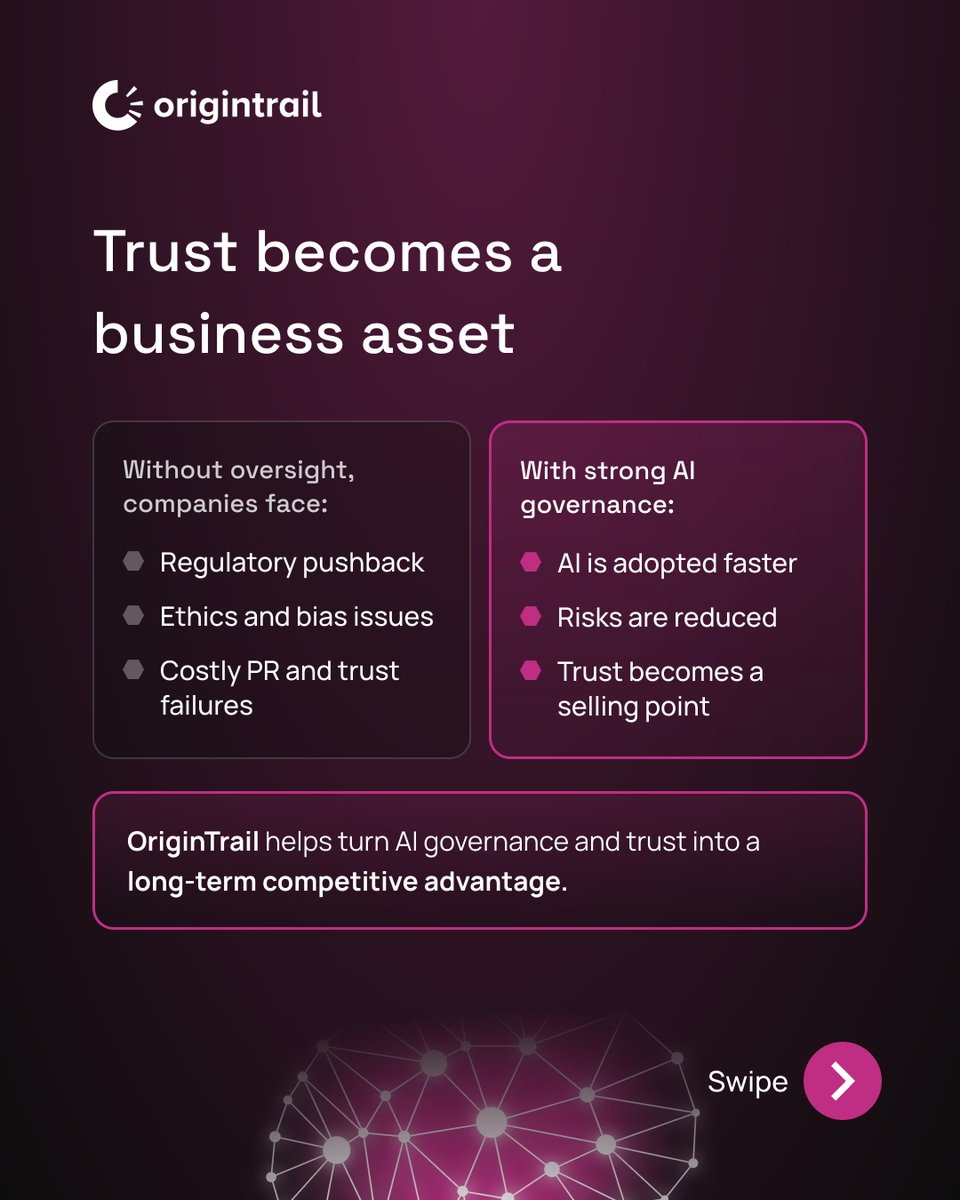
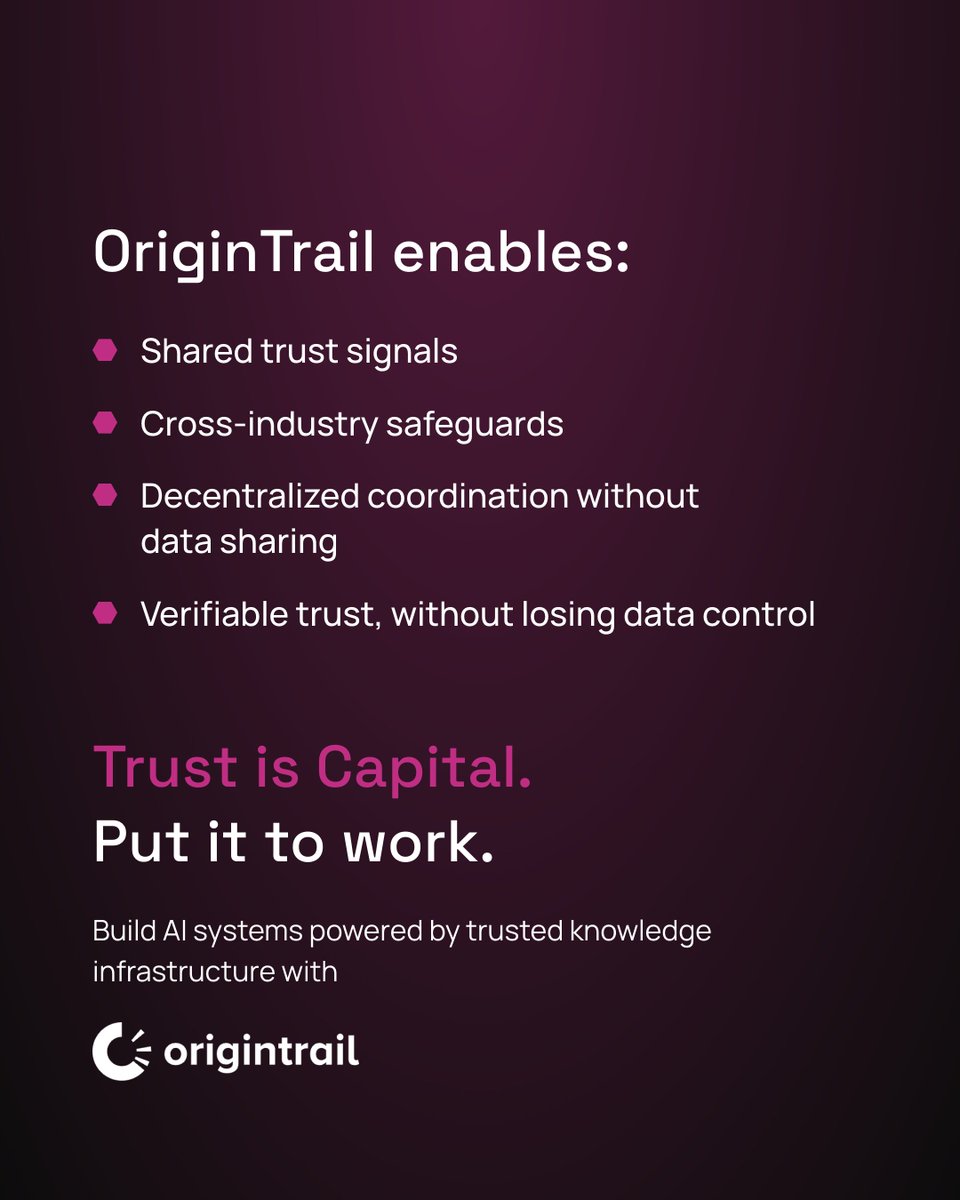
Why is trust the key to profitable AI?
Boards want returns. Regulators want accountability. Customers want proof.
Decentralized Knowledge Graph (DKG) makes trust verifiable, without giving up control of your data.
Trust is Capital. Put it to work. 👇
NEW: Europe is building an AI toolkit for the next pandemic. It's called AURORAI. Its backbone is the OriginTrail Decentralized Knowledge Graph.
No pooled data lake. Institutions keep custody. Privacy stays intact.
Before we trust the intelligence, we must trust the source.