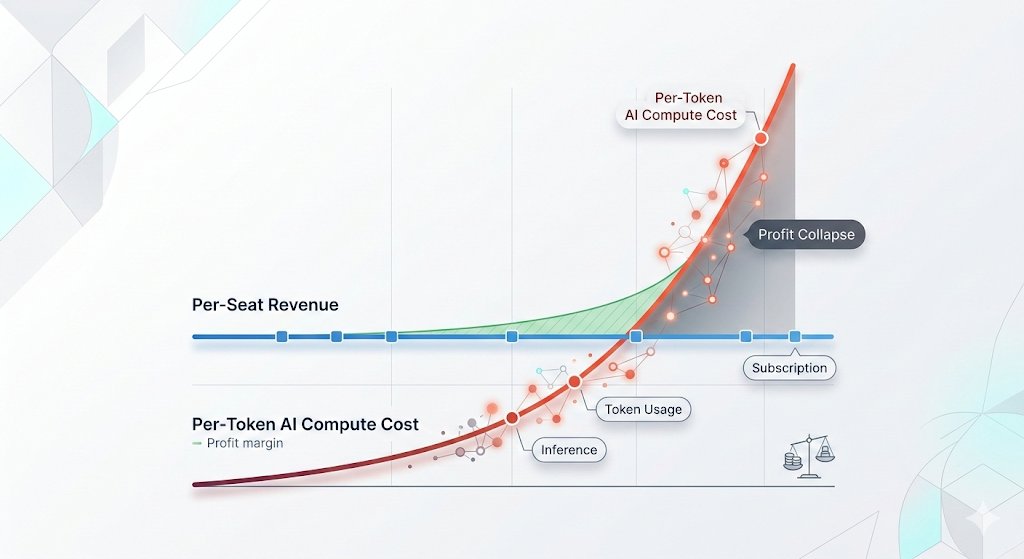
🦔Microsoft canceled its internal Claude Code licenses this week after token-based billing made the cost untenable, even for a company with effectively infinite cloud resources. Uber's CTO sent an internal memo warning the company burned through its entire 2026 AI budget in just four months. American AI software prices have jumped 20% to 37%, and GitHub (owned by Microsoft) is dropping flat-rate plans for usage-based billing across its products.
My Take
The AI subsidy era is ending in real time. The same company that put $13 billion into OpenAI and built the Azure infrastructure powering most of Anthropic's compute just looked at the bill from a competitor's coding tool and decided it was not worth paying. That is not a productivity failure on Anthropic's end. Token-based pricing is forcing every enterprise customer to confront the actual cost of running these models at scale, and the number turns out to be far higher than the flat-rate experiments suggested.
This ties directly to my Gemini Flash post yesterday. Anthropic, OpenAI, and Google all raised effective prices in the last six months. Enterprises that built workflows assuming AI costs would keep falling are now watching annual budgets evaporate in months. Two outcomes look likely from here. Either enterprises scale back AI usage to fit budgets, which slows the revenue ramp the labs need to justify their valuations ahead of IPOs, or the labs cut prices and absorb the losses, which makes the unit economics worse at exactly the wrong moment. Both paths land in the same place, the numbers stop working, and somebody has to take the writedown.
Hedgie🤗
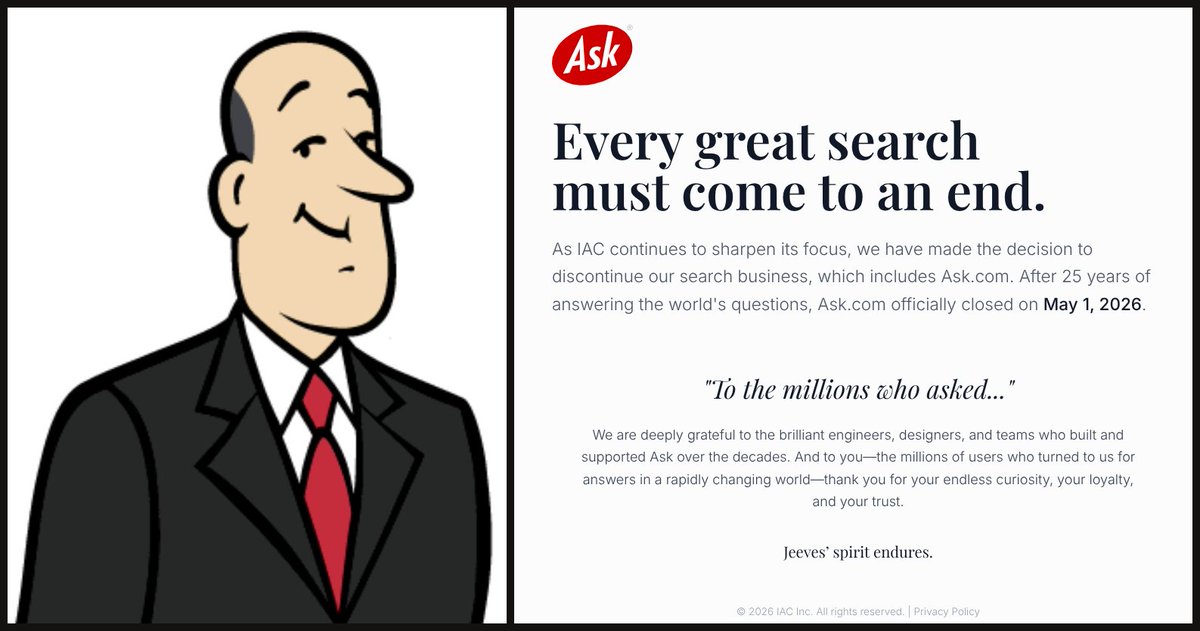
I regret to inform you that Ask Jeeves is dead. The site closed yesterday. Web 1.0 lost another founder.
Ask Jeeves: 3 June 1996 - 1 May 2026. Send no memes.
China just turned 10,000 drones into a single coordinated system 🤯
What looks like a light show is actually something deeper.
10,000 autonomous units moving in perfect coordination.
No collisions. No chaos. Just precision.
One wrong signal could collapse the entire formation.
Instead, they behave like a single system.
I see this as more than a spectacle.
It’s a glimpse into how AI systems are evolving — from isolated tools to coordinated swarms that act together in real time.
The first time you look at it this way, the implications go far beyond entertainment.
So here’s something I’d be curious to hear from you:
Where do you think swarm intelligence like this will have the biggest impact next?
#ArtificialIntelligence #Drones #Robotics #Innovation #FutureOfTech
How is AI impacting people and the planet, and how can we do better? 🌍
In my most recent TED talk, I shed light on how the current way we do AI and explore ways forward in which we can make it more sustainable -https://t.co/JIXRmdeb16
Just published "Zoology to Systems Thinking with Jenny Wilson, Chief Architect at Kingfisher" the latest Architect Tomorrow episode. You can find it on YouTube too. #ArchitectTomorrow https://t.co/PqpikAqwzE
1. "Nobody in their right mind will use autoregressive LLMs a few years from now."
The technology powering ChatGPT and GPT-4? Dead within years.
The problem isn't fixable with more data or compute. It's architectural.
Here's where it gets interesting...
Beyond training AI in vector space we could be building a conceptual world view model / KG connecting entities and properties? Challenges and it might require quite a lot of human input (and debate on the model specifics), but surely this is the grounding required for #AGI?
AI PROMPTING → AI VERIFYING
AI prompting scales, because prompting is just typing.
But AI verifying doesn’t scale, because verifying AI output involves much more than just typing.
Sometimes you can verify by eye, which is why AI is great for frontend, images, and video. But for anything subtle, you need to read the code or text deeply — and that means knowing the topic well enough to correct the AI.
Researchers are well aware of this, which is why there’s so much work on evals and hallucination.
However, the concept of verification as the bottleneck for AI users is under-discussed. Yes, you can try formal verification, or critic models where one AI checks another, or other techniques. But to even be aware of the issue as a first class problem is half the battle.
For users: AI verifying is as important as AI prompting.
I've #justdonated to support Cancer Research, Herts Young Homeless & Harrisons Fund cycling 4,004km, 47,895m in 22 days in Italy in August. How hard can it be ?. Donate on @justgiving and help raise 20000.00 https://t.co/u8JhBmu2W7
Call for speakers for the 7th @bcs#Architecture conference - London & online, 11th October.
Please nominate yourself or get in touch if you'd like to discuss.
"If we're going to develop new DATA CENTERS, they're likely to go in PRIME AGRICULTURAL LAND. They're likely to require a whole lot of WATER & ENERGY SYSTEMS" Katherine Daniell, WEF #AMNC24 Summer Davos