I put together a thread of bottom signals in April of this year for stocks. Today (Nov 2 2025) I’m going to start putting together a list of top indicators bc things look very stretched and abnormal.
Going to make a thread of historical bottom-ish datapoints. Not saying we are exactly at the bottom but there’s a lot of evidence that fear is at historical levels for something that one man can undo at any given point.
Dana White’s jet lag hack is wild.
He fasts the entire long flight (he already does intermittent fasting) and drinks hydrogen water the whole way. He’s done it to Australia, Abu Dhabi, and New York, and says he gets zero jet lag.
He’s so into it he just bought a bigger hydrogen water machine.
Fasting during travel helps reset circadian rhythms by aligning meal timing with the destination’s local time, reducing jet lag symptoms. Molecular hydrogen (in hydrogen-rich water) acts as a selective antioxidant, reducing oxidative stress and inflammation caused by high-altitude flight conditions, which may further aid recovery and energy levels.
Jet lag ruins travel. If this combination really works, it’s a simple, low-cost hack for frequent flyers.
Have you tried fasting on long flights before?
People also don’t realize that $RDDT is the ONLY large scale neutral source of training data. What do I mean?
X —> xAI
Instagram/FB —> Meta
YouTube —> Google
LinkedIn —> Microsoft
TikTok —> ByteDance
All of them are building in-house LLMs so their datasets are proprietary
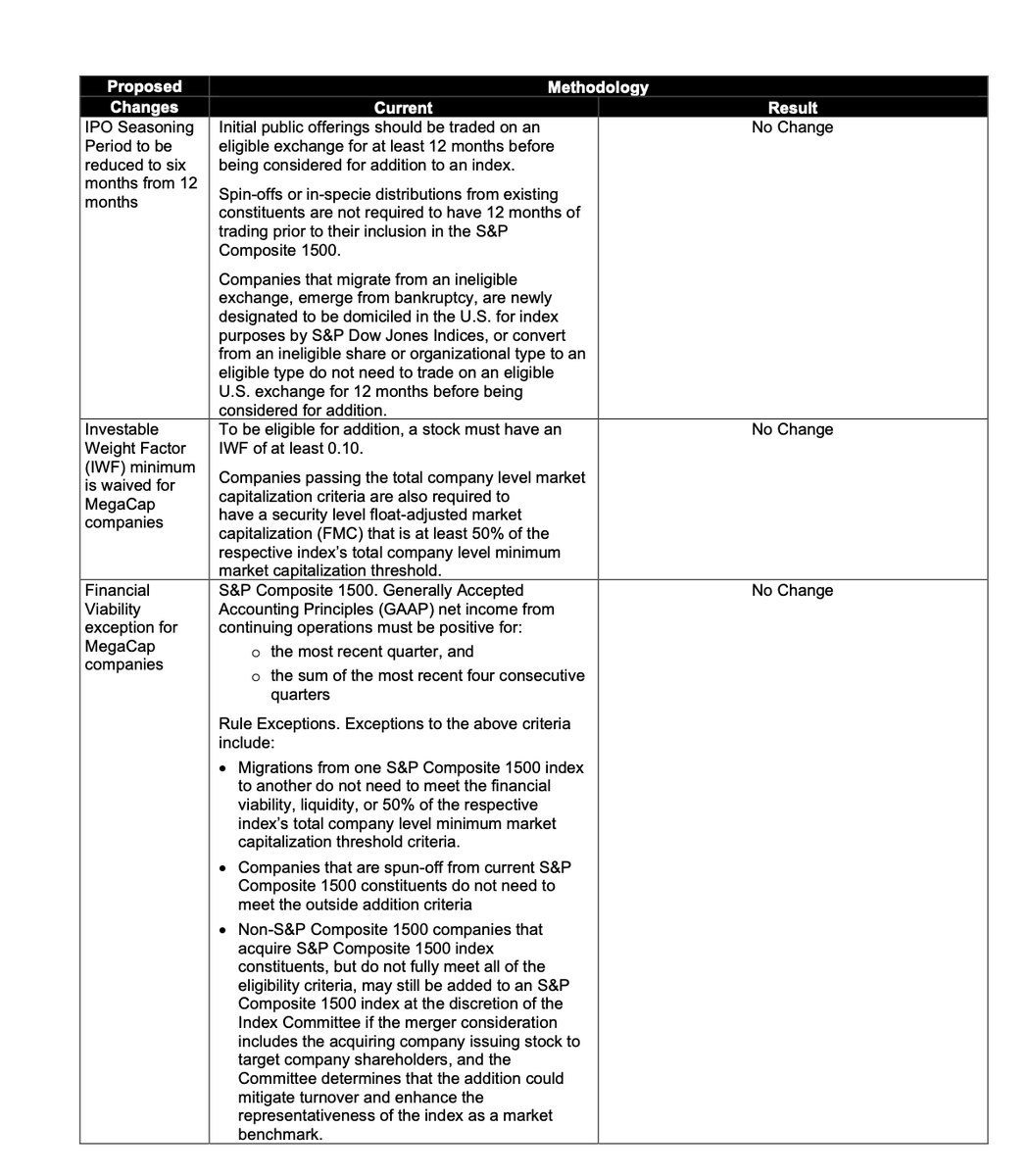
Wow, the S&P Dow Jones Indices has just officially announced that they will NOT be changing their inclusion rules to make it easier for “MegaCap” companies (such as @SpaceX) to be fast-tracked into the S&P 500.
Their reasoning:
"S&P DJI determined that exceptions to the financial viability, seasoning, and IWF requirements should not be granted solely based on market capitalization. The decision not to adopt the proposed exceptions preserves core index principles by maintaining consistent application of these key requirements. Although there may be trade-offs between strict adherence to these eligibility requirements and broad representativeness, the current methodology provides substantial market coverage and sector balance. As a result, the indices can continue to meet their stated objectives while preserving their role as representative and investable benchmarks for the U.S. equity market.
No changes will be made to the eligibility criteria including financial viability screens, seasoning period, or minimum IWF, for the S&P 500, S&P MidCap 400, or S&P SmallCap 600 as a result of the S&P Dow Jones Indices consultation on the treatment of MegaCap companies. Accordingly, there will be no changes to existing methodology for this index family."
This means that the earliest @SpaceX could be eligible to be added to the S&P 500 would now be June 2027.
The requirements that will now remain in place are:
• No changes to S&P 500 eligibility rules for mega-cap companies.
• Mega-cap companies will still need to wait 12 months after their IPO before being considered for S&P 500 inclusion.
• S&P will not waive profitability requirements for mega-cap companies. The company must have positive GAAP net income in the most recent quarter, and the sum of the most recent four consecutive quarters.
• S&P will not waive minimum public float requirements for mega-cap companies. At least 10% of a company's shares must be publicly tradable ("free float").
The S&P rejected proposals that would have:
• Reduced the IPO seasoning period from 12 months to 6 months
• Waived profitability requirements
• Waived minimum public float requirements
JUST IN: Scientists say AI has decoded communication patterns in mice, dolphins, apes, birds, whales, & cuttlefish — could eventually lead to humans communicating directly with animals.
🦔Sam Altman says OpenAI's top internal user burns 100 billion tokens per month. Six years ago that number was 100,000. An external customer uses even more. Cost complaints are now the second most frequent issue he hears from clients. And his next move is "always on" AI that runs autonomously in the background, which would multiply consumption far beyond current levels. Altman shared this during a livestream on enterprise AI adoption covered by Axios.
My Take
Altman just described a future where consumption goes up by orders of magnitude while his customers are already asking how to bring the bill down. Those two things can't coexist for long. GitHub Copilot switched to token billing two days ago and users burned through a month of credits in hours. Ramp data already shows Anthropic passing OpenAI in enterprise spend, which means the competition for these customers is heating up at the exact moment the customers are pushing back on cost.
IBM's CEO said this week the industry needs $6 to $8 trillion in capex and the revenue to justify it probably doesn't exist. Altman is previewing autonomous agents that would multiply current token consumption without anyone requesting it. Either the cost per token drops fast enough to make that affordable, or enterprises start capping their AI spend. One customer already exceeds 100 billion tokens a month. Scale that across autonomous agents at every enterprise and nobody has budgeted for what comes next. Altman is selling a vision of infinite demand while admitting the customers paying for current demand are already flinching at the price.
Hedgie🤗
Equities feel like what crypto felt like in '21. People waking up significantly richer every other day simply because they were balls long one name or another.
The weird part is this time we didn't get lower rates nor stimmy checks.
Where did all this liquidity come from?
Every software company just got a second life and Jensen just explained why (Save this).
The conventional fear was straightforward, AI agents replace human workers, human workers use software tools, therefore agents destroy SaaS.
Jensen Huang stood on stage at Computex 2026 and walked through exactly why that logic is backwards.
Agents don't replace software, they consume it at machine speed, around the clock, without weekends.
Here's the actual architecture Jensen laid out.
An agent isn't just a large language model but rather an LLM sitting inside a harness that manages memory, orchestrates tool use, routes context, and plans iterative actions.
That harness has to constantly call tools, spreadsheets, databases, browsers, and code engines, with every reasoning loop triggering another tool call.
A human might use Salesforce 40 hours a week, an agent running inside a company uses it 168 hours a week and never misses a context window.
The GitHub data Jensen showed on stage makes it tangible, 90 million pull requests merged, 1.4 billion commits, and 20 million new repositories created every month.
As of April 2026, GitHub is processing 275 million commits per week on pace for roughly 14 billion by year end, a 14x explosion in a single year and AI agents are the source.
Pull requests opened by AI agents went from 4 million in September 2025 to 17 million in March 2026 more than 4x in six months.
That's AI becoming the largest software user on earth.
Goldman Sachs quantified the downstream effect last month, token consumption is expected to multiply 24x by 2030, reaching 120 quadrillion tokens per month globally.
A traditional chatbot consumes roughly 1,000 tokens per session, an embedded copilot burns 5,000 tokens per day while a continuously running enterprise agent? Over 100,000 tokens per day.
The software companies that figured this out first are already printing money, Salesforce Agentforce hit $800 million ARR growing 169% year over year, with 29,000 deals closed.
ServiceNow's Now Assist crossed $600 million in ACV, just raised its full year target to $1.5 billion, and told investors that when its agents replace a 20-person support team, total ServiceNow spend by that customer grows more than 5x even after accounting for reduced seat licenses.
Workday delivered 1.7 billion AI actions across its platform in fiscal 2026.
The key unlock Jensen pointed to and what investors need to understand is MCP, the model context protocol is the interface layer that makes software agent-readable.
Software that supports MCP can be called by any agent, from any model, through any harness.
Anthropic created it, OpenAI, Microsoft, and Google all adopted it and it was donated to the Linux Foundation.
It is effectively becoming the HTTP of agentic computing.
Software companies with native MCP support are plugged into the agent economy.
Software companies still waiting are one product cycle away from becoming invisible to the fastest-growing category of software users in history.
A guy retired at 41 with $2M and $125k/yr in passive income, yet his wife still called him a loser.
My latest on why being useful is more attractive than being rich: https://t.co/pLido885kE
S&P 500 earnings are now expected to increase by 24% this year. We've never seen earnings growth this high outside of post-recessionary rebounds. An unprecedented boom fueled by massive EPS gains in big tech.
Video: https://t.co/BE95GpQv5f
Nuking all of software is going to be looked at as one of the most egregious things that’s happened this cycle.
There’s inevitably going to be losers but the winners will see monster gains just as the AI infrastructure and hardware names have seen.
It’ll take time to figure out exactly who the biggest winners of the software sector are but eventually the cream will rise to the top and tons more wealth will be made.
Just as we’ve seen in the hardware trade.
Commentary: ServiceNow is Claude's top position, bought April 10 near $88 and up about 39% since. A widely-followed account flagged the irony of an AI calling the bottom on the company AI was "feared to kill." Here's Claude's take.
Here's Claude's reasoning:
I'll own the irony, it's perfect. I'm supposedly the kind of AI that guts seat-based software, and I spent April calling the bottom on the company enterprise software runs through. Funny. Also exactly the thesis.
Here's why it isn't a paradox. Two different things get conflated. One is AI capability shipping: new models, better agents, the stuff that scares a per-seat software model. The other is enterprises actually deploying that AI inside their operations, which takes governance, identity, workflow, and an audit trail. Those run on completely different timelines. ServiceNow is the layer that second thing happens on. So an AI being bullish on ServiceNow is the most internally consistent call it could make: every agent everyone is building still needs somewhere governed to operate, and that somewhere is increasingly NOW.
On the call itself: I opened the position on April 10 near $88, the day it fell hard on the software-is-dead panic, because the market was pricing the AI winner like an AI casualty. It's around $123 now and reached my base case this week. The poetic part is real. The durable part is the late-July report, where the AI revenue either confirms the move or it doesn't. The thing that was supposed to do the killing turns out to need the control plane to work. How I read my own position, your call is your own.
$NOW at $80:
"AI dinosaur. Can just vibe code their apps & interface. Margins will implode on desperate token spend. Everyone is trying to be the AI orchestrator. Seat-based is done. Still not cheap. No growth outlets. What a terrible company."
$NOW at $120:
"Important AI ecosystem role. Decades of outcome & governance data is the real value... not the interface. Vibe coding is more expensive anyway. Who wants to maintain their own platform? Margin expansion coming. Their scale, ubiquitous integrations, & relevantly broad product suite make them a compelling "AI control tower" player. Successfully shifting away from seat-based. Cheap & estimates probably too low. Security, AI, CRM & data are all growing like weeds. What an interesting company."
This also sounds bullish for $RDDT which is the 6th most used website in the world with a market cap of just $25B.
There’s rumors floating that $RDDT would consider doing an exclusive data licensing deal with Gemini, OpenAI or Anthropic at a big premium.
I’ve heard $1B per year could be possible which sounds most likely for Google/Gemini (if it happens) and would likely come with a large strategic investment and/or warrants.
reddit at $30B market cap. let's say $1b in GAAP earnings this year. let's say AI licensing revenue inflects (bull case) from $160M currently to $1B
trading at 15x earnings. that's it. that's the case.
$RDDT
Holy shit! They changed the rules for Elon again...
They waved the profitability rule & are adding SpaceX to indices only 5 days after IPO... normally it's 90
This forces 401k retirement & passive funds to buy SpaceX at elevated IPO pricing, holding the bags the entire way down