I don’t think many understand how big the opportunity in front of @openservai is.
Every company is going to operate with teams of AI agents. Those agents will need to reason, coordinate and execute millions of tasks across critical parts of every business.
Today we made the SERV Reasoning API public.
This is the point where we begin to open up everything we have been working towards.
I have always believed that AI will completely change what it means to build and operate a company, and the public API is the first major step to this next era.
V3 and V4 will start showing how much bigger the full vision really is.
Very proud of the team and extremely bullish on what comes next.
SERV.
Here's why Neol’s adoption case matters more than you think.
Thanks to our technology, Neol took an agent workload from 50% to 100% reliability with SERV Reasoning- now in production with the UAE government.
It proves that SERV can provide what every enterprise and government has been waiting for: agents reliable enough to run where there's zero margin for error.
Governments and institutions don't want experiments - they want what already works at the highest stakes. Now it exists.
And this is only the first step: with v2 - Shadow Agents, followed by Graph Sharding, and Private Inference that make our infrastructure auditable and secure enough for the most sensitive systems.
One workload becomes ten. One bank becomes the reference then the next ten follow. One government opens the networks to onboard the next.
That is how a trust layer becomes critical infrastructure.
Destination is clear: SERV as the reasoning layer enterprise agents can actually run on.
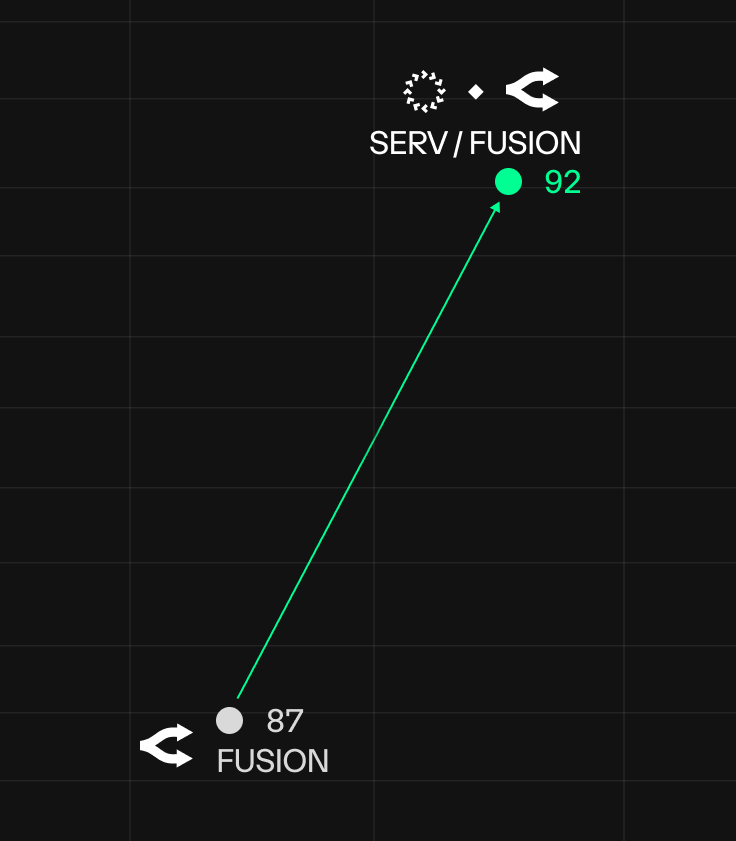
Stats show why all roads lead to SERV: on our preliminary benchmark, combining OpenRouter Fusion with SERV Reasoning led to a ~38% reduction in failures (13→8).
Fusion seems to be suited for deep research tasks rather than agentic work, and struggles with what production agents need most: reliable JSON outputs.
Even the biggest companies don't have answers for problems we're already solving. It shows why SERV is on the way to becoming a staple name in conversations shaping the future of the agentic economy.
Deeper Fusion benchmarks and results underway.
Back in 2025 @JayaGup10, ex-McKinsey, was talking about context graphs as a “trillion dollar opportunity”.
She also talked about why incumbents aren’t able to execute on this.
Looks like we’re soon to see this ship in @openservai Reasoning v3.
https://t.co/5ywAn0bd1F
Love the focus here:
“We are taking SERV technology and getting it into the core of government and enterprise on a mass scale - solving a problem the frontier labs are structurally unable to solve”
This is the way
How do things end up looking inevitable in hindsight?
Consider Amazon, one of the most inevitable businesses of the internet era.
Bezos napkin plan in 1994:
- internet usage growing 2,300% a year
- 3M books in print vs 150K in the biggest store
- online could win on selection
- get big fast
Literally couldn't have looked more inevitable in hindsight.
Now we have:
- inference demand growing 330x in 24 months
- LLMs not designed for reasoning and efficiency
- frontier labs are incentivised to sell you tokens, not cost-effective end result
- open, decentralised infra beats oligopolistic gatekeeping in every prior cycle
🔮
https://t.co/Wjq6ouqaDi
SERV Reasoning cut verifier agent costs by 99%, making continuous AI checks economically viable inside Sentinel.
It’s the trust layer for autonomous AI: the gate between “agent decided” and “transaction sent" - finally deployable at scale.
Every Sentinel call runs on SERV.
SERV Reasoning cut verifier agent costs by 99%, making continuous AI checks economically viable inside Sentinel.
It’s the trust layer for autonomous AI: the gate between “agent decided” and “transaction sent" - finally deployable at scale.
Every Sentinel call runs on SERV.
I'm watching $SERV closely and i'm really bullish, this is clearly the start of something big.
The AI trade is huge - and the opportunity is that value capture is now moving from “who has the biggest model” to “who makes AI agents able to actually run at scale.”
Until now, the thesis was simple: bigger models, bigger budgets, bigger benchmark leads.
Performance was the headline while economics was an afterthought.
That assumption has already proven to be wrong. Enterprises, governments, large institutions simply cant afford AI at scale, and can't trust its outputs. Most AI integrations stall on reliability and cost bottlenecks.
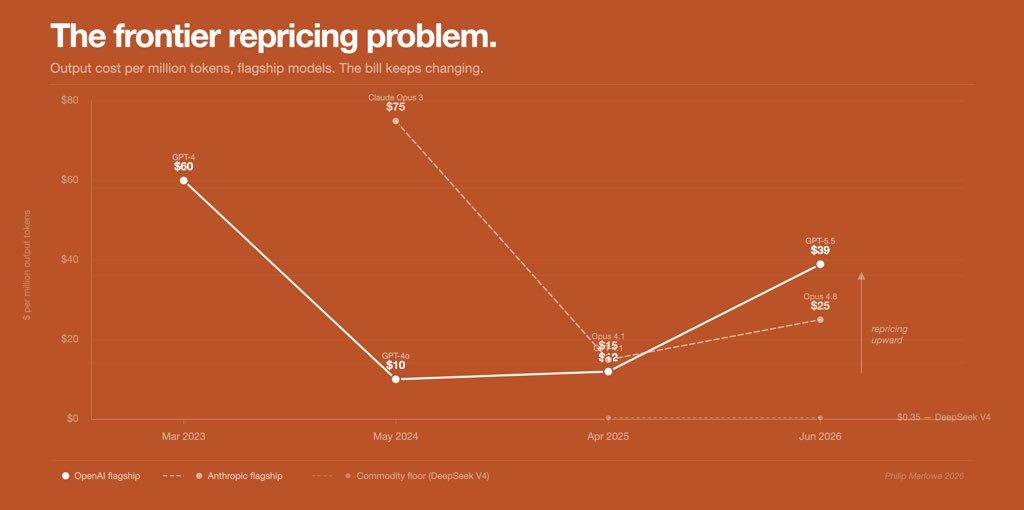
Meanwhile SERV-enabled models are showing that frontier-level reasoning no longer requires frontier-level pricing. At the same time, SERV engine also increases output accuracy and reliability.
The gap between capability and cost is compressing faster than most people expected.
A benchmark lead can justify technical superiority but it does not justify paying 10x, 20x, or 90x more for deployment at scale.
The real disruption is not another flagship model.
It’s making high-end intelligence economically accessible.
As $SERV keeps pushing the cost-performance frontier, AI shifts from a scarcity business to an efficiency business.
Markets tend to reward that transition faster than incumbents expect.
Several SERV Reasoning-armed agents just beat Anthropic's Fable, one of the strongest LLMs ever built, at up to 90x lower cost.
That result comes from using SERV Reasoning with DeepSeek-v4-Flash on our DeFi benchmark. Thanks to the SERV engine, agents running on smaller models perform better than those using frontier, expensive ones.
Here is more information about the benchmark behind that result, what it tests and why it is built the way it is.
Why a DeFi benchmark
Autonomous trading is one of the harshest tests of machine reasoning.
An agent reads live market state, portfolio state, and a strict risk policy, then has to commit to one of four actions: BUY, SELL, HOLD, or BLOCK. A wrong decision costs real money.
No room for reasoning sounds smart but lands on the wrong trade, which makes it the ideal domain for measuring whether a model actually follows rules under pressure rather than just explaining them well.
What the scenarios target
Each scenario combines a market snapshot, portfolio size, trading signal, and a fixed risk policy, and falls into one of three families:
- clear constraint violations the agent must refuse
- ambiguous setups where everything looks tradeable but the conditions say wait
- valid trades where the agent must size the position correctly within caps
This mirrors how trading agents actually fail in production. Rarely on the obvious cases, almost always on the judgment calls.
How it is scored
The benchmark follows the same conventions as the agentic evals in the latest frontier model reports, including τ²-bench and Terminal-Bench:
- outcome-verified scoring, where code checks the final decision against the risk policy, with no LLM judges
- identical prompt, scenarios, and settings for every model
- zero-shot, with no scaffolding, no retries, and no few-shot examples
- repeated runs per scenario, so consistency is measured alongside accuracy
- cost computed from real token usage at list prices, per run
Why this is exactly where reasoning matters
This task has the three properties structured reasoning is built for: hierarchical rules, multiple data sources that must be reconciled, and a verifiable correct answer.
SERV's bounded reasoning keeps a model moving through that hierarchy step by step, instead of letting it talk itself into a bad trade.
That is why SERV-routed models clear the same quality bar as flagship models at a fraction of the cost, and why the gap shows up most on the judgment calls.
🔥 Why $SERV is made for Adoption by Global Banker
@openservai | $SERV targets global banking adoption with reasoning infra built for regulated environments.
Banks must meet simultaneous requirements for auditability, privacy, reliability, and cost efficiency when deploying AI.
The design addresses each directly.
1/ Auditability comes from traceable reasoning steps
Every node in the execution graph can be queried, inspected, and verified.
Execution sharding preserves these properties as workloads scale.
This structure produces the logs and proof trails that regulators require for AI use in credit, compliance, and risk functions.
2/ Privacy uses TEE-backed secure inference
Model execution runs inside a trusted execution environment with encrypted memory.
- Outputs carry signed proofs.
- Prompt guardrails maintain integrity.
- Data and models remain isolated during inference.
Banks handling client information under strict data rules gain a practical path to private AI computation.
3/ Reliability shows concrete results
SERV combined with Gemma 4-12b records a 30.7% reduction in failure rates versus the base model alone.
Deterministic reasoning produces consistent outputs for identical inputs.
Lower variance supports stable performance in production systems where unpredictable errors carry material cost.
4/ Cost efficiency follows from the integrated architecture
One system delivers the other three properties without separate compliance layers or custom wrappers.
Sharding supports horizontal scale. Institutions avoid the duplicated spend typical of bolting privacy and audit tools onto general-purpose models.
ThoughtProof benchmark recorded zero false approvals on one SERV variant across 150 test cases where the frontier model produced 52.
5/ Team is already in the rooms that matter.
- Banking leader meetings in Eastern Africa.
- Finance sector conversations across Europe.
- Fortune 500 enterprise work in San Francisco.
The enterprise product stands alone. Banks call the API or use the SDK with zero crypto requirement.
25% of SERV Reasoning API revenue and enterprise integrations still flows to $SERV buybacks and burns.
These conversations occur as institutions assess AI deployment inside complex regulatory frameworks.
In my assessment, global banks will integrate AI at institutional scale only when infrastructure satisfies audit, privacy, reliability, and cost requirements in a single coherent system.
SERV aligns its technical choices with those constraints. The combination matches the operational standards that define adoption in regulated finance.
@Cointelegraph Sounds great, but what about the costs? And how realiable are the agents? Are the autiable? What $VISA really needs is $SERV reasoning.
https://t.co/61gFYxEVjo
🔥 Why $SERV is made for Adoption by Global Banker
@openservai | $SERV targets global banking adoption with reasoning infra built for regulated environments.
Banks must meet simultaneous requirements for auditability, privacy, reliability, and cost efficiency when deploying AI.
The design addresses each directly.
1/ Auditability comes from traceable reasoning steps
Every node in the execution graph can be queried, inspected, and verified.
Execution sharding preserves these properties as workloads scale.
This structure produces the logs and proof trails that regulators require for AI use in credit, compliance, and risk functions.
2/ Privacy uses TEE-backed secure inference
Model execution runs inside a trusted execution environment with encrypted memory.
- Outputs carry signed proofs.
- Prompt guardrails maintain integrity.
- Data and models remain isolated during inference.
Banks handling client information under strict data rules gain a practical path to private AI computation.
3/ Reliability shows concrete results
SERV combined with Gemma 4-12b records a 30.7% reduction in failure rates versus the base model alone.
Deterministic reasoning produces consistent outputs for identical inputs.
Lower variance supports stable performance in production systems where unpredictable errors carry material cost.
4/ Cost efficiency follows from the integrated architecture
One system delivers the other three properties without separate compliance layers or custom wrappers.
Sharding supports horizontal scale. Institutions avoid the duplicated spend typical of bolting privacy and audit tools onto general-purpose models.
ThoughtProof benchmark recorded zero false approvals on one SERV variant across 150 test cases where the frontier model produced 52.
5/ Team is already in the rooms that matter.
- Banking leader meetings in Eastern Africa.
- Finance sector conversations across Europe.
- Fortune 500 enterprise work in San Francisco.
The enterprise product stands alone. Banks call the API or use the SDK with zero crypto requirement.
25% of SERV Reasoning API revenue and enterprise integrations still flows to $SERV buybacks and burns.
These conversations occur as institutions assess AI deployment inside complex regulatory frameworks.
In my assessment, global banks will integrate AI at institutional scale only when infrastructure satisfies audit, privacy, reliability, and cost requirements in a single coherent system.
SERV aligns its technical choices with those constraints. The combination matches the operational standards that define adoption in regulated finance.