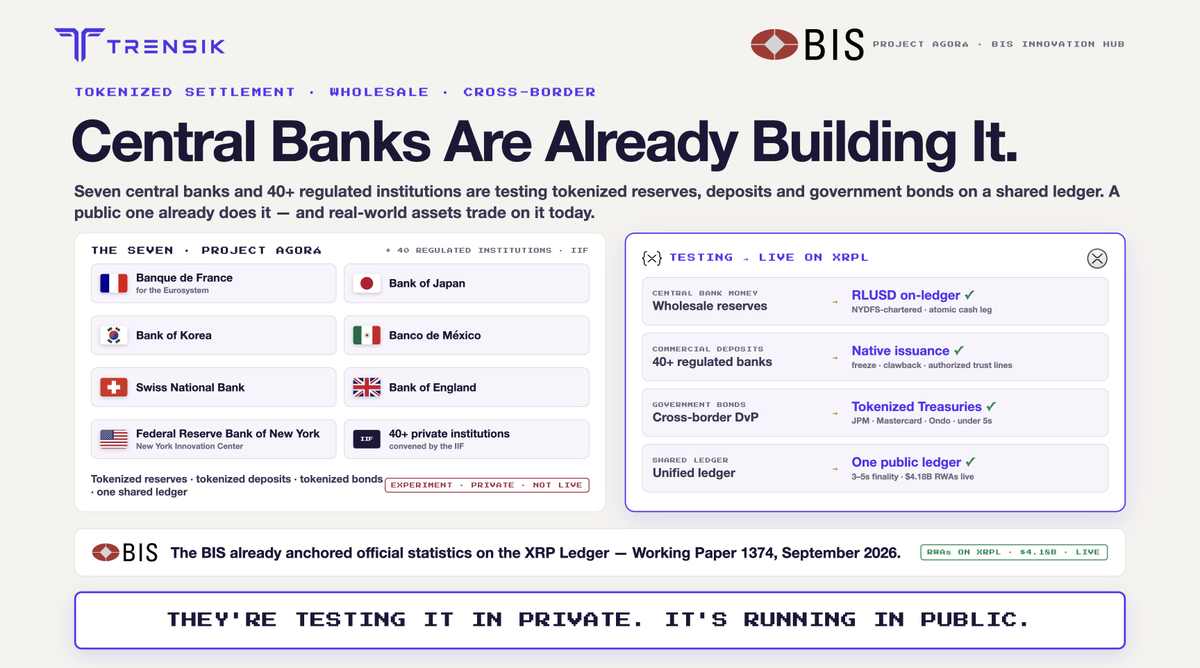
Central banks are already building tokenized settlement.
BIS Project Agorá: 8 central banks, 40+ regulated institutions, testing tokenized reserves, deposits and government bonds on a shared ledger. Private. Not live.
The $XRP Ledger runs this in public.
RWAs trade on it now. https://t.co/tduzKH2T5h
This is very interesting!
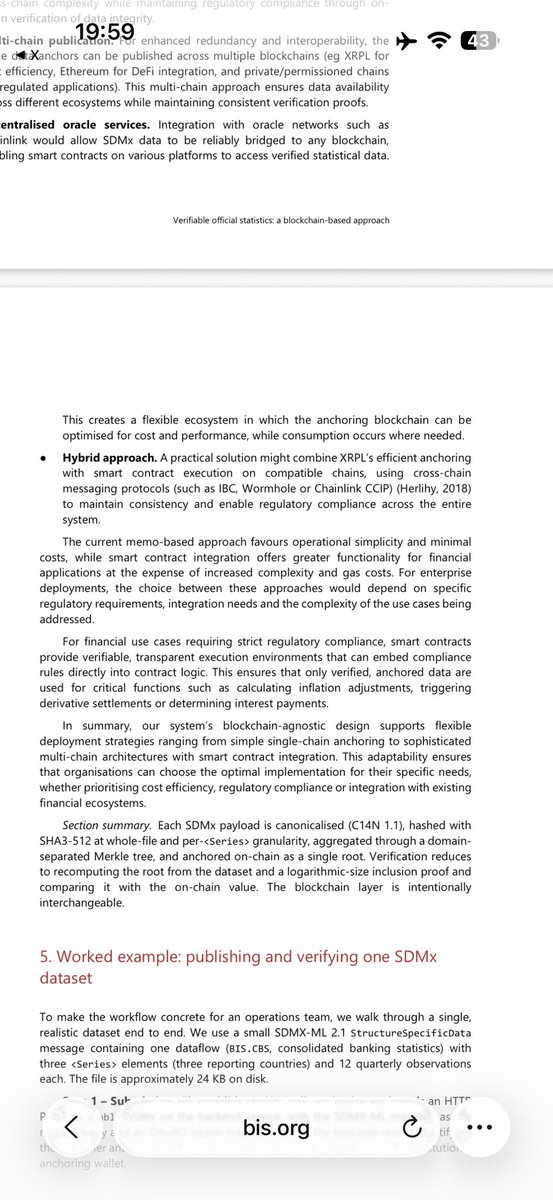
The Bank of International Settlement used in their research paper the XRP Ledger (dev net) for its immutability and public verifiable properties!
So what did they do? Spoiler, they used the memo field, i suggest to use something else at the end.
The BIS wants to eliminate the trust that comes with published statistic files on websites.
Hash the files first, connect those hashes with a Merkle tree into one summary, put that in a Payment memo and submit it to the XRP Ledger. Once validated it’s permanent and immutable.
You get a tx hash plus the leaves and a signed credential, put that in the statistic file so anyone can check it against the ledger.
IMO there is a much better way to achieve this:
Use an NFT. They mention IPFS and actually you can use Arweave too. But put the hash into the NFT URI, anyone finding the statistics file can compute the hash and match against the URI hash (immutable), if it matches you know its the right one and not altered.
Why is an NFT better than a memo tx?
Because NFTs (yes NFT pages, don't be a Timmy...) are objects on the ledger and the memo isn't. So unless you want to store ledger history forever you better use objects as they get carried over into every next ledger.
@mrcauliman Matthew 6:33 connotes that our priority should be we going after God's kingdom and those things we worry about would on their own be added to us without sweat.
In summary, the additions of life follow those who go after the things of God's kingdom and righteousness.