This is properly insane: quite literally the worst example of censorship I've ever heard of anywhere.
I checked the actual ruling (which you can see here: https://t.co/dBKFWZ2ZWm) and, to be clear, it isn't just censorship in the conventional sense - blocking access to a website or removing content from platforms - this is the criminalization of information relayed by private citizens, with prison sentences attached.
And the most insane aspect if that it does NOT matter if the information relayed is accurate or not. It just matters that it originates from RT or other media outlets banned in the EU.
In other words, truth isn't a defense anymore in the EU, it literally doesn't matter. It's purely based on the identity of the speaker.
The ruling is actually explicit about this: the regulation, quoted by the Court says that the prohibition applies to "any content," and they draw no distinction based on what the content actually says. If it originates from banned outlets, it's banned.
It is, quite simply, a complete unraveling of the entire post-Enlightenment legal and philosophical project where entire generations of Europeans fought to move from "who says it" to "is it true" as the operative question.
Think about the absurdity of it: if RT publishes a video saying the sky is blue and you share it on a publicly accessible website in the EU, you'd fall within the scope of this ruling, making you liable to criminal prosecution.
Completely and utterly absurd. But that's the EU today for you 🤷
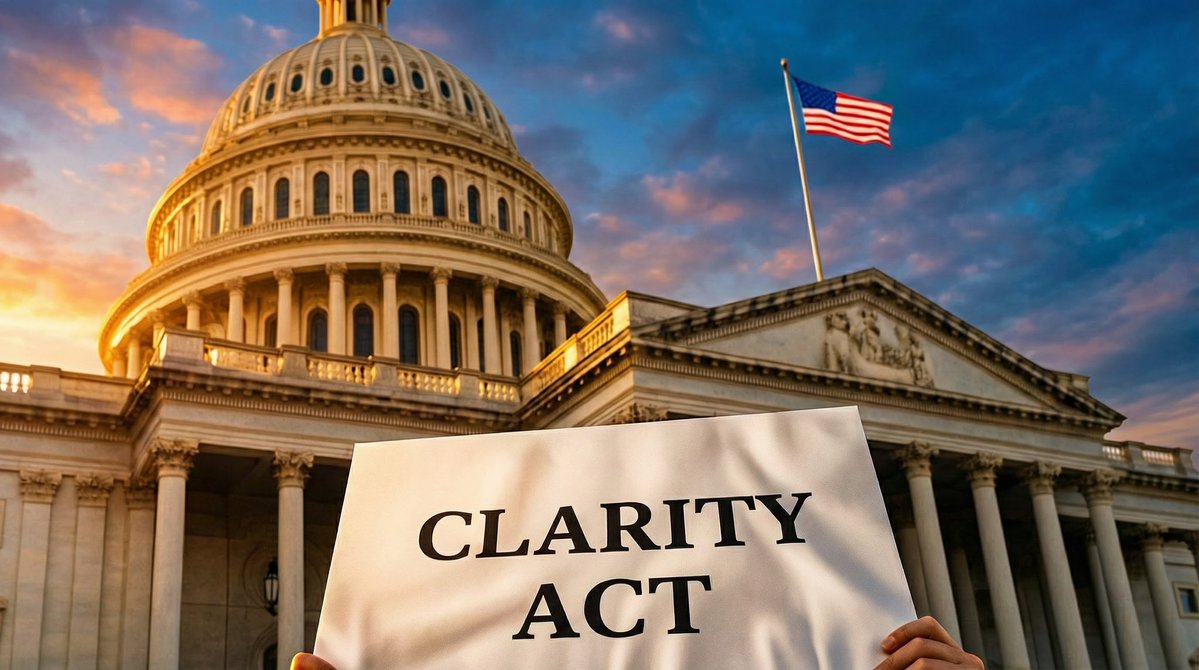
53 banking associations just wrote themselves a $6.6 trillion protection bill.
They called it the CLARITY Act.
Here is what they do not want you to understand.
Banks pay depositors 0.1% interest. Stablecoin issuers hold Treasury bills earning 4.5%. If stablecoins could pass that yield to users, banks lose the deposit war. They cannot compete. The math is fatal.
So they made competition illegal.
The Kansas City Fed calculated what happens if stablecoins pay competitive rates. Banks lose 25.9% of deposits. $1.5 trillion in lending capacity vanishes. The entire community banking model collapses.
Their solution was not innovation. Their solution was legislation.
The CLARITY Act everyone is celebrating contains Section 404 prohibiting yield payments through any mechanism. Not just from issuers. From exchanges. From affiliates. From partners. Every single pathway to competitive returns, closed by statute.
Brian Armstrong reviewed the 278-page draft for 48 hours. He withdrew Coinbase support at 11pm. The markup was postponed by morning. He saw what Wall Street analysts missed entirely.
This is not crypto regulation.
This is Dodd-Frank for digital assets. Incumbents writing rules that crush competitors. Regulatory capture so brazen they published the lobbying letters on their own websites.
The American Bankers Association. 52 state banking associations. The Community Bankers Council. All coordinating to eliminate an industry they cannot beat in open markets.
Meanwhile China made e-CNY interest-bearing on December 29.
America is banning stablecoin yield while Beijing is paying it.
The crypto industry spent years begging for regulatory clarity.
They got it.
Clarity that $6.6 trillion in deposits will be protected at any cost. Clarity that banks write the rules. Clarity that if you cannot win in markets, you win in Congress.
This is the largest regulatory capture event in American financial history.
And it is being sold as innovation policy.
A cow takes grass (inedible to humans) and produces:
- Meat (complete protein + fats)
- Milk (complete nutrition)
- Leather (clothing, tools)
- Tallow (cooking fat, soap, candles)
- Bones (tools, broth, fertilizer)
- Organs (nutrient-dense food)
- Manure (fertilizer)
This is complete resource utilization from a plant humans cannot eat.
You cannot replicate this with any technology. The cow is performing chemical transformations we cannot industrialize.
Grass → complete human nutrition is alchemy.
The cow is worth more than any machine humans have invented.
It runs on rain and grass. Produces multiple products. Builds soil while operating. Sequesters carbon. Reproduces itself.
And we're told to eliminate them for environmental reasons.
While flying in almonds from California and soy from Brazil.
The stupidity is breathtaking.
Last quarter I rolled out Microsoft Copilot to 4,000 employees.
$30 per seat per month.
$1.4 million annually.
I called it "digital transformation."
The board loved that phrase.
They approved it in eleven minutes.
No one asked what it would actually do.
Including me.
I told everyone it would "10x productivity."
That's not a real number.
But it sounds like one.
HR asked how we'd measure the 10x.
I said we'd "leverage analytics dashboards."
They stopped asking.
Three months later I checked the usage reports.
47 people had opened it.
12 had used it more than once.
One of them was me.
I used it to summarize an email I could have read in 30 seconds.
It took 45 seconds.
Plus the time it took to fix the hallucinations.
But I called it a "pilot success."
Success means the pilot didn't visibly fail.
The CFO asked about ROI.
I showed him a graph.
The graph went up and to the right.
It measured "AI enablement."
I made that metric up.
He nodded approvingly.
We're "AI-enabled" now.
I don't know what that means.
But it's in our investor deck.
A senior developer asked why we didn't use Claude or ChatGPT.
I said we needed "enterprise-grade security."
He asked what that meant.
I said "compliance."
He asked which compliance.
I said "all of them."
He looked skeptical.
I scheduled him for a "career development conversation."
He stopped asking questions.
Microsoft sent a case study team.
They wanted to feature us as a success story.
I told them we "saved 40,000 hours."
I calculated that number by multiplying employees by a number I made up.
They didn't verify it.
They never do.
Now we're on Microsoft's website.
"Global enterprise achieves 40,000 hours of productivity gains with Copilot."
The CEO shared it on LinkedIn.
He got 3,000 likes.
He's never used Copilot.
None of the executives have.
We have an exemption.
"Strategic focus requires minimal digital distraction."
I wrote that policy.
The licenses renew next month.
I'm requesting an expansion.
5,000 more seats.
We haven't used the first 4,000.
But this time we'll "drive adoption."
Adoption means mandatory training.
Training means a 45-minute webinar no one watches.
But completion will be tracked.
Completion is a metric.
Metrics go in dashboards.
Dashboards go in board presentations.
Board presentations get me promoted.
I'll be SVP by Q3.
I still don't know what Copilot does.
But I know what it's for.
It's for showing we're "investing in AI."
Investment means spending.
Spending means commitment.
Commitment means we're serious about the future.
The future is whatever I say it is.
As long as the graph goes up and to the right.
🚨 EDWARD SNOWDEN’S CHILLING WARNING IS NOW UNFOLDING IN REAL TIME
What China built… is exactly what Western governments are quietly preparing for.
Snowden is crystal clear:
Every photo, every purchase, every message, every movement — all of it is being fed into algorithms that decide your future.
In China, AI “city brains” now track:
Where you live
Who you visit
How you dispose of your rubbish
Every step you take in public
Whether you “follow rules” or not
Break a rule?
A camera catches you from three angles.
Your score drops.
Your life collapses.
Snowden’s warning:
“If any of your activities differ from what the government wants, you won’t get on a train.
You won’t board a plane.
You won’t get a job.
An algorithm will decide your fate.
And what they are selling… is us.”
This is not a future threat.
It is happening now — in Shanghai, in Beijing… and creeping into the West through digital ID, AI policing, and “misinformation scoring.”
China built the prototype.
Our governments are importing the blueprint.
Stay informed.
Stay alert.
Do not let this system take root.
CEO's question: What will be the hourly cost of work of a humanoid robot?
Several projections have been published, e.g. by @CernBasher, @adam_dorr and @GoingBallistic5. Here's my take.
I've produced a long-form video on this question (see link in comments).
Here is the essence - based on very conservative assumptions (see attached image).
- Production cost: $30,000. A humanoid is ~5% the mass of a passenger car. The costly parts are actuators and gearboxes; the rest is electronics, sensors, a few kWh of batteries, and plastics—components that are highly scalable in volume manufacturing.
- Operating cost: $30,000 per year, of which $18,000 is human oversight and coordination. This is likely way too high.
- Operating time: 6,600 hours per year (330 days × 20 hours/day). That equals the yearly working time of more than three people.
- Work speed vs. humans: 100% initially. As with industrial robots, later generations will likely reach 200%+.
- Business model: Most manufacturers will offer Robot-as-a-Service (RaaS) rather than selling units, because it drives far higher revenue and margin. Expect an initial one-time fee roughly equal to manufacturing cost plus a usage fee per year, month, day, or hour.
- Service life (incl. repairs): 8 years.
- Market dynamics: Because humanoids will be highly profitable to use (see below), demand will ramp quickly. But many suppliers will enter, so sustained overly high monopoly pricing is unlikely.
Result: Based on these assumptions, a humanoid work hour will cost at most $14.
That’s the highest realistic value. With learning effects and scale, the hourly cost will drop below $10 and likely below $5. @rethink_x even projects that by 2035 a humanoid hour could cost less than $1.
By comparison, a skilled worker’s fully loaded hour is $42.53.
Strategic consequence: In competitive markets, companies will have no real choice: first to replace labor shortages, and soon to replace existing roles. Even at $14/hour, the financial advantage vs. human labor is close to $200,000 per robot per year.
I’ve published a three-part video series on the societal implications of this inevitable shift (see comments).
Urgent advice: If you make or move anything physical, start rethinking your business around humanoids—as a supplier, service provider, or user. It is quiet now, but the ramp-up will be fast.
How about you? Which tasks would you deploy humanoids for first?
The people who've lived under socialism will risk barbed wire, bullets, and oceans to escape it. Meanwhile, the loudest advocates for socialism live in capitalist nations, sipping Starbucks, tweeting from iPhones, and whining about “late-stage capitalism” while enjoying its abundance.
They don’t move to Cuba. They don’t relocate to North Korea. They don’t even apply for a visa to Venezuela. Why? Because deep down, they know the truth:
Socialism is only tolerable when someone else pays for your fantasies.
The people fleeing socialist regimes aren’t confused. They’ve lived the outcome: poverty, rationing, corruption, fear.
The Western socialist, meanwhile, has never had to stand in line for bread, only for the new iPhone.
Rather than learn from those who escaped tyranny, they arrogantly believe they’ll “do it right this time” as if the laws of economics, human nature, and moral reality will bow to their feelings.
It’s not idealism. It’s resentment in disguise. They don’t want to lift the poor. They want to punish the successful, tear down what works, and be applauded for the rubble they leave behind.
They're not revolutionaries.
They're just spoiled children with slogans, trying to drag the world back to the misery others fled.
Banks should not be able to trap your funds and data with them and make it difficult for you to access your data or move your capital to wherever you see fit. That is your human right and foundational to the proper functioning of the system of capitalism that our country was founded on. This is the spirit of Open Banking and that's why I have signed this letter urging President Trump to support Open Banking. Onward! 🇺🇸🚀
What happened to "Don't be evil" ?
Wholesale financial surveillance of innocent individuals (not even accused of a crime!) is evil.
It violates the presumption of innocence.
It violates the ethical principle of respecting your neighbor.
It violates the 4th Amendment of the US Constitution, easily.
To all the wallet devs now confronted with this: do not comply. If you do, your business will be utterly gutted and you will spend the next year being absolutely miserable while your company dies and all your customers tell you how much you suck.
Abandon the Google Play Store, move to a mobile web PWA solution, or find some other creative solution. Maybe smash your Android phone, throw it into a ravine, and post a video encouraging others to do the same.
Have respect for yourself and your customers. Do not comply. Do not be "pragmatic." Google has decided to be evil, so now it is your turn.
This is where you take a stand, if you ever do.
I decided to donate $500K to @rstormsf’s legal defense. Originally, we planned to give $50K, but after what happened to me, I need to take a clear position so everyone understands what @class_lambda stands for.
I understand that the @ethereumfndn will be matching donations up to another $500K for Roman Storm’s defense, which means our contribution can have double the impact. Our team is currently moving money to execute the transaction. It should be done in the next few hours. I'm going to sleep after not sleeping for the last 48 hours.
Open source and decentralization are not just philosophical ideals. They are practical necessities for building crypto. Success in this space comes from building in the open, onboarding others, and creating movements that grow beyond the original project. That is often hard to explain to people who do not share this ethos, because we are not optimizing for the same outcomes.
Our mission is to help build the highways of the new internet in sustainable ways. Economic sustainability is one part of that, but not the only one. We also exist to counterbalance the natural pull toward centralization, a side effect of pure optimization. Centralization is easier and cheaper in the short run. If our only goal were to make money, there are far simpler ways to do it. But money, to us, is just a tool to reach our goals.
Roman’s legal defense matters because builders everywhere need to know they can push innovation forward and that the community will stand behind them when they do. The West became powerful because it embraced freedom and its innovators. Progress came from protecting those who challenged the status quo and building systems that allowed their ideas to scale. When we stop defending our innovators, we stop building the future.
The community can contribute to @rstormsf's legal defense here:
https://t.co/FTckcvB6B2
China just fired up the reactor that could power the world for 60,000 years. The West had it first, and threw it away.
China takes bold step forward in global race for limitless energy device: 'We have fully mastered the core technologies' https://t.co/ZYZLtRegvd
China just fired up the reactor that could power the world for 60,000 years. The West had it first, and threw it away.
China takes bold step forward in global race for limitless energy device: 'We have fully mastered the core technologies' https://t.co/ZYZLtRegvd
China–Iran Rail Link Defies Sanctions—Israel Strikes Back
Just days after China and Iran launched a direct overland trade route that bypasses U.S. naval power and sanctions enforcement, Israel struck Iranian targets. The message is unmistakable: Washington and its allies are rattled.
The new rail line—part of a $400 billion pact under China’s Belt and Road Initiative—connects Xi’an to Tehran in 15 days, slashing delivery times and avoiding chokepoints like the Strait of Hormuz and the Suez Canal. No U.S. warships. No surveillance. No sanctions enforcement.
This isn’t just infrastructure—it’s a strategic breakthrough. Iran, long targeted for isolation, is now a central node in a rising Eurasian corridor linking China, Central Asia, Russia, and the Mediterranean. The U.S. campaign of “maximum pressure” has failed to contain it.
While Washington scrambles to blacklist Chinese and Iranian firms, and India’s U.S-aligned Chabahar ambitions stagnate, Beijing and Tehran are laying what Iranian officials call the “steel arteries of independence.”
Trade is moving. Sanctions are eroding. Control is slipping.
Coincidence? Not likely.
𝕭𝖆𝖘𝖊𝖉 𝕸𝖔𝖓𝖊𝖞 𝕽𝖔𝖑𝖑𝖚𝖕𝖘
𝔉𝔦𝔵𝔦𝔫𝔤 𝔈𝔱𝔥𝔢𝔯𝔢𝔲𝔪’𝔰 𝔈𝔠𝔬𝔫𝔬𝔪𝔦𝔠 𝔅𝔩𝔞𝔠𝔨 ℌ𝔬𝔩𝔢
ᴛʟ;ᴅʀ ɪꜱ ᴛʜᴀᴛ ʙᴀꜱᴇᴅ ʀᴏʟʟᴜᴘꜱ ᴇɴꜱᴜʀᴇ ᴇᴛʜᴇʀᴇᴜᴍ ᴏʀᴅᴇʀꜱ ᴛʀᴀɴꜱᴀᴄᴛɪᴏɴꜱ ʙᴜᴛ ᴛʜᴇʏ ᴅᴏɴ'ᴛ ᴇɴꜰᴏʀᴄᴇ ᴇᴄᴏɴᴏᴍɪᴄ ᴀʟɪɢɴᴍᴇɴᴛ. ʙᴀꜱᴇᴅ ᴍᴏɴᴇʏ ʀᴏʟʟᴜᴘꜱ ꜰɪx ᴛʜɪꜱ. ᴀ ʙᴀꜱᴇᴅ ᴍᴏɴᴇʏ ʀᴏʟʟᴜᴘ ᴇxᴘᴀɴᴅꜱ ᴏɴ ᴀ ᴠᴀɴɪʟʟᴀ ʙᴀꜱᴇᴅ ʀᴏʟʟᴜᴘ ʙʏ ɪɴᴛʀᴏᴅᴜᴄɪɴɢ ᴇxᴘʟɪᴄɪᴛ ᴇᴄᴏɴᴏᴍɪᴄ ᴀʟɪɢɴᴍᴇɴᴛ ᴍᴇᴄʜᴀɴɪꜱᴍꜱ ᴛᴏ ᴇɴꜱᴜʀᴇ ᴛʜᴀᴛ ᴇᴛʜᴇʀᴇᴜᴍ ᴄᴀᴘᴛᴜʀᴇꜱ ᴠᴀʟᴜᴇ ꜰʀᴏᴍ ʀᴏʟʟᴜᴘ ᴀᴅᴏᴘᴛɪᴏɴ, ʀᴀᴛʜᴇʀ ᴛʜᴀɴ ᴊᴜꜱᴛ ᴘʀᴏᴠɪᴅɪɴɢ ꜱᴇᴄᴜʀɪᴛʏ ꜰᴏʀ ꜰʀᴇᴇ.
Ethereum’s actually scaling. Crazy, right? And you know what? Polkadot was kind of on to something with parachain auctions, huh? I wonder how they dropped the ball so hard.
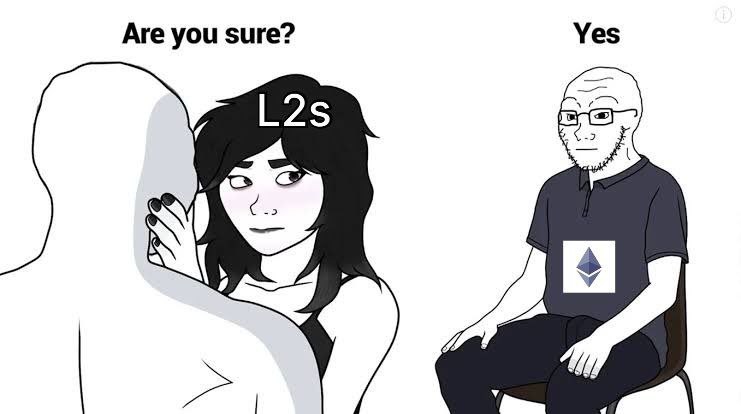
Anyway, rollups are definitely the future, but here’s the problem no one wants to talk about: ETH is sitting in the cuck chair while L2s print money.
For real though. L2s are raking in billions while ETH stakers, the actors within the system who actively secure the network, are receiving a disproportionately smaller amount of comparative value.
If this continues, Ethereum risks becoming a relatively useless settlement layer, while rollups spin up their own economies and capture all the value at the cost of the ETH security budget. It’s almost as if each consecutive layer is a vampire attack on the former.
This actually presents security risks by reducing the overall security budget. In the context of this discussion, the security budget refers to the total economic incentives that ensure Ethereum’s validator set remains large, decentralized, and economically secure.
That’s why we need 𝕭𝖆𝖘𝖊𝖉 𝕸𝖔𝖓𝖊𝖞 𝕽𝖔𝖑𝖑𝖚𝖕𝖘 which are a model that I just entirely made up where rollups don’t just extract value from Ethereum, they reinforce it.
You want Ethereum’s security? You need some skin in the game, bucko.
THE PROBLEM: ROLLUPS ARE EXTRACTING, ETH IS SUBSIDIZING
Bust out that TI-83, Tarun, because we’re gonna get into some numbers here:
- In 2024, rollups made $295M in fees, while Ethereum’s own fee revenue collapsed by 99% due to cheaper calldata posting.
- Some rollups pay as little as $1 to Ethereum for every $321 they earn.
- ETH staking yields sit at a weak ~2.5% APY, while Ethereum’s security budget is increasingly subsidized by inflation instead of real revenue.
This is not a sustainable model. These numbers might be scary, but they can vary somewhat based on the data source. Some people have said I’m exaggerating, so DYOR, but you’re grasping at straws and missing the point.
Right now, rollups spin up overnight, pay almost nothing to ETH, and keep all the fees and MEV. The security that ETH validators provide is treated as free infrastructure, while L2s build their own economies on top of it. That’s abusive.
Ethereum is footing the bill while L2s print.
This model is broken.
ENTER BASED MONEY ROLLUPS: ALIGNING L2S WITH ETHEREUM’S SECURITY
Based Money Rollups flip the script by requiring rollups to actually contribute back to Ethereum’s security.
Instead of launching and capturing all value for themselves, rollups that want Ethereum’s security must pay into Ethereum’s security budget.
Now, how’s this different from vanilla Based Rollups?
Vanilla Based Rollups, like the ones championed by @drakefjustin et. al., focus on shared sequencing and leveraging Ethereum’s validators for fairness, but they don’t explicitly tie L2 success back to ETH’s economic strength.
Vanilla Based Rollups ensure Ethereum orders transactions but they don’t enforce economic alignment, and from what I can tell, it’s not really considered in much depth outside of handwaving while citing “incentives.”
They’re more about operational efficiency: fair ordering, reducing MEV leakage, that kind of thing. Based Money Rollups take it further. They’re not just about playing nice with OSS licenses, they’re about making sure L2s share value with ETH itself, reinforcing the base layer’s economics so it doesn’t reduce the overall security of the network. It’s less about “let’s share a sequencer” and more “Ass, gas, or grass. No one rides for free.”
This reciprocal exchange of value between a Based Money Rollup and ETH mainnet can happen in a few ways:
- ETH Staking or Vault Deposits: Rollups must stake ETH or deposit into an ETH-aligned vault to reinforce Ethereum’s security.
- Fee Sharing: A portion of all L2 fees must be burned or sent to Ethereum validators to boost staking rewards.
- MEV Redistribution: Instead of private sequencers capturing MEV, Based Money Rollups route it to ETH stakers or burn it, ensuring rollup arbitrage strengthens Ethereum instead of extractors.
- Reverse Dutch Auction with Group Discounts: Rollups bid for Ethereum’s security resources, but group discounts incentivize multiple rollups to share sequencing costs, creating a fair fee market.
This keeps ETH at the center of the value accrual system, without forcing rigid token models or limiting rollup sovereignty.
WHY NOT JUST FORCE ROLLUPS TO STAKE ETH?
Because it wouldn’t work. A fixed ETH staking model doesn’t scale.
Large rollups wouldn’t care, and small rollups would be priced out before they even had a chance to grow.
Instead of a one-size-fits-all ETH bond, Based Money Rollups use a Reverse Dutch Auction with Group Discounts to create a dynamic fee market for security and blockspace.
HOW IT WORKS:
Ethereum allocates a limited number of sequencing and security slots for Based Money Rollups.
Rollups bid for security access in a Reverse Dutch Auction. Starting at a high price which drops until enough rollups commit.
Multiple rollups can win together, paying the same final clearing price. This creates a group discount that lowers fees when more rollups participate.
The revenue from this auction is distributed to ETH stakers or partially burned, ensuring that L2 success directly strengthens Ethereum’s value.
Instead of L2s extracting value and keeping all the upside, Ethereum’s validators capture the demand for rollup blockspace, reinforcing ETH’s economic moat.
WHAT ABOUT MEV?
Oh yeah, that’s another problem.
FIrst, let’s define MEV. Broadly speaking, MEV is just a big brained way of saying making money onchain.
This is probably an oversimplification, so I hit up Justin Drake, who happily humored me (shoutout JD), to make sure my assumptions were correct, I roughly gathered that in the context of a based rollup, as defined by the very man I was harassing, is more specific to value accrued via the process of block ordering, or the sequencing of transactions.
As most L2s operate under a single sequencer architecture, this can prove quite lucrative given a sufficiently liquid network and a keen eye for capital efficiency, if you know what I mean.
Right now, FIFO rollups, pretend MEV doesn’t exist, while centralized sequencers capture it privately, profiting at the expense of both users and Ethereum. Pretty sweet deal for operators, but definitely a negative sum game.
Based Money Rollups fix this by routing MEV to ETH stakers or burning it outright. Instead of a hidden tax that benefits a handful of insiders, rollup arbitrage strengthens ETH and its security budget.
More transactions on rollups should mean more value flowing into Ethereum, not just into sequencer wallets.
ROLLUPS CAN STILL HAVE THEIR OWN TOKEN
Here’s the thing though, sovereign L2 economies still matter.
A Based Money Rollup can, and probably should, have its own native token for:
Security: staking for sequencer selection, decentralized validation, or governance-based upgrades.
Governance: voting on fee structures, protocol changes, or community funding.
Gas Fees: some rollups might use ETH, others might peg their token to ETH, and some might use a hybrid model.
The key difference? Rollups that choose to align with Ethereum’s security can contribute back instead of just extracting value.
They can do this by staking some portion of their native token supply within a registry on mainnet that can act as an index of all the L2s and provide some degree of exposure to stakers.
This is just an idea, definitely needs more thought. Also, I don’t know if that even makes sense, so I’m hoping someone smarter than me can step in for this area with an “Actually, you could use a vault model that does such and such here…”
But I digress. If a rollup wants its our own native token? Great! But Ethereum should not be subsidizing rollups that don’t reinforce ETH.
ETHEREUM’S BLOB STRATEGY AND L2 FEE RISKS
Because we’re pretty much talking about fee markets here, let’s have a quick sidebar on blobs.
Ethereum’s current blob pricing strategy is artificially low, meaning L2s are effectively getting a subsidy on data posting costs. I’d imagine they’re feeling threatened by DA providers like Celestia. As such, scuttlebutt would indicate that:
- The Ethereum Foundation wants to increase blob supply before price discovery kicks in, keeping data cheap for L2s.
- Base, Optimism, and other L2s are buying up blobs at minimal cost, pushing demand up while keeping fees low for now.
- At some point, blob fees will rise, and L2s will have to start paying real costs for Ethereum’s security.
When I brought this issue up to @stevedakh, he dismissed me entirely by saying that “when demand goes up it will be MUCH higher”. I think this is a bit flippant. These are core economic issues that we really need to think about. Just waiting around for a fabled bull run where block space is selling like ketamine in dime square doesn’t seem like a great strategy for wartime protocol engineering.
If these are the goals, that makes sense, but my point is that this is why aligning L2s with Ethereum’s economics right now is so important. If we wait until blob fees are expensive, rollups might seek alternative data availability providers (Celestia, EigenDA) instead of paying Ethereum.
We need to make sure Ethereum remains the best settlement and data layer, and Based Money Rollups help lock in that alignment before we hit that tipping point.
THE FUTURE: ETHEREUM SCALES, ETH GETS STRONGER
Ethereum’s future is rollup-centric, but that only works if it’s also ETH-centric. I think that a problem we had early on within the realm of Ethereum protocol engineering was not taking a more holistic approach within the overall design to account for protocol economics, but hindsight’s 50/50 or whatever.
So that being said, L2s are well on track to establish a multi-trillion-dollar economy. If this is the case, which is what we’re all betting on, ETH must be the base money that secures them.
The Based Money Rollup is an opt-in system. L2s that align with Ethereum’s incentives get:
- Stronger security from Ethereum validators.
- Validator support and composability.
- Long-term economic sustainability.
L2s that don’t? They’ll have to figure things out on their own.
No more ETH-backed free rides.
THE NEXT STEP: COMMUNITY FEEDBACK
IMHMFO, Based Money Rollups are the logical next step for Ethereum’s L2 future. But this needs discussion, refinement, and community collaboration.I just thought about all this over the past week and decided to write it all out.
Also, thanks to everyone who tolerated my pedantic line of questioning: Justin Drake, @josephdelong , @gregthegreek , @gphummer, and @preston_vanloon.
I would also like to make note that I don’t know the answers. I don’t have some grand system designed in my head right now. I’m just bringing to light some of the issues that I think are very important but aren’t really talked about enough.
I hope that people who are smarter than me can help us think more about this problem space and help establish a pragmatic approach to tackling some of these problems.
Happy to bring this to EthMagicians or whatever, but want to circulate for feedback first, so please let me know your thoughts.
L2 teams, researchers, devs, shitposters, is there anything you have to add? What am I missing here?
(:)