the app business much like saas is now entering decline. culture now moves faster than software companies can build, distribute, & retain attention. not to mention ai has commoditized every part of the traditional software value chain.
if you’ve followed me for any length of time none of this should be surprising to you at all.
the world is moving from apps you operate to agents that operate for you. that is a profound shift in how every part of the software business functions & it has deep implications for both b2b & consumer experiences. if you do not shift your thinking to how software will work in the ai age, you’re gonna have a bad time.
i never knew there was an actual term for this:
epistemic loneliness is a cognitive form of isolation that happens when you cannot share complex ideas, inner thoughts, or meaningful perspectives because you lack a willing, able, or understanding conversational partner.
Why can’t communists be communist the way the Amish are Amish, as in, peacefully, voluntarily, among themselves, without taking anyone else’s property or forcing anyone else to participate?
If communism is really about cooperation and community, why does everyone else have to be forced into it?
Socialism is not about living a socialist lifestyle. It is about forcing everyone else to live a socialist lifestyle. That's what the "social" part means.
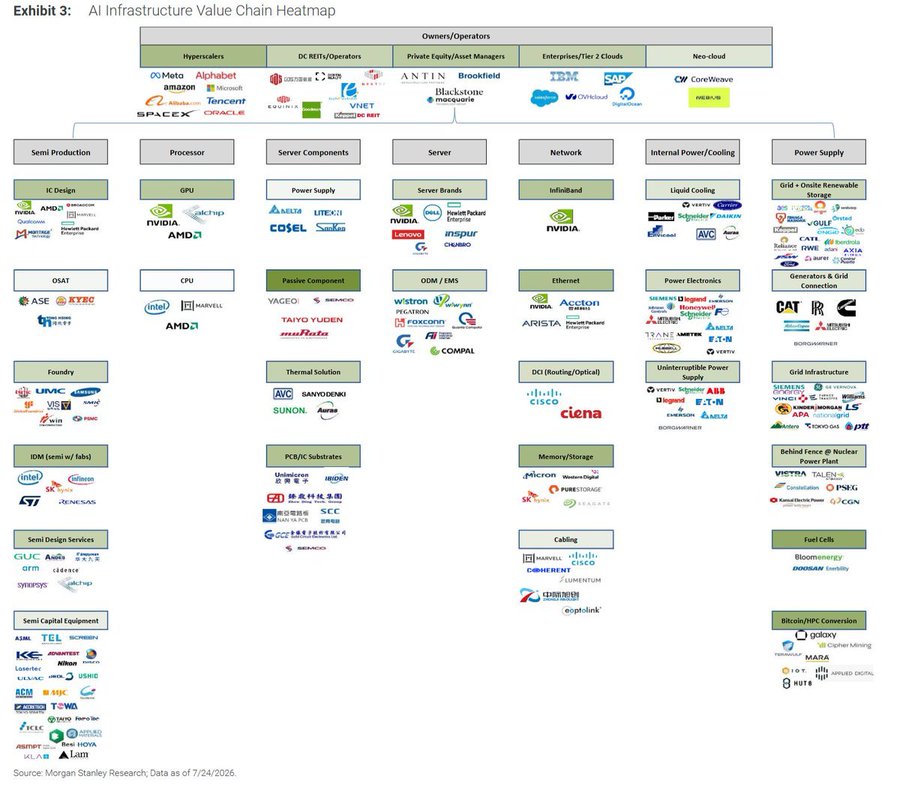
Morgan Stanley mapped out the entire AI infrastructure supply chain and it reveals who actually gets paid at every layer of the trillion dollar buildout (Save this).
This heatmap breaks the AI infrastructure value chain into two dimensions those who owns and operates the data centers at the top and what physical and technical components get built underneath to make those data centers function.
At the top sit the owners/operators, the hyperscalers like Meta, Alphabet, Amazon and Microsoft, alongside data center REITs, private equity giants like Blackstone and Brookfield, enterprises and neoclouds including CoreWeave and Nebius.
These are the companies writing the massive capex checks that fund everything below them.
Below that sits the actual build out, split into seven layers, semi production, processors, server components, servers, network, internal power/cooling and power supply.
Semiconductor production is dominated by names your audience already knows well, Nvidia and AMD for GPUs, TSMC adjacent foundries, ASML and Applied Materials for capital equipment, and Micron and SK Hynix under memory/storage.
But the less obvious money is in the physical infrastructure layers most retail investors never look at.
Server components include passive parts from Yageo and Murata, thermal solutions from Sanyo Denki, and PCB substrates from companies like Unimicron.
Network infrastructure includes InfiniBand and Ethernet gear from Nvidia and Arista, plus optical/DCI routing from Cisco and Ciena.
Internal power and cooling is arguably the most underappreciated category here.
It includes liquid cooling specialists like Vertiv and CoolIT, power electronics from Siemens and Eaton, and uninterruptible power supply makers like ABB and Legrand, all companies solving the literal heat and electricity problem created by cramming more GPUs into less space.
So who benefits from all of this?
Everyone in every box benefits in some way but the real insight is that value doesn't concentrate at just the GPU layer anymore.
The hyperscalers at the top are distributing capex across seven distinct physical layers which means the picks and shovels opportunity set has expanded well beyond Nvidia into cooling, grid infrastructure, and power generation.
Bullish on AI infrastructure, make sure to follow @MelvinInvests for more AI infrastructure insights, and if you want to see exactly what I'm buying as an analyst at Milk Road Pro, you can check out the link below for more.
MSNBC host accidentally nails it…
The far-left is driven by over-educated failures who can’t succeed in the real world, which is why they overwhelmingly hide in academia, NGOs and push socialism.
I'm a cardiologist. Everyone is sharing this study as a skin story. They're burying the part that matters.
Scientists took the aorta of a 75-year-old donor, applied a single engineered enzyme, and stripped away more than 70% of the molecular damage — bringing it down to the levels you'd see in a 30-year-old artery.
Published five days ago in Nature Communications. Revel Pharmaceuticals, with Calico and the University of Colorado.
Here's what they erased.
Sugar reacts with proteins in your body the same way heat browns bread — slowly, over a lifetime. It leaves behind a residue called CML, the most abundant advanced glycation end product in aging tissue. It welds itself onto collagen and elastin in your skin, your eye lens, and your arterial walls.
Two things follow. Your arteries stiffen. And CML latches onto a receptor called RAGE, which drives chronic inflammation — the exact fire I've been writing about for months as the engine of heart disease.
Since the 1980s this damage was considered permanent. Your body has no enzyme to remove it. Every existing approach only slows new damage from forming. Nothing touched what was already there.
So they built an enzyme that doesn't exist in nature. They screened 45,000 protein structures, then ran five rounds of directed evolution across more than 500 million variants until they had CMLase — a molecular lawnmower that oxidizes the CML off the protein and restores the original, healthy lysine underneath.
Not patched. Reversed.
Over 70% cleared from elderly arterial tissue. Over 55% from elderly skin — below the levels found in 31-year-old skin. 45-78% in lens proteins. The CEO said they expected 20% and were floored.
Arterial stiffness drives systolic hypertension, heart failure, and stroke, and I have no drug that reverses it. I can slow the process. I cannot undo it. This paper says undoing it may be possible.
The caveats are real and I won't skip them. This was done on donated tissue in a dish, not in a living person. No functional data yet — we don't know if that artery got measurably more elastic. Delivering a large enzyme deep into human tissue is a hard, unsolved problem. Clinical trials are years away.
But something considered permanent for forty years just came off human tissue.
We spent a century learning to slow aging. Someone finally figured out how to erase it.
Thank you @theallinpod@friedberg@chamath@pesottas
you're not having a hard time buying a house because jeff bezos owns a yacht. you're having a hard time buying a house because you voted for people who hate you.
Atlas Shrugged made simple:
1. Society runs on a small number of highly capable producers – industrialists, inventors, engineers – whose work everyone depends on but takes for granted.
2. The system starts rewarding need over achievement: the more capable you are, the more you’re expected to sacrifice for those who aren’t.
3. Success gets treated like a debt – taxed, regulated, resented – until the most capable start asking why they bother trying at all.
4. One by one, led by a man named John Galt, they simply withdraw – walking away rather than keep propping up a system that punishes them for producing.
5. Without them, the whole structure collapses, revealing that the “automatic” prosperity everyone assumed was actually being generated by specific, irreplaceable people.
6. Atlas is the Titan from Greek myth, condemned to carry the sky on his shoulders forever – Rand’s stand-in for the producer class, holding up civilization while getting blamed for it.
7. “Shrugged” is the whole argument in one word: Atlas doesn’t fight, doesn’t protest – he just quietly sets the weight down. Nobody realized the sky was being held up by anyone in particular, until the day it isn’t.
You don’t want us? We just go…🤷🏻♂️
I was never taught America is great because it’s richer/bigger. I heard about the light bulb,airplanes, movies, the telephone, rock, jazz, basketball, the Internet, nuclear power, Ali-Frazier, Thoreau, King, Lincoln, Twain, Chandler, the Hoover Dam and the Fender Stratocaster…
EXPOSED: Austin’s $125 MILLION dollar library is completely OVERRUN with the homeless.
The last time I came to this library it was so terrifying that I knew I had to come back to expose how dangerous it is for families and children.
Within 2 minutes of visiting, I got stuck on an elevator with a homeless man who was clearly on drugs.
The city of Austin has completely abandoned their duties and the homeless have taken over every floor of this six story, 200,000 sq ft library: