As tokenization of traditional financial assets gains regulatory attention, a fundamental question demands rigorous analysis: Can blockchain technology provide secure settlement?
In a new paper with @camharvey (@DukeU) and Kose John (@NYUStern), we develop an economic model to address this question. Our analysis yields two main insights.
First: blockchain security is tied to blockchain productivity. A blockchain generating more economic value for users can share that value with validators through higher staking rewards. In turn, higher rewards attract more staked capital, raising the cost for any adversary seeking to disrupt settlement.
Second: under reasonable conditions, a PoS blockchain can be secured against arbitrarily large attack incentives. This may seem surprising, but it follows from a familiar financial phenomenon that prior blockchain literature has overlooked: price impact. To disrupt settlement, an attacker must acquire a large fraction of the blockchain's native asset. However, staked assets are subject to withdrawal delays and cannot be traded immediately, so a higher staking ratio translates directly into a smaller circulating float of the blockchain's native asset. In particular, the attacker must acquire what they need from unstaked assets, and buying a large share of a small supply drives up the price.
This is where the economics become powerful. Higher staking rewards attract more capital into staking, which shrinks circulating supply, amplifying the price impact an attacker would face. Because staking responds to incentives, the staking ratio can be engineered to achieve a desired level of security. Our model shows that, by setting staking rewards appropriately, price impact can be made arbitrarily large, rendering attacks unprofitable regardless of potential gains.
A concrete illustration: Ethereum currently has roughly 30% of ether staked. A majority attack would require purchasing another 30% from the 70% in circulation. Our model shows this generates a price impact of approximately 75%, a cost prior literature has failed to incorporate. Importantly, 75% reflects current staking levels. By increasing staking incentives to raise the staking ratio, price impact can be made larger. This is precisely how a blockchain can be secured against arbitrarily large attack incentives.
📄 Paper: https://t.co/Nk0VwQyV5z
Yesterday's bank outages, and today a Fed governor says the bank monopoly on payments is breaking down.
Every day there's another reason to move onchain.
[2/2] i'm sharing this in hopes that it helps others think through the implications of these fundamental roadmap decisions and opens a wider community dialog.
https://t.co/bJgOrWoptQ
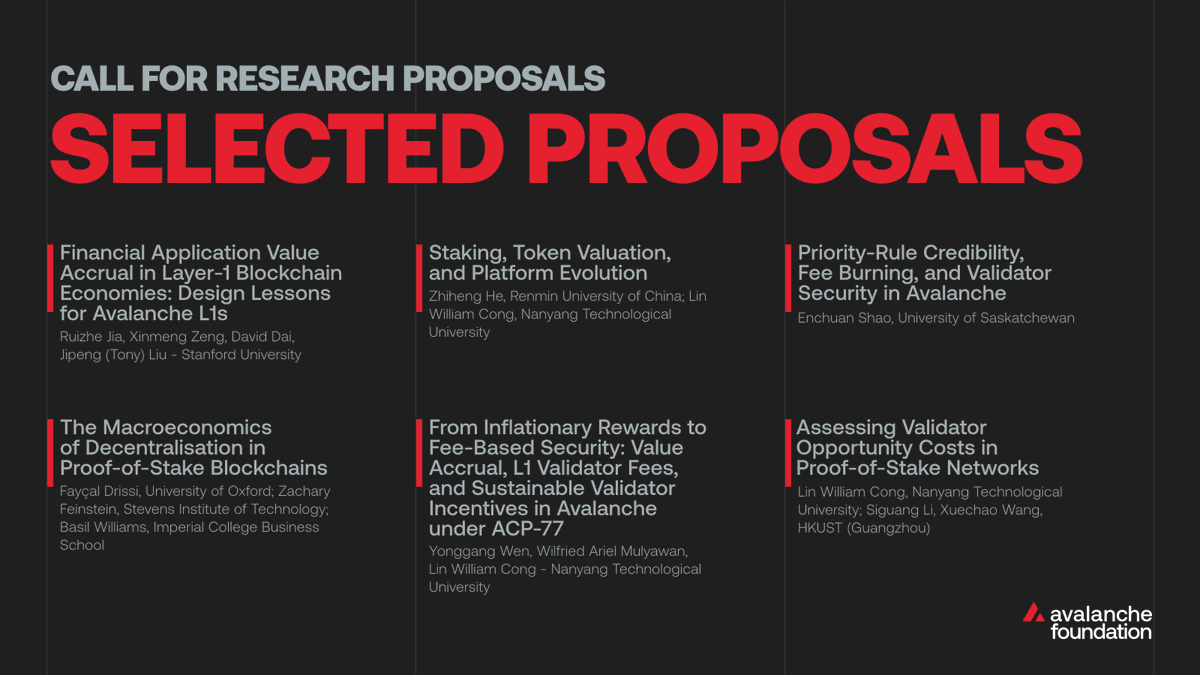
Each proposal was selected for its potential to inform how Avalanche approaches cryptoasset pricing and valuation, and validator economics and network security.
The funded teams include faculty and researchers from Stanford University, the University of Oxford, Imperial College London, Nanyang Technological University and HKUST (Guangzhou), among other leading institutions.
Crazy how Robinhood literally PnD'd their own chain, hurt their brand and then acted like it never happened.
Completely insane behavior from a $100B+ company.
Their crypto team is beyond incompetent.
Details
*Exclusive agreement
*NYSE tested multiple options
*NYSE chose $AVAX for its speed, throughput, and "ability to support a controlled network with compliance requirements"
crypto as a space has elevated the worst spokespeople we possibly could have - and even after repeated red flags the size of barns we are BARELY learning.
wtf is it going to take to actually try and repair the public image of this industry?
do you want it to survive and thrive? start elevating more helpful voices.
🚨NEW: Former House Financial Services Chair @PatrickMcHenry just delivered blistering criticism of the crypto industry on @BloombergTV for squandering its best opportunity to pass market structure legislation this year:
“Frankly, you had a crypto coalition that blew it. They had an opportunity to legislate, and they were holding out for something that was unattainable, a perfect piece of legislation. And rather than take something that was good, many of them held out for perfection, and now have ended up with nothing legislatively.”
Crypto's SEC gains could be reversed: Dems reportedly float a Clarity Act rewrite giving the SEC more power and the CFTC less
"Democrats aim for major changes to Clarity Act with election win."
"If we get a Clarity Act or something similar, it will now be written by the people who hate the industry most. It took about three hours for this to come true."
"Maxine Waters, has now floated new language for an updated version, basically, of what would replace the Clarity Act, as predicted before. This was cited by 3 industry sources who spoke with Democrat staffers and reported by my friend Eleanor Terrett."
"The main ideas here are a larger SEC role and a smaller CFTC role, which seems like it's not a big deal right now because we have a very favorable SEC and a very favorable CFTC."
"When the pendulum inevitably swings back, anything being done right now by the SEC that's pro-crypto could effectively be reversed."
🚨NEW: The OKXICE opt-out list keeps growing.
Palantir, S&P Global, KLA, Super Micro and Meta are the latest to object to tokenized trading of their shares.
67 issuers have now objected, including 56 of the 62 companies in the venue’s original lineup.
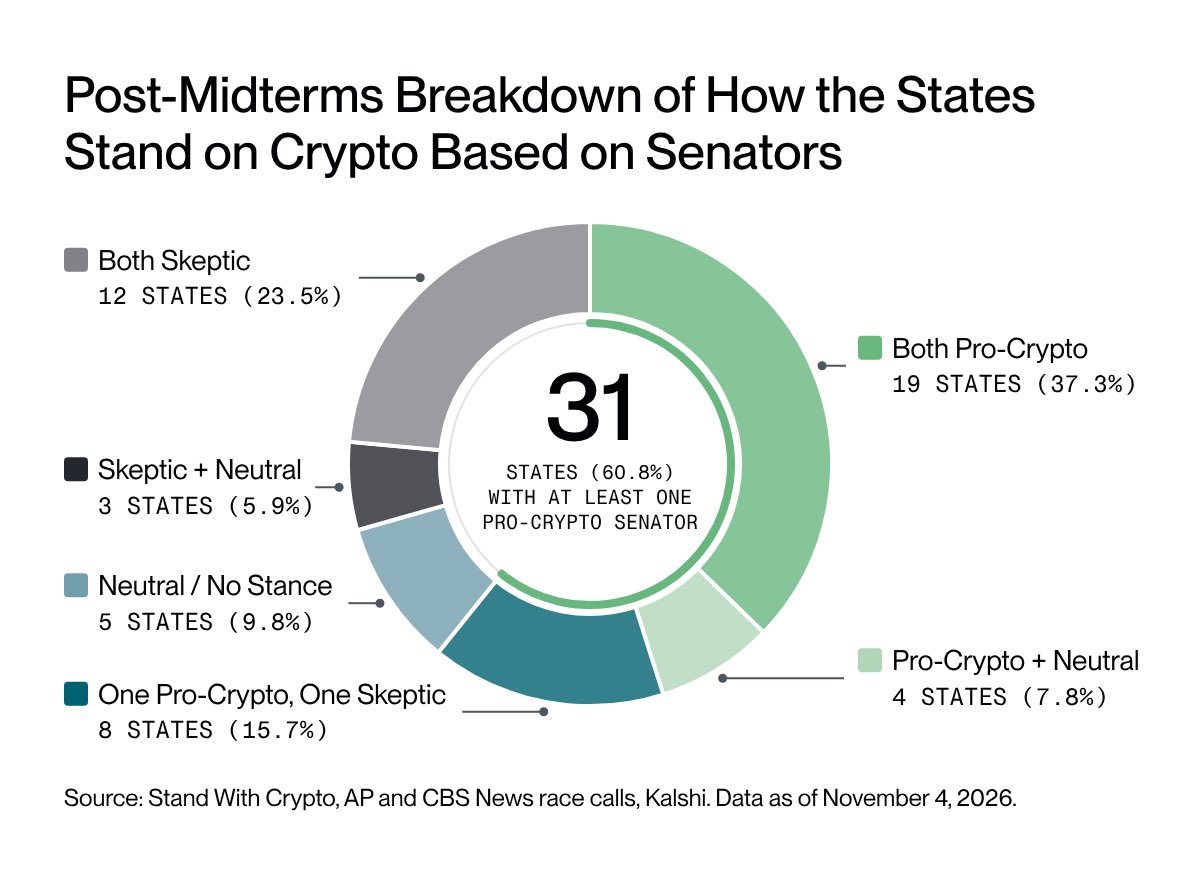
Some of those "pro-crypto" senators are Democrats who voted against CLARITY. One of the issues with the crypto community is that even bad news is interpreted as good news so there's never any reason to reflect and change course.
Before the CLARITY vote, the crypto community insisted it was important to pass that legislation. However, afterwards, the narrative became that it's no big deal that it did not pass. Now we get the same propaganda associated with the midterm elections.
Take the loss. Reflect. Come back stronger. What doesn't kill you makes you stronger but if you won't accept that something is killing you then you are going to die predictably.
🚨NEW: Three more issuers have objected to @okx/@ICE_Markets tokenizing their shares, bringing the total to 59:
Apple
The Home Depot
GE Vernova
Six of the Magnificent Seven have now objected. Meta wasn’t on the original list.
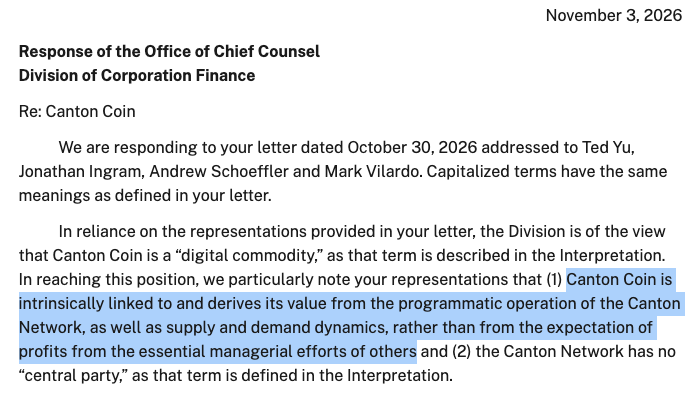
Incredible. @CantonNetwork just received no action relief from the SEC for its network token.
The @SECGov's token taxonomy from March and follow up FAQs have now created a clear pathway out of securities laws—Network tokens are digital commodities.