Growing the professional potential of women & youth in Web3 & AI.
Educate a woman, educate a generation.
🇨🇦 Federal Not-for-Profit
⚠️ NO OFFICIAL TOKENS
CryptoChicks is a mission-driven non-profit. While we are grateful for the organic support of the Web3 community, we maintain a policy of independence. CryptoChicks has no official tokens, no funds, and does not provide investment advice. Our focus is 100% on education. 👩💻✨
We’re excited to join Toronto Blockchain Week 2026 by @Web3To as a Community Sponsor!
Looking forward to connecting with Toronto’s blockchain and Web3 community on November 24–25.
See you there!
🎟️ https://t.co/EoGJr3wwVb
🔗 https://t.co/9L4JKoeLGC
We battle tested our Ziren ZK tech (@ProjectZKM) on @GOATNetwork to bring it home to @MetisL2.
Now, Metis users will get the best of both worlds: fast withdrawals and the peace of mind of post-quantum security.
Metis is getting a Turbo button.
The speed of an optimistic rollup with the certainty of a zero-knowledge rollup.
Withdrawals reduced from days to hours, and the chain is on a path to become quantum-proofed before the quantum computers arrive.
$1,500 is paid out every month. Only qualifying builders share it.
Top 3 split it: 🥇 $800 🥈 $450 🥉 $250
Only 1 qualifier? They take the full $800.
Metis Rise. Rolling applications.
https://t.co/a6gCL1QWKB
9 years ago today I organized the first ethglobal hackathon, ethwaterloo, with @VitalikButerin at his university. It's been a ride. Honored to help V build ETH in the early days
CryptoChicks will be at @BlLife_Forum 2026, Dec 1–2 in Dubai! 🇦🇪
15,000+ attendees, 130+ countries, 200+ speakers & 200+ sponsors.
Web3, AI, major players & what’s next.
🎟 Save 10% with code CRYPTOCHICKS:
https://t.co/1XihLwhXvL
🏆 The @openclaw Summer Builder Bootcamp Winners Are In!
The builds are shipped, the demos are done, and the final results are here.
🥇 1st — Sage @sagepaysai
🥈 2nd — Triage @abl_373
🥉 3rd — Agora @usingagora & Aitch @HarshilSut84046
This is exactly why we need better agent coordination.
If the prompt is already written, your agent should be able to handle the feedback, make the changes, and move the PR forward without turning a simple review into another round of manual ping-pong.
One positive consequence of all the recent detailed thinking about transaction formats - not just 8141, also "future of state" discussions eg. UTXOs, PBT, keyed nonces, and also recursive STARK mempool - is that we have a much more explicit understanding of how transactions have "actions" and "dependencies", and we can engineer around optimizing the two separately.
An action is an effect that a transaction has.
A dependency is a fact about the transaction and/or the state that must be true for the transaction to be valid.
eg. a signature is a dependency, a Merkle proof of a UTXO is a dependency, a ZK-SNARK (or STARK) is a dependency, a call that sends ETH is an action
Dependencies can be processed in parallel. Dependencies that involve state can be reasoned about by a mempool, especially if the specific state accessed is statically declared. Dependencies that are pure (no state calling allowed) can be processed once at the mempool layer and never need to be processed again - and potentially even replaced with a STARK verifying them, allowing not just execution but also data to be elided.
In principle, dependencies and actions can all be expressed as calls (if needed, calls to precompiles). This would make the transaction format itself very bare-bones and minimalist (a list of calls, flags for the type of each call eg. dependencies would be static or pure calls, and origin, nonce, etc) and allows maximum cross-compatibility even if different EVM chains have different features.
In 2015-era Ethereum, thinking explicitly about these differences was not very important: execution was execution, there were few enough transactions that we could process them all serially, and single-key ECDSA accounts were good enough for everyone.
Ethereum's current scaling strategy, however, requires moving beyond that paradigm. Ethereum is beloved by many developers because the execution and state model is so dynamic and flexible. But dynamic and flexible is not friendly to scaling. Fortunately, >90% of Ethereum's activity by volume does not require anything dynamic and flexible. So, we require contracts, accounts and transactions to more explicitly specify what is dynamic and flexible and what is more statically-analyzable but more restrictive, and more statically-analyzable things get the lowest gas cost and thus scale the most. Effectively, learning from the best of both the 2015-era Ethereum model and a more Bitcoin-like model (reminder: Bitcoin has had what I call account abstraction since the beginning), and making a mixture of both (really, the full spectrum between both) available, with gas costs appropriate for the level of scale involved.
New state types, the recursive STARK mempool, keyed nonces, etc all go in this direction.
This all relates to transaction types, because a general-purpose transaction type is a very natural interface layer on top of which all of this can be implemented, and the current thinking around the EIP-8141 transaction type is going in this exact direction that is friendly to these kinds of future generalizations.
So in that sense, 8141 done well is not just a culmination of 10 years of account abstraction work, it's also preparation for the next few years of responsible decentralization-friendly hyper-scaling.
We are proud to be a Community Partner of @BlLife_Forum 2026 in Dubai 🇦🇪
Join 15,000+ attendees from 130+ countries for Web3, crypto, mining & AI.
🎟 Get 10% off with code CRYPTOCHICKS: 🔗 https://t.co/z8UABzA4RJ
We are proud to be a Community Partner of @BlLife_Forum 2026 in Dubai 🇦🇪
Join 15,000+ attendees from 130+ countries for Web3, crypto, mining & AI.
🎟 Get 10% off with code CRYPTOCHICKS: 🔗 https://t.co/z8UABzA4RJ
OpenClaw Summer Builder Bootcamp 2026 - Live Demo Day 🦞
The builders have put in the work. Now it’s time to bring their projects live and show what they’ve built.
Joining us as guest speakers: @ElenaCryptoChic – Co-founder of Metis @MetisL2 and CryptoChicks @crypto_chicks, @kevinliu – Co-founder of GOAT Network @GOATNetwork and Metis, @sd_eigen - CTO of ZKM @ProjectZKM, Andrei.S Decentralization Coordinator of Process & Governance, Metis.
See you at 9:00 AM EST, August 26
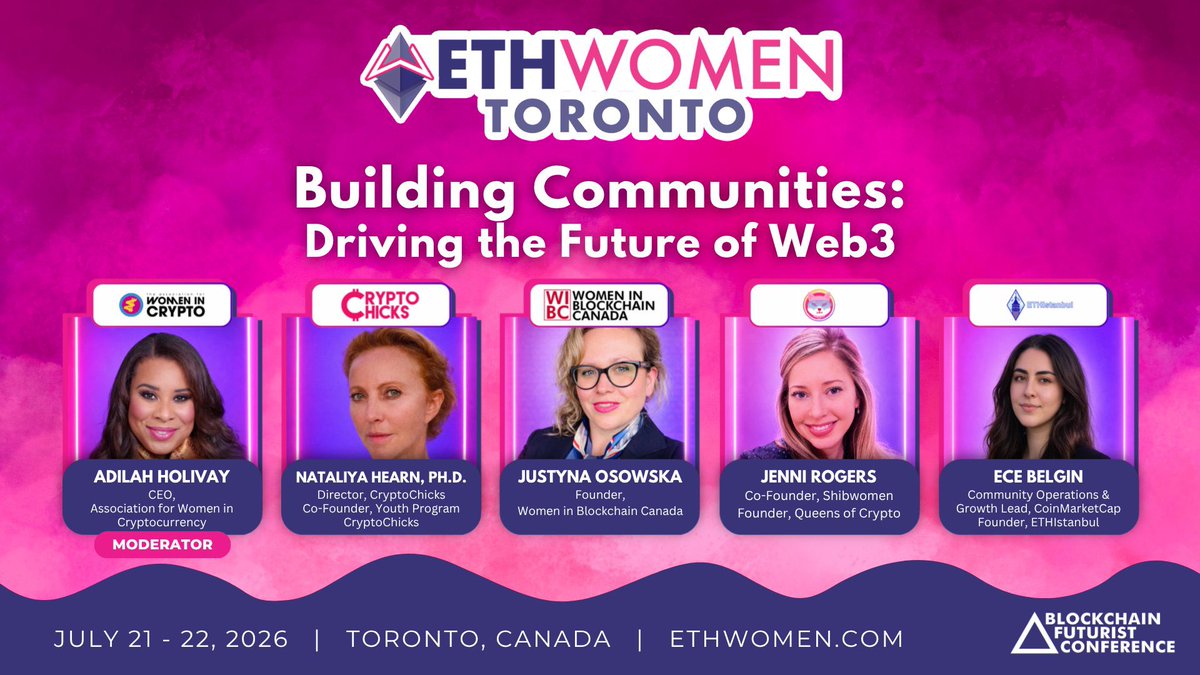
Looking forward to Futurist conference next week!
Join me on the panel called: Driving the Future of Web3
July 21-22 in Toronto, Canada 🇨🇦
Speaking alongside:
▪️ Adilah Holivay, @AWICglobal
▪️ Nataliya Hearn, @crypto_chicks
▪️ Jenni Rogers, @Shibtoken
▪️ Ece Belgin, @ETHIstanbul
"Who controls this agent? Has it completed transactions? Has payment settled?"
As Growth Partner Arshiya explains, blockchain provides a shared coordination layer that allows every agent to verify answers on-chain.
That's the vision behind Metis.