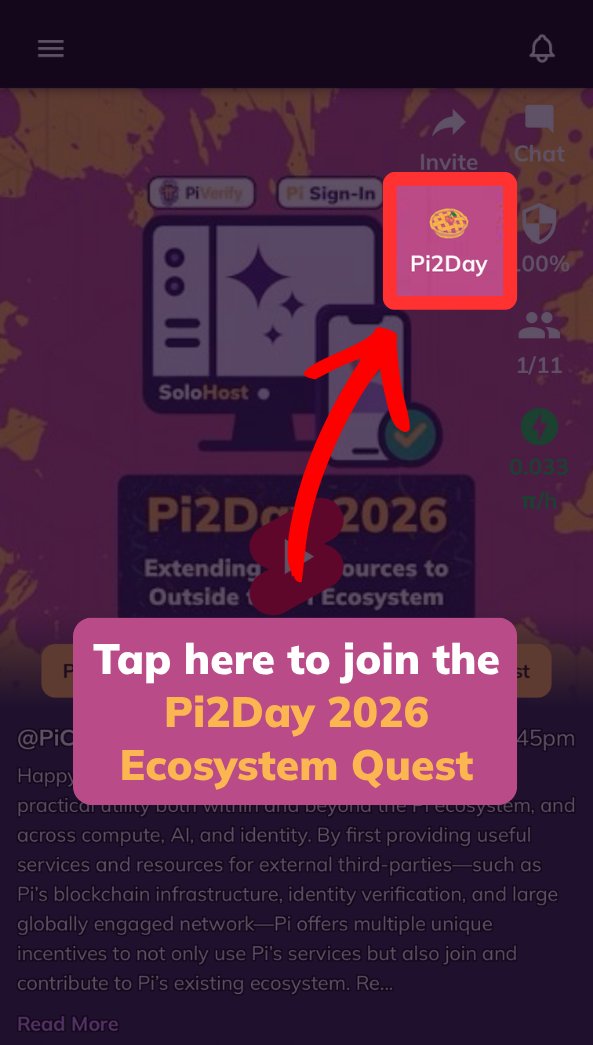
Take on the Pi2Day Ecosystem Quest to celebrate new feature releases and receive a special in-app badge!
The Ecosystem Quest guides Pioneers to complete activities to discover new apps, test ecosystem features, and understand how Pi’s infrastructure supports utility creation across compute, AI, and identity.
Certain steps in the Quest require completing a quiz, so remember to pay attention to the updates! You can show-off your in-app badge in Pi Chats, Fireside Forum, and Pi Social Profiles.
Participate in the Ecosystem Quest by tapping the “Pi2Day” icon on the top right of the Pi mining app home screen. The event will end on July 13.
New to Pi? Download the Pi mining app and get started here https://t.co/sHTvwa8Vt7
Pi2Day 2026 reflects how Pi’s utility continues to grow through infrastructure and participation.
- Through SoloHost, Pi Desktop and Nodes can support new local AI app and compute use cases
- Pi Sign-in can help connect those experiences across users, devices, and services
- PiVerify can extend Pi’s real-human verification capabilities to third-party clients.
Together, these releases point to a broader direction for the ecosystem: Pi products are built both for the Pi ecosystem and to extend Pi services and resources to the external world. This, in turn, enriches and strengthens the Pi ecosystem.
Pi’s practical utility is built not only by product releases but by the Pioneers, Node operators, developers, KYC validators, app teams, merchants, and third-party services that use them, test them, and build on them.
Read the Pi2Day 2026 blog to learn more
https://t.co/5hkl8TAxxQ
PiVerify is a KYC identity verification service available to third-party companies, making Pi’s real-human verification capabilities available outside the Pi ecosystem.
With PiVerify, external platforms can verify their users, reduce fake or duplicate accounts, and support compliance-related identity workflows.
For businesses and platforms, the need is straightforward: many digital services need to know whether users are real people. Verified identities are needed for any meaningful transactions, especially in real-world economies.
PiVerify services are also paid for in Pi, which increases Pi utility.
By making this infrastructure available to third parties, the Pi2Day 2026 PiVerify release extends the utility of Pi’s verified identity technology and resources beyond Pi’s own apps and services.
Learn more at https://t.co/azUeoeGENF
Pi2Day (tomorrow, June 28) is a moment to engage with new product releases and gain insight into the direction and priorities of the network.
Reminder: This year, Pioneers also have a timely opportunity to take part in app utilities expansion, community growth, and ecosystem development feedback before the events end tomorrow on June 28.
Participate in the two initiatives, the vibe coder campaign and Pi Launchpad Testnet token, now and stay tuned tomorrow for Pi2Day!
https://t.co/CCff3IuRQv
Does anyone else feel that running AI models and agents locally, on your own computer, should be much easier?
The privacy benefits are clear: your data stays with you. But while there are many open-source models and projects out there, turning them into a usable local AI agent is still far too hard for non-engineers.
Ecosystem Directory Staking just got a new look and improved user experience!
Originally launched on Pi2Day 2025, staking through this feature increases an app’s exposure to the Pi community, resulting in more impressions and potentially more user traffic. By staking Pi, Pioneers can collectively support apps and services while developers and creators can promote their apps and tap into Pi’s 60M+ engaged community to acquire users.
The update prepares the feature for further utilization by developers, creators, vibe coders and Pioneers as more apps onboard to the ecosystem.
Note there are no rewards at the protocol level for staking, and the original staked amount will be returned once the staked duration has ended.
Go to the Pi home screen to learn more about Ecosystem Directory Staking and check out the recent design updates to the Ecosystem Interface.
Pi Launchpad has updated its participation flow and model, incorporating data and feedback from the first Testnet token that launched on Pi Day 2026!
The first Launchpad test token attracted over 478,000 participating Pioneers and generated valuable feedback on the Launchpad mechanism. That feedback has now been incorporated into a simpler participation flow, updated Launchpad mechanics, and an improved user experience.
A second test token “SLICE” is now live on Testnet to help evaluate if the updates can achieve these goals, and to give Pioneers another chance to learn the new ecosystem token mechanics. As a reminder, SLICE is a Testnet token and will never go onto Mainnet.
To participate:
• Open Pi Launchpad in Pi Browser
• Review the SLICE test token and project
• Choose a commitment amount in Test-Pi
• Confirm participation
• Engage with the Slice of Pi app and provide feedback
Participation will remain open until Pi2Day on June 28.
Learn more on the Pi home screen!
The Pi Mainnet is upgrading to Protocol 25.
Deadline: June 18.
All Mainnet nodes are required to complete this step before the deadline to remain connected to the network. This upgrade takes longer to complete. Plan accordingly.
Details here: https://t.co/9VehO7hhj1
🚀 Over 5 Million Pi Now Staked on CiDi Games! 🎮💞
More than 5 million Pi has now been staked on CiDi Games, showing the strong support and trust the community has in the project.
This milestone didn't happen by chance. It reflects developers building, players engaging, and Pioneers supporting a growing gaming ecosystem powered by Pi.
Every Pi staked is a sign that people believe in the long-term vision and future potential of CiDi Games. 🔥
From the first launch to today, the progress has been impressive—and it still feels like we're only getting started.
Congratulations to the entire CiDi community!
#PiNetwork #CiDiGames #PiGaming #Pi
The Pi Mainnet is upgrading to Protocol 24 – Deadline: June 2.
The Pi Mainnet has successfully upgraded to Protocol 23. All Mainnet nodes are required to complete this step before the deadline to remain connected to the network.
Details here: https://t.co/9VehO7hhj1
BIG: Pi Network’s month was bigger than price action, with major moves across access, infrastructure, AI apps, and ecosystem utility.
This month, $Pi Network moved on three key fronts: access, infrastructure and apps.
1. OKX made PI accessible to millions of users in the United States for the first time through its platform, giving the token a wider market reach.
2. On the technical side, Pi said most major Mainnet Nodes have upgraded to v23, with the protocol expected to move ahead after one of its most important infrastructure upgrades.
3. The ecosystem also pushed deeper into AI. Pi App Studio now allows creators to convert AI built apps into Pi Apps, while builders using tools like OpenAI Codex, Claude Code and Replit can integrate Pi into their workflows.
4. At the same time, Pi continues to face token unlock pressure, with over 200M PI scheduled to unlock this month and 1.65B more over the next 12 months.
Watch Pi Founder Nicolas Kokkalis speak in the Consensus 2026 panel “How to Prove You’re Human in an AI World (Without Doxing Yourself)”.
The discussion focused on how digital trust and identity verification systems must evolve as AI makes it possible to generate bots, agents, and synthetic identities that closely resemble real human behavior at scale.
The panel explored a core question for the AI era: how systems can continue to verify real human participation without requiring unnecessary disclosure of personal information.
A key theme was that proof of humanity is context-dependent, with different systems requiring different levels of verification depending on use case and risk.
The importance of privacy-preserving design was also highlighted, ensuring verification can scale while remaining usable for real users.
As AI lowers the barrier to building and interacting online, the harder challenge may be connecting digital systems to real users, trusted participation, and meaningful utility.
Pi’s Layer 1 blockchain, identity verification, payments infrastructure, non-custodial wallets, smart contracts, and engaged global community are all part of Pi’s ongoing work to address that challenge.
Watch the full presentation now!
https://t.co/nFCz9nF7RR
JUST IN 🚨
The Pi ecosystem keeps expanding fast. 🟢🎮
@playcidi has officially launched Elf Continent — a new social gaming world built for Pi Pioneers and CiDizens.
Players can now:
🌾 Farm resources
⚒️ Craft items
💱 Trade with others
🌍 Explore a shared virtual world together.
This is another strong signal that the Pi ecosystem is moving far beyond simple mining and into real Web3 experiences with community-driven utility. 👀🔥
If adoption keeps accelerating like this, gaming could become one of the biggest growth sectors inside the Pi ecosystem. 🚀
#PiNetwork #PiCoin #PiCommunity #Web3 #CryptoGaming #GameFi #PiFuture #CiDiGames
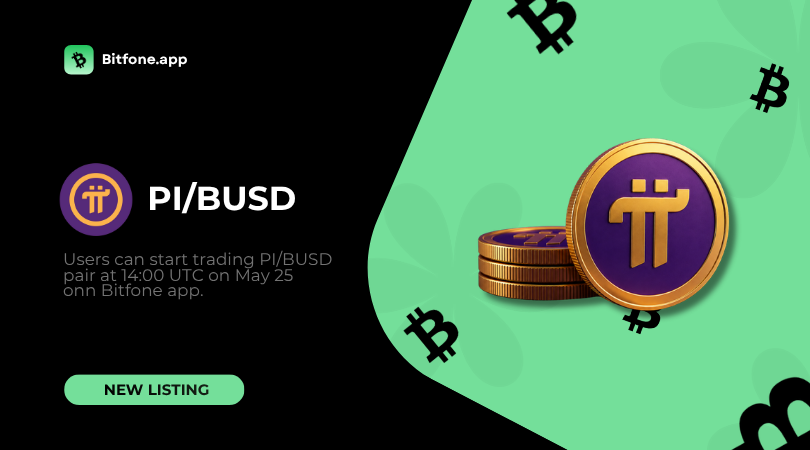
📢FIRST FUTURES LISTING ALERT
Bitfone will officially list $PI on its testnet futures exchange!
Users can start trading $PI / $BUSD pair at 14:00 UTC on May 25.
Our ecosystem keeps growing - and to celebrate, we're giving away 1,000 $PI to 10 users who comment how long the $PI community was mining $PI before its launch date.
Start mining $BUSD now at https://t.co/xY9DX0bbHk
First week of CiDi Games Beta.
- 81,000+ Pioneers registered.
- From 162 countries and regions.
- 1.2M+ game sessions.
- 21,000+ entries in our first tournaments.
- 40,000+ peak daily actives.
- 3.19M+ Pi staked.
- 10,000 Genesis Pioneer skins fully claimed.
To every CiDizen who made this week real, thank you.💚
Pi Founder Chengdiao Fan’s talk at Consensus 2026 was centred on a simple but important challenge:
The frequent misalignment between token design and real product innovation.
Her presentation, “Aligning Web3, AI, and Blockchain for Utility,” explored how tokens can be treated as tools that can support user acquisition, product engagement, and long-term utility.
One implementation of this approach is Pi Launchpad, Pi’s design for ecosystem tokens and launch mechanisms that aims to help products acquire real users who can engage, provide feedback, and use those tokens within actual product experiences.
As AI makes it easier to build applications, the limiting factor is no longer creation.
It is distribution and usage.
Pi’s approach combines blockchain infrastructure, innovative token and launch mechanisms, identity verification, and a large engaged network of real users to address that gap directly.
Enjoy the full talk & leave your thoughts on Pi’s approach to tokens and launch mechanisms!
https://t.co/YiYqcxo0jJ