AI agents are going to trade very differently from people, with thousands of small decisions a minute, positions to adjust constantly and zero tolerance for friction.
In trading, friction shows up as cost and latency, and every bridge, wrap, gas payment or deposit to a centralized venue slows execution, eats into returns or leaves capital sitting idle in the wrong place.
State channels change that math, because an agent can open a channel with a venue once, execute continuously in real time, net every trade off chain and settle only the final balance, without ever handing its funds to anyone.
That lets an agent react to the market as fast as its logic allows, entering and exiting positions without paying for every single move or trusting a counterparty with custody.
Run that on rails like the @XRPLF EVM Sidechain, where settlement is fast and cheap with @XRP as gas, and agents can trade tokenized real world assets with the same speed they'd expect from any liquid market.
That's why we integrated Clearnet with XRPL EVM, and I think the next real wave of onchain volume comes from agents trading with as little friction as the infrastructure allows.
State channels eliminate the friction of high-frequency operations.
Yellow is bridging the autonomous AI economy with the ultimate standard in digital settlement. ⚡
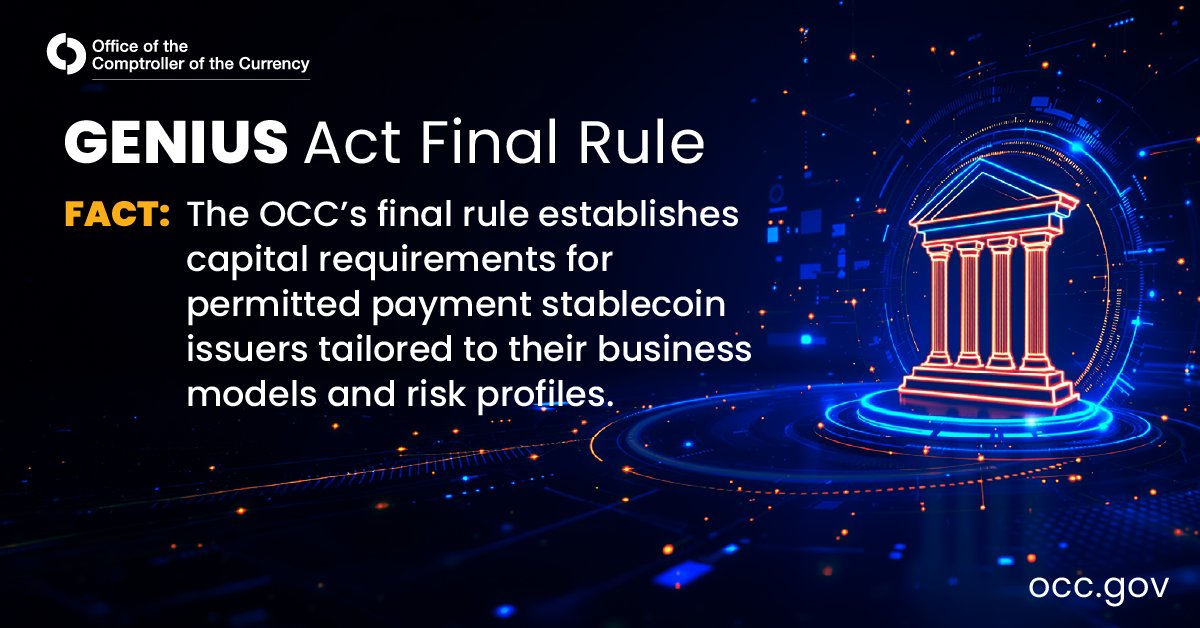
A strong financial foundation supports responsible innovation and confidence in the new industry. The OCC’s final rule establishes capital requirements that complement the rule’s broader financial safeguards, which are designed to support timely redemption of payment stablecoins and issuer solvency. https://t.co/e2YOVjynUN
President Trump signed the GENIUS Act into law to reshore innovation, reassert dollar dominance, and cement America’s leadership in digital assets. @USComptroller Jonathan Gould discussed the OCC’s final rule to implement this historic legislation and create a federal framework around payment stablecoins from the floor of the @NYSE as the Trump Administration propels American capital markets into the future.
The internet is going into a LOCKDOWN.
Hundreds of millions of websites are potentially at risk from cyberattacks.
Governments, banks and major platforms have already taken their websites OFFLINE.
Many are already calling it “Black October.”
At the centre of the shutdowns is something most of us have never heard of, but use every day.
PHP, the software behind roughly 7 in 10 websites, has two critical flaws that can let hackers break in without a password.
Dubbed PHP2Shell, both are rated 9.2 out of 10 for severity.
Details began circulating on Oct 20. Emergency fixes arrived the next day, but attackers were already moving.
Cloudflare’s CEO says hacking attempts then jumped from thousands to MILLIONS within hours.
Cybersecurity agencies across several countries are telling PHP site owners the same thing: Patch it now, or take it offline.
Websites have gone dark worldwide, from government portals and hospitals to banks.
CrowdStrike warns these attacks leave almost no trace, so some sites may not know if they’ve been hit.
Around 2.6 MILLION internet-facing servers run PHP, potentially hosting hundreds of sites each.
Over 1.1 million use older versions no longer receiving official PHP updates.
Older installations may need an upgrade to a supported PHP version or a fix from their software provider.
And patching does not remove a backdoor an attacker may already have planted.
Cloudflare also says hackers are now tweaking their attacks to try to slip past its protections.
But PHP isn’t the only security story unfolding.
-Japan’s Onamae suspended ALL Desktop Cloud plans after malware was found on customer servers.
-India’s eMudhra had 8 website-certificate keys so weak, one was literally the number “4”.
-State Bank of India confirmed 3,897 customer records on the dark web.
-Criminals used AI agents to break into 400+ Latin American banks.
-Capcom confirmed a breach exposing 11.7 million email addresses.
-GitLab disclosed a 10/10 severity flaw in versions going back to 2014.
-LiteLLM removed a malware-containing release. Railway reported possible exposure of customer secrets.
None of these has a confirmed link to PHP2Shell.
We’re seeing separate breaches unfold together.
The true number of incidents could take months to come out.
The world is still on alert. Attacks are still coming.
The people who run digital assets at DTCC and U.S. Bank will be in Lisbon next week, talking about what they’re building on @StellarOrg.
You can be in the room. Meridian, Oct 28–29.
Register: https://t.co/TpceCSCUfs
SBI XDC Network APAC, SBI VC Trade and Shinhan Card have signed an MOU to explore cross-border payments and in-store payment integration using a JPY-denominated stablecoin.
Advancing payment use cases across Japan and Korea.
https://t.co/O6Qf1vsd29