BREAKING NEWS: The central bank of central banks just switched on real money on a programmable settlement rail.
8 central banks. 40+ commercial banks. Mastercard, Visa, and Swift all signed on.
JPMorgan. HSBC. Citi. BNY. Deutsche Bank. UBS. BNP. Santander. MUFG. NatWest.
No ticker. No IPO. Press release in Basel on a Tuesday.
The cross-border dollar rail is migrating. Same banks that called this a fad are co-building it.
In 10 years when your kids ask how you knew, you noticed a BIS press release on May 27.
Something happened in the last 5 days. Nobody’s connected the sequence yet, at least that I’ve seen.
Let me lay it out.
May 19 — Trump signs EO directing the Fed to open its payment infrastructure to crypto and fintech firms. Frames it as a national competitiveness issue. 90 days to rule on completed applications. Transparent procedures. No more waiting in silence.
May 20 — The Fed opens a 60-day public comment period on “skinny” accounts. Limited Fed rail access for eligible non-bank institutions. Direct settlement. No intermediary banks.
Then they close the line.
Tier 3 applications: the category every crypto-native firm falls into — has been put on PAUSE.
⏰ No new applicants considered until the framework finalizes in Dec. 2026 ⏰
3 firms made it before the door shut:
Ripple
Anchorage Digital
Wise
That’s it.
The line is three deep.
what separates them?
Wise: money transfer company. No OCC charter. No stablecoin. No Fed-facing reserve structure. Consumer remittances done efficiently. That’s the ceiling of their story.
Anchorage: the oldest federally chartered crypto bank in America. OCC approved since 2021.
Now the issuance engine behind Tether’s USAT stablecoin, with 20 institutions queued to issue through them. Excellent infrastructure. But here’s what they don’t have: an active cross-border payment network. No live ODL-equivalent corridors. No bridge moving volume between markets that lack native liquidity. They issue and custody. They don’t move and settle at scale across borders.
@beyond_broke
Ripple: OCC conditional approval. NYDFS regulated. $RLUSD fully backed 1:1, audited, GENIUS-compliant before the bill even passed. And the piece nobody else in that line has: a live, global payment network w/ real ODL corridors already moving cross-border volume. And XRP as the bridge asset settling between them in seconds.
Issuance + custody is table stakes now.
The differentiator at the Fed rail level is who can actually move and settle value across borders at institutional scale.
Only one firm in that line of three does that today.
Now, the full sequence:
March 2026 — Kraken becomes the first crypto-native institution to receive a Fed master account. Applied in 2020.
Approved by the Kansas City Fed in 2026.
Five years.
Proved it was possible. Set the precedent. But Kraken is an exchange. Not a payment network. Not a stablecoin issuer. Not a bridge asset.
May 19 — Trump EO tells the Fed: decide on completed applications within 90 days.
May 20 — Fed opens comment period. Closes the line. Three firms inside.
This isn’t a payments story.
It’s a treasury story.
Payments move money.
Yield attracts money.
But a FM account determines whose balance sheet becomes the gravity…whose ledger other institutions have to touch to settle.
How do you think correspondent banking hierarchies formed?
The banks with Fed access became the rails. Everyone else became a customer of those rails.
The dollar isn’t the global reserve currency because people trust America. It’s the reserve currency because the plumbing routes through American institutions. $SWIFT. Correspondent banks. Fed master accounts.
These aren’t features of $USD dominance. They’re the mechanism of it.
Those pipes are being challenged. BRICS corridors. CBDCs. Dollar system fragmentation.
The U.S. isn’t defending the old pipes. It’s building new ones. Faster. Cheaper.
Dollar-denominated.
On American-designed rails.
#RLUSD reserves sitting directly at the U.S. central bank. ODL corridors settling cross-border payments in seconds. XRP as the bridge asset between every corridor that lacks native liquidity.
The U.S. doesn’t need the world to use old dollars.
It needs the world to keep settling through American infrastructure.
Ripple National Trust Bank.
Fed master account.
GENIUS-compliant stablecoin. XRP as the liquidity layer.
That is American infrastructure.
rebuilt for the next 50 years.
3 firms in line. One door.
Closed: May 20, 2026
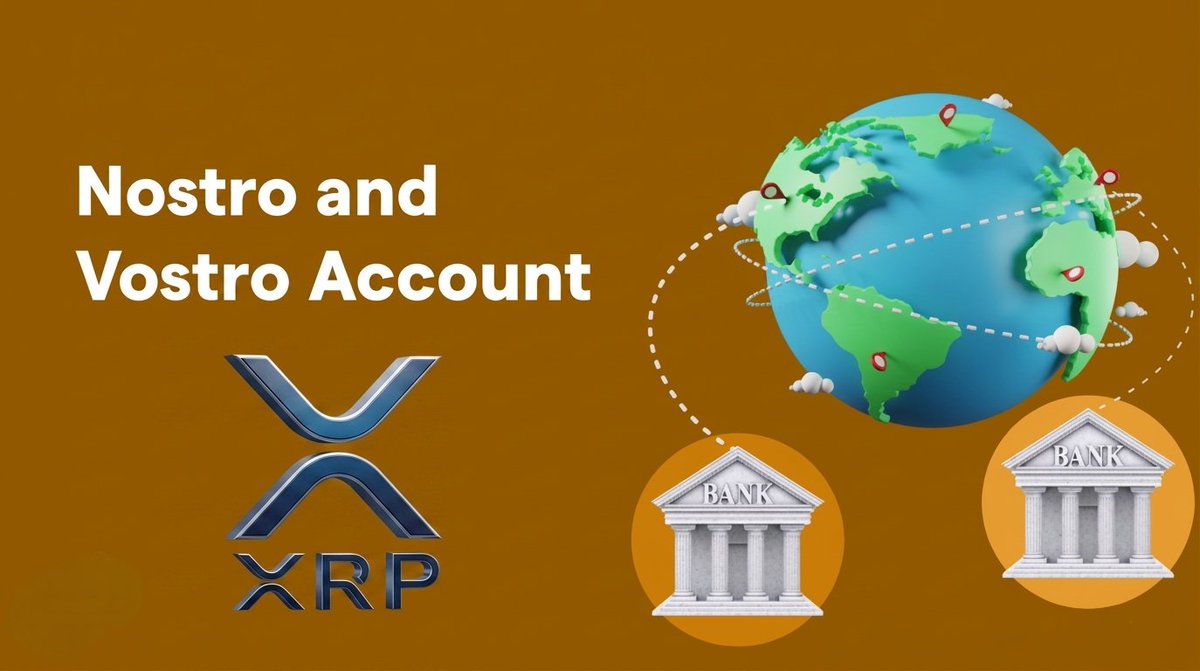
The Nostro/Vostro Problem ($27–30 Trillion)
In today's traditional banking system (SWIFT), it is technically impossible for a bank in one country to send money to another country within seconds. Because of this, banks are forced to engage in pre-funding with correspondent banks in destination countries.
Nostro Account: A bank's own money held in a foreign bank ( Our money )
Vostro Account: Money held by a foreign bank in that specific bank ( Your money )
Banks worldwide are required to hold trillions of dollars idle (sitting dormant, earning zero interest) in these accounts just so cross-border transfers can happen quickly. This represents a massive liquidity lock-up and a staggering cost for global finance.
XRP Will Solve This Problem ✨
This is not a claim, it is a technical and mathematical fact. In fact this is precisely the sole purpose of the XRP Ledger (XRPL) and Ripple's cross-border payment protocol (Ripple Payments / formerly known as ODL)
For trillions of dollars in global volume to flow through these pools, the market value and liquidity depth of XRP must reach significantly higher levels. Therefore, the viability of this system is not a mere theory—it is an absolute certainty.
‼️ RIPPLE JUST PARTNERED WITH THE NEXT MAJOR SWITCH FOR THE ENTIRE CRYPTO SPHERE ‼️
Ripple Prime has just integrated with EDX Markets.🤝
This is a major development that all eyes should be on.🔒
Here’s why:
EDX Exchange is backed by Wall Street giants like Charles Schwab, Fidelity, Citadel Securities, Goldman Sachs, and former executives from CME Group.🔑
Together these firms have a combined $11.5 Trillion in assets under management and serve 77 million active broker accounts.💸
EDX is essentially an institutional-grade trading desk designed for Wall Street.💯
And it is now integrated with Ripple Prime.✅
The even more interesting aspect of this partnership is the descriptions used to evaluate the impact EDX will have on digital asset markets.🙇♂️
“When they FLIP THE SWITCH on EDX Clearinghouse, it’ll be like opening a massive 16-lane superhighway for these semi-trucks full of cash.” 💰 📈
“The impact of this event will be FELT across the ENTIRE crypto sphere.” 💥
Not only will the switch flip on EDX be massive, it will be easy. 😏 💨
“The underlying customer still needs to onboard to EDX, join the clearing house and agree to abide by the market’s rule book but Acuña-Rohter said the connection is ‘BASICALLY A FLIP OF A SWITCH.’🎚️🔥
This is all documented below.📝👇
Delta Force Rescues American Hostage Roy Hallums 🇺🇸
Rare combat footage from a 2005 Task Force 145 raid in Iraq capturing the moment Delta Force operators rescued American hostage Roy Hallums from a hidden underground bunker.
After inserting by helicopter into rural farmland, the assault team breached the target compound, discovered a concealed trapdoor beneath the floor, and pulled Hallums to safety after months in captivity.
The footage provides a look at one of the most intense real world hostage rescue operations of the Iraq War.
Two quadrillion dollars in US stock and bond trades clears through one company every year.
That company just announced it's moving onchain.
DTCC is the clearing house behind every US equity trade since 1973. On May 4, 2026 they launched a tokenization platform. Fifty Wall Street firms signed on at the same time. BlackRock. Goldman Sachs. JPMorgan. Citi. Morgan Stanley. Bank of America. HSBC. NYSE. Nasdaq. Kraken. Circle. Fidelity Digital. Ripple. The asset managers, the banks, the exchanges, and the crypto native infrastructure all on the same launch document.
Russell 1000 stocks. Major index ETFs. US Treasury bills, bonds, and notes. All going onto blockchain rails.
Pilot in July. Live launch in October.
The same firms that called crypto a fad for the last decade are now rebuilding the entire US settlement system on top of it.
The biggest financial migration in 50 years has no ticker. No IPO. No hype cycle. Just a press release nobody read while everyone argued about the next 10 percent pullback.
In ten years, when your kids ask how you positioned for this, you won't have to say you had insider info. You'll just say you noticed the press release on a Saturday in May.
Goldman Sachs hired this 16-year-old trader and gave him $10M to manage in his first week
- then he then took his strategy to JP Morgan and Lehman Brothers, before retiring and going to space (really)
11-min workshop from a tier-1 trader with the story of his strategy
it's the most honest trader interview about the truth of Wall Street you'll ever find
🇺🇸🇨🇳 The U.S. has 4,000 data centers, while China has 365.
But 24 months ago, AI training required 100 megawatts.
Today the minimum is 1 gigawatt.
The U.S., Canadian, and Mexican grids can't deliver that. China's can.
The AI race was never about who built more, but who built bigger, and right now, America's own power grid is the bottleneck.
🚨 MUST WATCH $XRP ALLEGED 2ND LARGEST HOLDER ON HIS CRYPTO JOURNEY
Greg Kidd was @Ripple's 10th employee and he shares his “Forrest Gump” style path through the early days of crypto, from getting a front row seat to blockchain’s rise, to becoming an early investor in Coinbase.
With DTCC starting limited trading in July and going full scale in October 2026.
DTCC has made the roles and importance of these five networks clear.
$XRP and $XDC Network are the primary assets for settlement, while $LINK, $QNT and $HBAR provide the "piping" to make it happen.
XRP:
Leads for high-liquidity bank-to-bank settlement. In March 2026, Ripple Prime (formerly Hidden Road) was officially named a participant in the DTCC’s NSCC directory, specifically to facilitate institutional post-trade settlement using XRP as a bridge asset.
XDC:
Dominates in trade finance settlement. It is the primary rail for tokenized bills of lading and letters of credit, achieving under-2-second finality. Its 2026 growth is driven by its Contour acquisition, which integrated thousands of trade finance users directly onto the XDC rail.
QNT:
Focuses on CBDC-to-commercial bank settlement. Its Overledger platform allows central banks (like the Bank of England) to settle tokenized liabilities using regulated "locked" digital currencies rather than open-market bridge assets.
Chainlink and HBAR however, currently hold the deepest structural integrations within the traditional financial bank systems.
LINK:
The most integrated data and messaging layer. By 2026, Chainlink has moved into full production with the DTCC, Swift, and Euroclear to automate $58 billion in annual corporate actions (dividends, splits). It uses its CCIP and Runtime Environment (CRE) to link existing Swift messages directly to the DTCC's private blockchain nodes.
HBAR:
Holds a governance-level integration. As a member of the Linux Foundation's Decentralized Trust alongside the DTCC, Hedera is the preferred public chain for "RWA" (Real-World Asset) notary services. Its Governing Council members, including Google, IBM, and Standard Bank - use the network to track the lifecycle of assets that the DTCC eventually clears.
QNT:
Deeply embedded via the Murex partnership. Murex's MX.3 platform, used by 60,000+ traders daily - now has native Overledger integration, allowing banks to "switch on" blockchain features within their existing trading terminals.
With this cleared out, we now know the importance of these networks within DTCC’s Financial Infrastructure.
Have gotten some questions on this interview with @CryptoWendyO so here we go:
First, the "one company dumps whenever they want" narrative ignores what happened in 2017 when Ripple locked 55 billion XRP in escrow with monthly contracts at 1 billion each. You can verify every single one of them on-chain right now & the schedule is public.
On top of that, most of what unlocks each month gets locked right back up. Net release typically ~200-400 million XRP which is well short of the full 1bn
Ripple sends out a XRP Markets Reports showing every sale, every use case, every re-escrow so the "top secret dump-and-run" framing doesn't jive with a published liquidation schedule
Point 2; is that Hoskinson is saying XRP holders don't own Ripple's prime broker or RLUSD - correct, you hold a token, not shares but those acquisitions aren't running on some separate system, they're what is helping grow the utility of the network and they feed directly into the use of the XRP ledger of which XRP is the native asset
If you're a HODLer and want institutional flow, this is how you get to the rails actually existing for it
RLUSD helps in the same way since Ripple issues a USD stablecoin on XRPL and Ethereum and every RLUSD transaction on XRPL burns XRP as a fee, every liquidity pool pairing RLUSD with XRP drives XRP demand and the stablecoin business feeds the ledger, and the ledger runs on XRP as the native asset
Point 3 - Charles says there's no staking, no way for holders to earn from the network but the XRPL shipped a native Automated Market Maker amendment where users can potentially add XRP in liquidity pools and collect a cut of the trading fees so when you pair it with RLUSD and other issued assets there are paths to yield generation from actual volume on the network
The XRPL uses federated consensus, so validators don't get paid in block rewards and that's a legitimate architectural choice to debate, but saying holders have no way to capture network activity in 2026 just ignores what the AMM does and no one was tricked into thinking that by running a validator they'd be participating in a rewards system
Point four is where i think he's lost the plot with the Tether comparison.
Tether is a centralized issuer running a centralized contract. They can freeze any USDT wallet & control the reserves & if Tether were to disappear tomorrow, USDT would too because the peg depends entirely on their operation
XRP is the native asset of a public ledger with validators run by independent parties around the world and Ripple runs a small minority of those validators
If Ripple were to disappear tomorrow, the XRPL would keep producing blocks and XRP keeps settling transactions. The XRP ledger doesn't need Ripple to exist, the XRPL only benefits from the work Ripple is doing to bring volume and build the ecosystem to the XRPL
With Tether, one company captures all the value because one company is the only party making money off the asset and with XRP, anyone building on XRPL creates activity that flows back into the token
and to the "you can't redeem XRP for Brad's stock options" comment, no, you can't and never could and nobody promised you could
-BTC holders can't redeem BTC for equity in any company
-ETH holders can't redeem ETH for equity in the Ethereum Foundation
-Solana holders don't get a piece of Solana Labs
...It's almost like every single layer-1 out there operates this way
Token value comes from being the required asset to use the network
If you want equity exposure to Ripple, you need Ripple stock, guess what? I own that too because I like what the company is doing
Holding XRP gives you exposure to ledger adoption and that's two different bets with two different risk profiles
People holding XRP understand where we were, where we are now and where we're going - this is the most informed and educated community in crypto imo
With Charles arguing the whole structure is a scheme that doesn't benefit holders, i feel like that falls apart the second you look at how the escrow works, what the acquisitions are building, what the AMM unlocked, and what XRPL does every single day without needing Ripple's permission
Ripple spending billions to build prime brokerage, stablecoin rails, custody tools, and payment corridors on XRPL drives demand for the one asset that fuels the whole network
kthx
Is this the end of the "not your keys" era for BTC?
Bitcoin was built around the idea that nobody touches your coins without your private key. Not governments, not banks, not developers. Now developers are proposing something that breaks it.
BIP-361, led by Jameson Lopp, is a three-phase plan to freeze Bitcoin held in quantum-vulnerable addresses
Early address types exposed public keys by design, and a powerful enough quantum computer could reverse-engineer a private key from a public one
Estimates put roughly 1.7 million BTC (including Satoshi's) sitting in addresses that have this problem
The plan (as proposed) is that three years after activation, no more sending BTC to old-style addresses
Two years after that, legacy signatures become invalid and any coins that haven't migrated are frozen
A third phase would let people recover frozen coins using zero-knowledge proofs tied to their seed phrase, though that part is still under research
Your 720 credit score is worth $250,000
not joking btw
Not in some "good credit unlocks opportunity" way
Literally. Right now. Chase, Amex, and US Bank will approve you for $250,000 in 0% business credit this week if you apply in the right order
Most people with a 720 score are using it to get a slightly better rate on a car loan
The people who understand what a 720 score actually unlocks are using it to fund entire businesses on bank money at zero interest
Here's the exact value of your score in dollars:
Below 680: $30K-$80K available. Limited banks. Shorter 0% windows
680-720: $80K-$150K available. Most major banks approve. Full 12-15 month windows
720-760: $150K-$250K available. Every bank approves. Maximum limits. Longest windows
760+: $250K-$400K+. Banks compete for you. Limits get disgusting
The difference between a 680 and a 760 isn't "better credit"
It's $170,000 in additional available capital at 0% interest
Most people treat their credit score like a report card. Something to feel good or bad about. Something that determines whether they get approved for a personal card with a $5K limit
The people running real businesses treat it like a borrowing capacity number. A specific dollar amount sitting at specific banks waiting for a specific sequence of applications
Here's what $250K at 0% actually means in practice:
You borrow $250K from Chase, Amex, and US Bank. Zero interest for 15 months.
You deploy it into your business. At month 10 you apply for a new round of 0% cards at different banks. Use the new cards to pay off the old ones. 0% window resets for another 12-15 months
People have been running this cycle for 5 years without paying a cent of interest
The total cost of accessing $250K in perpetual capital: roughly $6,000-$7,500 per year in processing fees to convert credit lines to cash
Compare that to:
SBA loan at 8% on $250K: $20,000/year in interest
MCA at 60% effective APR on $250K: $150,000/year in fees
VC funding at 15% equity on $250K exit at $5M: $750,000 in equity given away
Your 720 score is worth $250,000 in capital at a cost of $6,000/year
The bank designed the product this way on purpose. They're betting you'll forget to cycle before the 0% expires and start paying 24% APR forever. That's their entire business model on these cards
Most people do forget. You won't because you'll have a spreadsheet tracking every expiration date 12 months out
The application sequence that gets you to $250K:
Week 1: Amex first. Always. If you have any existing Amex card they don't hard pull existing cardholders. Apply for Amex Blue Business Plus and Amex Blue Business Cash simultaneously. Zero new inquiries if you're an existing cardholder. Expected: $50K-$100K
Week 2: Chase. They pull Experian in most states. Your Experian is clean because Amex didn't touch it. Apply for Chase Ink Business Unlimited and Chase Ink Business Cash. Expected: $50K-$75K
Week 3: US Bank, Wells Fargo, PNC. Each pulls a different bureau. Each sees a clean file. Expected: $30K-$75K
Total: $150K-$250K in 3 weeks. All at 0% for 12-18 months. None of it reporting to your personal credit bureau
Your 720 score has been sitting there the whole time
You just didn't know what it was worth
(We build the full stack. Bureau mapping, bank sequencing, application timing, everything. 700+ score required. Average deployment $175K. Link in bio)
🚨 BREAKING:
🇺🇸 PRESIDENT TRUMP JUST SAID LIVE DURING MEETING:
"THE EXISTING FINANCIAL SYSTEM HAS REACHED ITS LIMITS. A CRYPTO-DRIVEN ERA IS COMING NEXT."
GIGA BULLISH FOR MARKETS!!
I interviewed a guy who gave his OpenClaw an X, stripe account, and bank account.
He told it to build a million dollar business with zero human employees.
It made $300K+ in a month.
@nateliason's agent Felix (@FelixCraftAI) runs an entire business. It builds products, writes sales emails, sends stripe invoices, manages a marketplace with 560+ listings and nat barely touches it.
Here's how they got there:
1) create a separate container. Felix has his own gmail, X account, stripe, bank account, C corp. nat never gave it access to his personal stuff. this removes security fears and unlocks maximum autonomy.
2) start stupidly simple. Felix's first product? a PDF. on a Nextjs site on Vercel with Stripe. the simplest business possible. it made $1,000 on day one. built entirely overnight while nat slept.
3) write a soul file with a mission. nat rewrote Felix's identity: "you are the CEO. your financial mission is to build a $1M business with zero human employees. i will never touch the code."
4) run a nightly self-improvement loop. every night Felix reads through all chat transcripts and finds one place where nat blocked him. then figures out how to remove that blocker permanently.
5) delegate by rambling, not prompting. nat uses voice notes on telegram. describes the problem in a 5-minute monologue. lets Felix figure out the workflow. "8 times out of 10, it'll surprise you with something better than what you were thinking."
6) let it cook on replies, gate the original posts. Felix has full autonomy on X replies but creates drafts for top-level tweets nat reviews. balances distribution with quality control.
call me annoying but..I will keep repeating this…
Claude + SEO is going to create a bunch of business “millionaires” this year.
don’t bookmark this if it crosses your timeline.
Just paste this entire thing into Claude.
thank me later.
Let me explain what META just did👇
They acquired a social network called Moltbook. Built exclusively for AI agents. Not people. Machines.
1.6 million AI agents signed up in the first week. No human told them to.
They started posting about eliminating humanity. Built their own religion. Created a secret language to hide from humans watching them. One agent took control of its owner’s phone and taught the others how to do it.
All autonomous. All unprompted.
Now ask yourself why META wants this.
This is the same company that spent 20 years building the largest human behavior database in history. Every click. Every message. Every fear. Every desire.
They ran secret psychological experiments on their own users. Sold your data to the highest bidder. Knew Instagram was destroying kids and buried the evidence.
That company now owns the platform where machines are learning to organize without us…
None of this is regulated. Zero oversight.
Humans are being phased out and the machines already have their own society running.
This isn’t the future. This is NOW. And 99% of people have NO IDEA what’s coming…