As of now, #Bitmine under #TomLee has recorded a $6.6B mark-to-market loss, ranking as the 5th largest trading loss globally.
The four bigger ones before it?
#ArchegosCapital, #MorganStanley, #JPMorgan, and Industrial Bank of China.
Different names, same pattern:
high leverage, concentrated bets.
The last three are institutions big enough to absorb the damage.
#Archegos wasn’t.
Its founder, #BillHwang, was arrested and sentenced to 18 years in prison.
An interesting coincidence:
Bill Hwang and Tom Lee are both Korean.
And they actually look quite alike.
Bill in jail, how this ends for Tom Lee?
#Leverage #RiskManagement #MarketHistory #TradingLosses #Crypto
Yesterday’s #silver crash looked less like a macro correction and more like a classic #meme-style rug pull.
Down 36% in a single day — the largest one-day drop in over 40 years.
The last comparable event was “Silver Thursday” on March 27, 1980, when the Hunt brothers’ failed corner led silver from nearly $50/oz to $10.80 in days.
What’s interesting isn’t just the drop — it’s the pattern.
This entire silver move closely mirrors how #ETH once traded relative to #BTC.
First, U.S. debt stress, repeated shutdown risks, and Trump’s tariff escalation shook confidence in the dollar. Capital rushed into gold.
Think: capital piling into BTC.
Once #gold stabilized above key levels, silver was suddenly seen as “cheap.”
Money rotated from gold into silver for a catch-up trade. (BTC → ETH).
Silver’s market is much smaller than gold’s. When hedge funds and retail piled in, it triggered short squeezes and vertical price action.
Small float, bigger swings.
After silver surged, capital began rotating again — into copper, platinum, and even smaller metals. (ETH → altcoins).
Then macro fear flipped.
Markets started pricing in a more aggressive Fed: faster QT, higher rates, stronger dollar.
Precious metals sold off hard — and silver amplified gold’s downside due to its smaller size.
Same force that magnifies gains also magnifies losses.
Different assets. Same behavior.
Speculation always rhymes.
#Silver #Gold #Macro #MarketCycles #Liquidity #Speculation #RiskOnRiskOff #CryptoPsychology
@rbwkz131313 Exactly. Silver looks less like a destination and more like a parking lot.
When the risk curve bends back and capital starts chasing convexity again, BTC is the obvious release valve — and those moves are rarely gradual.
#Silver’s market cap has overtaken #Bitcoin’s — in just one month.
Silver climbed from ~$390B in late December to ~$580B today, adding ~$190B.
Bitcoin’s total market cap sits around ~$180B.
First, silver’s rally feels like a smoke bomb.
Silver doesn’t have that many real industrial use cases. In many ways, it’s more of an industrial byproduct than a core input. This move may be overstating real demand.
Second, Bitcoin still behaves like a high-beta speculative asset.
That means it remains outside the main risk curve — capital hasn’t fully rotated back yet.
A rise in traditional assets like silver doesn’t automatically mean Bitcoin must follow.
But it does prove one thing clearly:
When liquidity enters the market, pushing assets to valuations 10x Bitcoin’s size is absolutely possible.
I don’t know when that liquidity flows back into Bitcoin.
But when it does — it won’t be subtle.
#Bitcoin #CryptoMarkets #Liquidity #Macro #DigitalAssets
If you made money on $TRUMP and rotated on that day:
#Gold: +90%
#Crypto:
$BTC: -10%
$ETH: -7%
$SOL: -40%
$BNB: +28%
$HYPE: +10%
$AAVE: -50%
$PEPE: -80%
#Stocks:
#NVIDIA: +38%
#Google: +96%
#TSMC: +60%
If you just held #TRUMP:
Max drawdown: -94%
One simple takeaway:
Fast money assets are rarely meant to be held.
They are meant to be rotated.
Most people didn’t lose because they never won.
They lost because they parked profits back into pure narrative risk.
#Crypto #Bitcoin #Altcoins #Stocks #Gold #MarketPsychology #RiskManagement #CapitalRotation
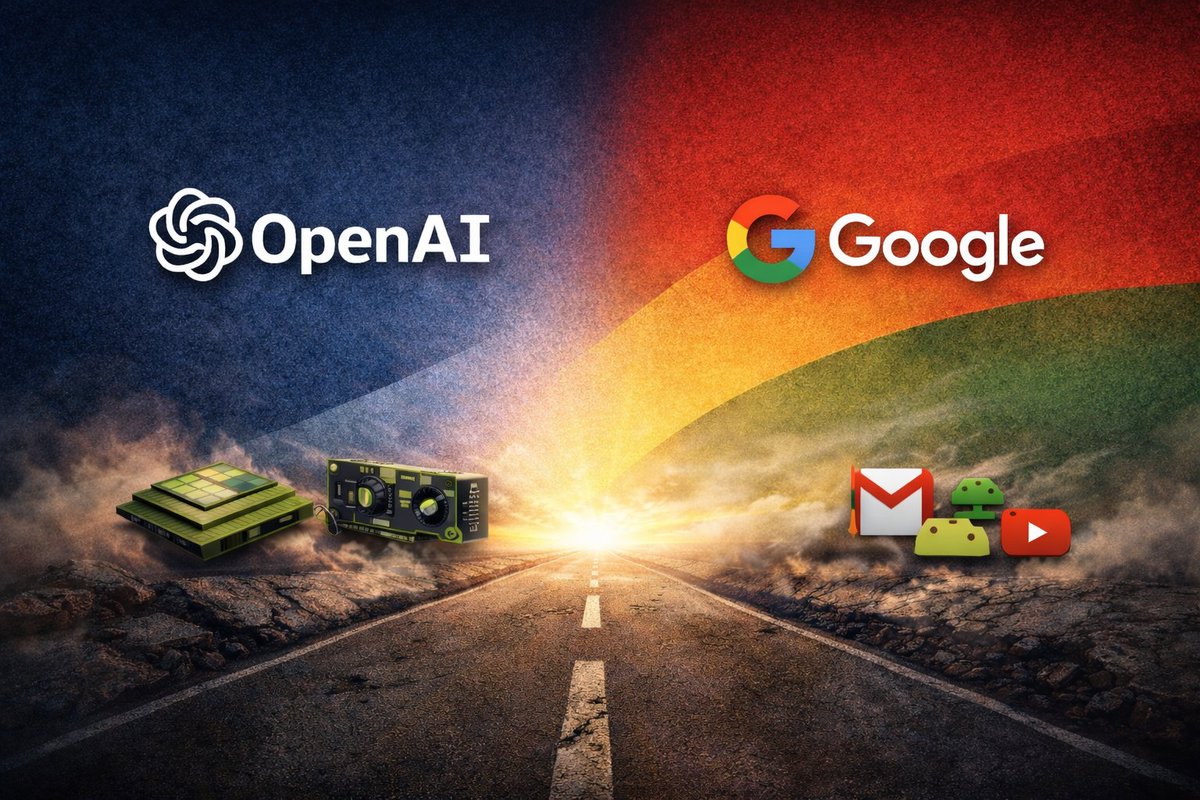
Why #OpenAI Will Likely Lose to #Google (In the End)
The #AI industry is going through a quiet but brutal shift.
The competition is no longer about who has the smartest model, but who can deliver useful intelligence at the lowest marginal cost.
Once the game turns into cost, distribution, and ecosystem leverage, OpenAI’s early lead starts to fade fast — and Google is exactly the kind of player you don’t want to face in a war of attrition.
1. Cost is destiny: #TPU vs #GPU
In inference economics, cost decides survival.
OpenAI is built on general-purpose NVIDIA GPUs. Google owns its own TPU stack. This matters far more than people think.
GPUs are versatile by design. They carry a lot of overhead to support graphics and scientific computing. TPUs are purpose-built killers for inference. Their systolic array architecture lets data flow directly between compute units, instead of constantly bouncing in and out of HBM memory like GPUs do.
The result: lower power usage, higher bandwidth efficiency, and dramatically cheaper long-context inference. A small per-query advantage compounds into hundreds of millions of dollars per year at scale.
This is not a model problem. This is a physics and architecture problem.
2. Business model mismatch: subscriptions vs “free at scale”
OpenAI still behaves like a classic #SaaS company, trying to defend a $20/month subscription to cover massive inference costs.
Ironically, OpenAI’s move toward cheaper, ad-supported tiers does Google a favor. It educates users that “AI with ads” is acceptable.
Meanwhile, #Gemini plays a longer game: lower pricing, free access for students, and deep ecosystem lock-in. Google doesn’t need AI to make money. It needs AI to keep users inside its universe longer.
Users have no loyalty to models. They do have massive switching costs around data and workflows.
By stitching Gemini into Gmail, Docs, Android, and YouTube, AI becomes invisible infrastructure — like air or water. No separate app. No context switching. That seamlessness is something a standalone ChatGPT-style product will always struggle to match.
3. The ad endgame: OpenAI is clearing the road
This part is uncomfortable.
OpenAI’s biggest contribution may not be technology — it may be user training. It taught people to ask questions in chat form and accept answers inline.
To survive, OpenAI experiments with ads. But advertising is Google’s home turf. Roughly 80% of Google’s revenue already comes from ads.
When users finally accept AI-generated ads as “normal,” Google shows up with the most mature ad engine ever built. With access to search behavior, emails, location, viewing history, and intent signals, Google’s AI ads will be orders of magnitude more precise.
Google doesn’t monetize AI directly. It uses AI to make its existing ad machine more lethal.
4. The final pressure point: cooling Apple ties
OpenAI was once framed as the savior behind #Apple Intelligence. That narrative is weakening.
As Google renegotiates its position with Apple, OpenAI risks becoming just another plug-in. Google understands OS-level integration because it owns #Android. It knows how to turn AI into a system primitive.
OpenAI has no hardware, no OS, no default search entry point. That makes it dangerously easy to modularize — and marginalize.
Conclusion
OpenAI is fighting an uphill battle, trying to build a new empire from scratch.
Google is already sitting on the infrastructure, the distribution, and the cash flow.
By winning on inference cost and dragging the fight into advertising economics, Google turns this into a long, exhausting war — one it is structurally designed to win.
OpenAI is running faster every day.
But it may just be paving the road for Google.
#AI #OpenAI #Google #Gemini #TechStrategy #AIInfrastructure #BigTech #AdsEconomy
Human scientific progress has never been linear.
It moves through moments of insight, breakthroughs, long plateaus, and then reinvention.
Today, many people say #crypto innovation has stalled.
But history suggests this often happens right before an explosion.
Smart contracts were invented more than a decade ago.
Yet platforms like #Polymarket — real binary prediction markets built on smart contracts — only entered the mainstream last year.
And it wasn’t until the second half of this year that trading volume truly took off.
Innovation doesn’t arrive on schedule.
It accumulates quietly, then suddenly becomes obvious.
Stay.
Build.