Je veux présenter mes excuses, au nom des Français, pour avoir enfanté la French Theory (qui a enfanté la pire des merdes idéologiques : le wokisme).
Nous avons donné au monde Descartes, Pascal, Tocqueville. Et puis, dans les ruines intellectuelles de l'après-68, nous avons donné Foucault, Derrida, Deleuze. Trois hommes brillants qui ont fabriqué, dans l'élégance de notre langue, l'arme idéologique qui paralyse aujourd'hui l'Occident.
Il faut comprendre ce qu'ils ont fait. Foucault a enseigné que la vérité n'existe pas, qu'il n'y a que des rapports de pouvoir déguisés en savoir. Que la science, la raison, la justice, l'institution médicale, l'école, la prison, la sexualité, tout n'est qu'une mise en scène de la domination. Derrida a enseigné que les textes n'ont pas de sens stable, que tout signifiant glisse, que toute lecture est une trahison, que l'auteur est mort et que le lecteur règne. Deleuze a enseigné qu'il fallait préférer le rhizome à l'arbre, le nomade au sédentaire, le désir à la loi, le devenir à l'être, la différence à l'identité.
Pris isolément, ce sont des thèses discutables. Combinées, exportées, vulgarisées, elles forment un système. Et ce système est un poison.
Car voici ce qui s'est passé. Ces textes, illisibles en France, ont traversé l'Atlantique. Les départements de Yale, de Berkeley, de Columbia les ont absorbés dans les années 80. Ils y ont trouvé un terreau qui n'existait pas chez nous : le puritanisme américain, sa culpabilité raciale, son obsession identitaire. La French Theory s'est mariée à ce substrat, et l'enfant de ce mariage s'appelle le wokisme.
Judith Butler lit Foucault et invente le genre performatif. Edward Said lit Foucault et invente le post-colonialisme académique. Kimberlé Crenshaw hérite du cadre et invente l'intersectionnalité. À chaque étape, la matrice est française : il n'y a pas de vérité, il n'y a que du pouvoir, donc toute hiérarchie est suspecte, toute institution est oppressive, toute norme est violence, toute identité est construite donc négociable, toute majorité est coupable.
Voilà comment trois philosophes parisiens, qui n'ont probablement jamais imaginé leurs conséquences pratiques, ont fourni le logiciel d'exploitation à une génération entière d'activistes, de bureaucrates universitaires, de DRH, de journalistes, de législateurs. Voilà comment on a obtenu une civilisation qui ne sait plus dire si une femme est une femme, si sa propre histoire mérite d'être défendue, si le mérite existe, si la vérité se distingue de l'opinion.
C'est de la merde pour une raison simple, et il faut la dire calmement. Une civilisation se tient debout sur trois piliers : la croyance qu'il existe une vérité accessible à la raison, la croyance qu'il existe un bien distinct du mal, la croyance qu'il existe un héritage à transmettre. La French Theory a entrepris de dynamiter les trois. Pas par méchanceté. Par jeu intellectuel, par fascination du soupçon, par haine de la bourgeoisie qui les avait nourris. Mais le résultat est là. Une génération entière a appris à déconstruire et n'a jamais appris à construire. Une génération entière sait soupçonner et ne sait plus admirer. Une génération entière voit le pouvoir partout et la beauté nulle part.
Je m'excuse parce que nous, Français, avons une responsabilité particulière. C'est notre langue, nos universités, nos éditeurs, notre prestige qui ont donné à ce nihilisme son emballage chic. Sans la légitimité de la Sorbonne et de Vincennes, ces idées n'auraient jamais traversé l'océan. Nous avons exporté le doute comme d'autres exportent des armes.
Ce qui se construit maintenant, en silicon valley, dans les labos d'IA, dans les startups, dans les ateliers, dans tous les lieux où des gens fabriquent encore des choses au lieu de les déconstruire, c'est la réponse. Une civilisation se reconstruit par les bâtisseurs, pas par les commentateurs. Par ceux qui croient que la vérité existe et qu'elle vaut qu'on s'y consacre. Par ceux qui assument une hiérarchie du beau, du vrai, du bon, et qui n'ont pas honte de la transmettre.
Alors pardon. Et au travail.
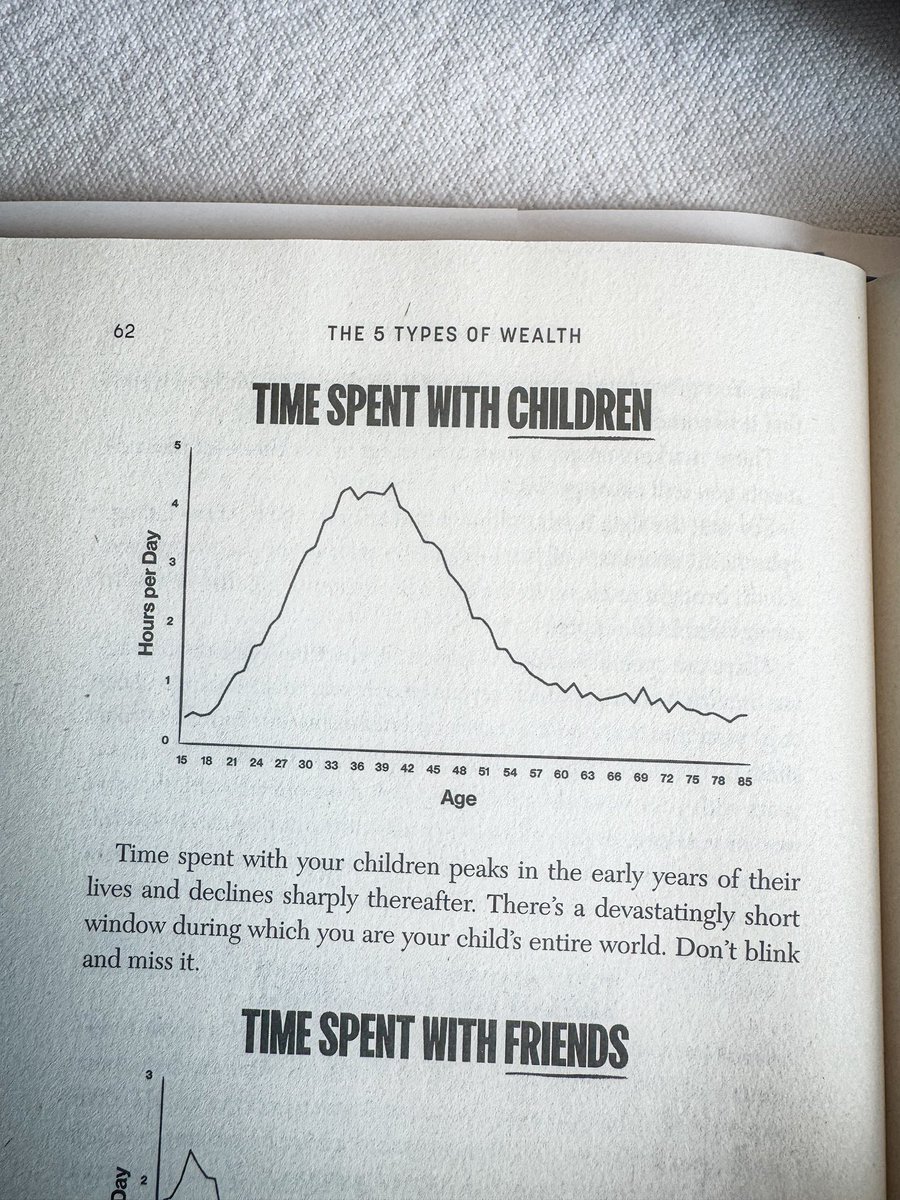
A Christmas morning reflection…
95%
By the time your child turns 18, you've spent ~95% of the time you will ever spend with them in your lifetime.
There are specific windows, much shorter than you care to admit, during which certain people and relationships will occupy your life.
You may have only one more summer with all of your siblings. Two more trips with that old group of friends. A few more years with your grandpa. A handful of encounters with that coworker you love. One more long walk with your parents.
If you fail to appreciate these windows, they will quickly disappear.
Time Wealth is about an awareness of these windows.
But more importantly, it’s about taking action against that awareness.
It's about recognizing that you are in more control of your time than you realize.
That you can take actions to create time with the people you love most.
That you can bend these curves.
That 95% is an average—and you’ve never wanted to be average in anything your entire life.
So, show up to that recital. Plan that trip with old friends. Grab that quick coffee. Go on that walk with your parents. Have that meal with your sibling.
In the end, it's not about the journey, it's not about the destination, it's about the company. The people along the way.
Cherish the people and the rest will fall into place as it should.
Major preprint just out!
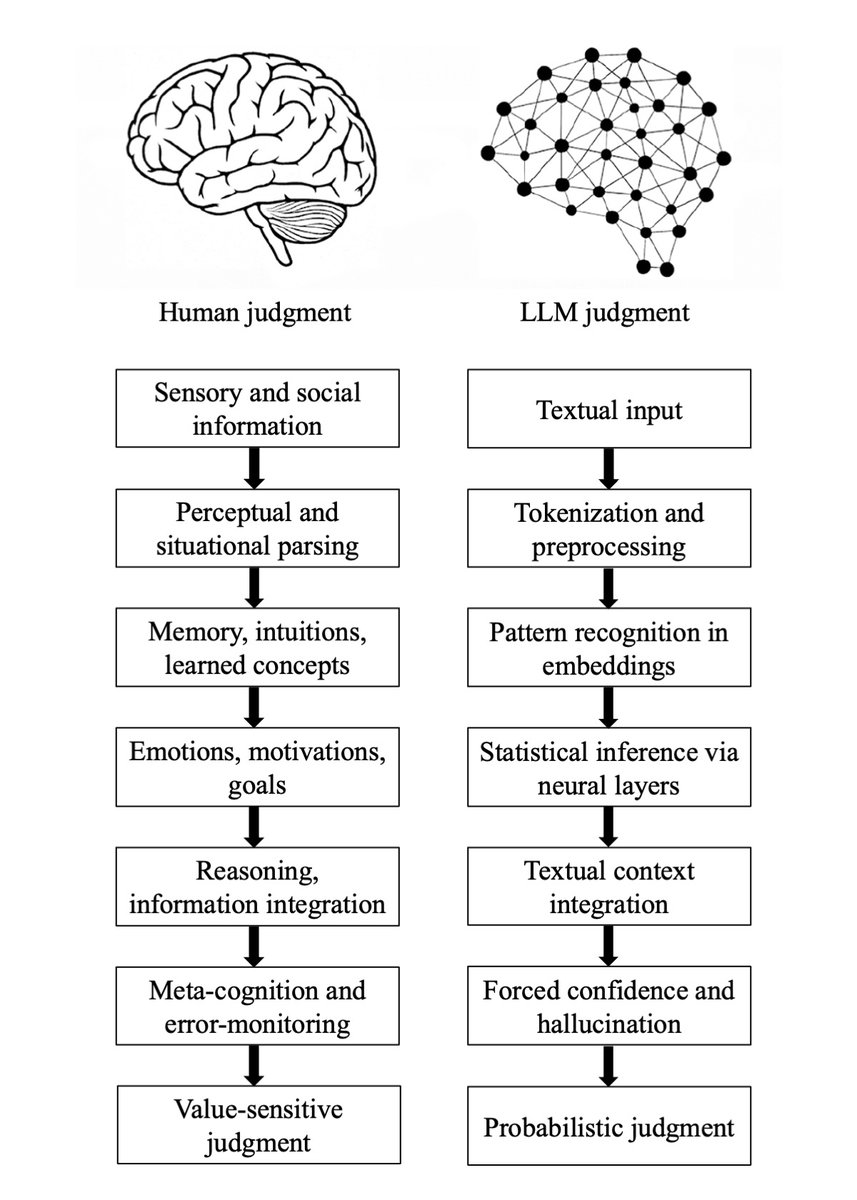
We compare how humans and LLMs form judgments across seven epistemological stages.
We highlight seven fault lines, points at which humans and LLMs fundamentally diverge:
The Grounding fault: Humans anchor judgment in perceptual, embodied, and social experience, whereas LLMs begin from text alone, reconstructing meaning indirectly from symbols.
The Parsing fault: Humans parse situations through integrated perceptual and conceptual processes; LLMs perform mechanical tokenization that yields a structurally convenient but semantically thin representation.
The Experience fault: Humans rely on episodic memory, intuitive physics and psychology, and learned concepts; LLMs rely solely on statistical associations encoded in embeddings.
The Motivation fault: Human judgment is guided by emotions, goals, values, and evolutionarily shaped motivations; LLMs have no intrinsic preferences, aims, or affective significance.
The Causality fault: Humans reason using causal models, counterfactuals, and principled evaluation; LLMs integrate textual context without constructing causal explanations, depending instead on surface correlations.
The Metacognitive fault: Humans monitor uncertainty, detect errors, and can suspend judgment; LLMs lack metacognition and must always produce an output, making hallucinations structurally unavoidable.
The Value fault: Human judgments reflect identity, morality, and real-world stakes; LLM "judgments" are probabilistic next-token predictions without intrinsic valuation or accountability.
Despite these fault lines, humans systematically over-believe LLM outputs, because fluent and confident language produce a credibility bias.
We argue that this creates a structural condition, Epistemia:
linguistic plausibility substitutes for epistemic evaluation, producing the feeling of knowing without actually knowing.
To address Epistemia, we propose three complementary strategies: epistemic evaluation, epistemic governance, and epistemic literacy.
Full paper in the first reply.
Joint with @Walter4C & @matjazperc
Deep, interesting analysis of the qualitative differences between natural and (one kind of) artificial intelligence (LLMs), despite the remarkable abilities of the latter.
🚨🇲🇽🇨🇭 | SUSPICIOUS TRANSFER: Federal intelligence detected that a tax fraud operator from Tabasco transferred 3 billion pesos to a Swiss bank account linked to Jorge Amílcar Olán, an associate and close friend of AMLO’s son, “El Andy”, according to journalist Raymundo Riva Palacio.
The only reason you'd offer a $1bn salary is if you believed you were incredibly close to cracking technology that will leave today's world in the dust.
The only reason you'd turn down a $1bn salary is if you thought you might get there first.
No one's following this enough.
Because session 4 of the study revealed something interesting:
People with strong cognitive baselines showed HIGHER neural connectivity when using AI than chronic users.
But chronic AI users forced to work without it? They performed worse than people who never used AI at all.
MIT researchers call this "cognitive debt" - like technical debt, but for your brain.
Every shortcut you take with AI creates interest payments in lost thinking ability.
And just like financial debt, the bill comes due eventually.
But there's good news...
Companies celebrating AI productivity gains are unknowingly creating cognitively weaker teams.
Employees become dependent on tools they can't live without, and less capable of independent thinking.
Many recent studies underscore the same problem, including the one by Microsoft:
This website has become pretty useless for news. Three years ago my feed would have been full of updates about the latest India-Pakistan news. Now it's just random chuds talking about 2017-era racial politics.
To me, one of the most infuriating things that has happened in the past 20 years in political discourse is referring to people who use Tik Tok as "tech savvy".