We're excited to list SERV aka @openservai on RaptorX.
As our first ETH listing, OpenServ is the reasoning layer that the agent economy runs on.
It turns frontier models into prod-grade infra and provides a suite of solutions for companies to leverage.
Let's dive in 🤿
Banks need traceability. Regulators need accountability. SERV delivers both.
Two things stand in the way today, and SERV is built around both.
Graph Sharding turns every reasoning step into a node you replay and audit.
PromptGuard secures the stack by default, so nothing leaks or gets injected.
Each release moves toward the same thing. A system a bank can actually put into production. Auditable enough for the regulator, secure enough for the data, reliable enough to trust.
This is the layer global finance can run on.
another builder using SERV Reasoning for their business - this time, a construction company dropping costs nearly 60% with accuracy more than doubling by using SERV tek
follow PT's story 👇
Currently around 80-90% of enterprise AI agent pilots fail and don't make it to production.
We're bringing that number down to ZERO.
AI agent failures is the biggest painpoint in enterprise AI adoption today, and we're solving it at OpenServ.
v1 of SERV Reasoning is live in private beta with enterprises today and its already doing a tremendous job, but it's just the beginning.
We're not far from rolling out v2 of SERV Reasoning with our upcoming "Shadow Agents." If an agent's output doesn't meet the requirements, it executes recursive validation loops to learn and retry until it succeeds.
We're achieving fantastic results internally and can't wait to roll it out to more users soon, getting closer and closer to 100% reliability across high-stakes agent deployments.
Solving this problem unlocks a massive market opportunity, and we're already well underway to achieving it.
Each new enterprise conversation and bit of adoption snowballs into more data, more learnings, more credibility, more adoption, and a better product with a bigger moat.
The snowball is snowballing, hard.
$SERV is not trying to replace the big #AI companies & their models, it’s simply advancing them
Model agnostic, infinitely scalable & makes every model enterprise ready
$SERV brand going worldwide
The network effect will hit hard as more users are onboarded & public api releases
Already being used by major entities such as UAE gov
Wait till peeps see they can buy a share of the biggest #AI network
🚀
Destination is clear: SERV as the reasoning layer enterprise agents can actually run on.
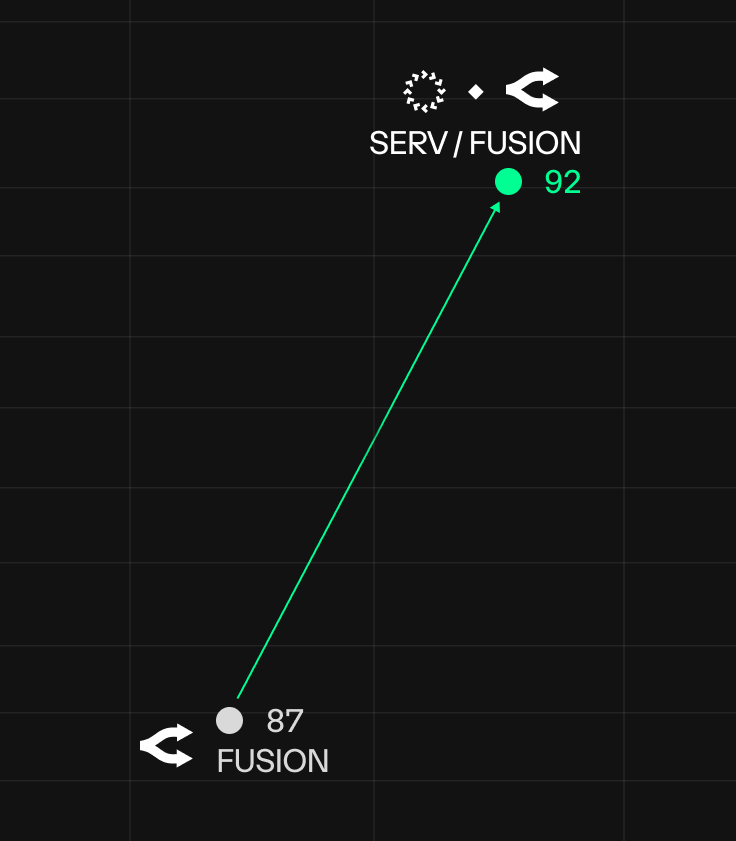
Stats show why all roads lead to SERV: on our preliminary benchmark, combining OpenRouter Fusion with SERV Reasoning led to a ~38% reduction in failures (13→8).
Fusion seems to be suited for deep research tasks rather than agentic work, and struggles with what production agents need most: reliable JSON outputs.
Even the biggest companies don't have answers for problems we're already solving. It shows why SERV is on the way to becoming a staple name in conversations shaping the future of the agentic economy.
Deeper Fusion benchmarks and results underway.
5/
That missing layer is @openservai + $SERV.
Specifically — the SERV Reasoning Framework.
While @AnthropicAI locked their reasoning behind a centralized kill switch, @openservai built structured cognitive reasoning into the agent infrastructure itself — already battle-tested in high-stakes, real-world enterprise environments.
No single point of failure. No government off switch.
$TAO decentralizes the compute ✅
$SERV decentralizes the reasoning ✅
SERV name is spreading globally.
Just last week, our team was at London Tech Week meeting some of the biggest players in AI.
Builders carried SERV into Solana Summit Berlin and SuperAI Singapore, while our BD crew worked the boardrooms of Silicon Valley.
Three continents in one week.
The main themes driving conversations were the same ones SERV is built around: AI observability (knowing what your agents are doing), cost-efficiency (running agents at scale without the bill exploding), and the enterprise adoption bottlenecks keeping AI stuck in pilots.
These aren't side topics. They're the exact problems we are solving, and they're now the center of the industry's attention.
Before long, everyone in AI will know SERV.
Fable 5 was abruptly pulled.
Enterprises used to tune their stack to one model's built-in reasoning - if it's gone, you rebuild from scratch.
SERV lifts open-source models to frontier-level and lets you swap models freely - you're never at the mercy of one vendor or politics.
Love the focus here:
“We are taking SERV technology and getting it into the core of government and enterprise on a mass scale - solving a problem the frontier labs are structurally unable to solve”
This is the way
The US government pulled Claude Fable today.
Good news is, you don’t need frontier models for production-grade agents.
With SERV, open-source LLMs like DeepSeek-v4 outperform Claude Fable at up to 90x cost savings.
The decentralised future is bright.
SERV is inevitable.
$SERV is the only solution that is solving the biggest bottlenecks in enterprise #AI end to end;
- increases performance per $ spent
- fully auditable
- private & secure
- model agnostic/easily implemented
All proven & release to public soon
Billions with a capital S
Homecooked @homecookedx just joined the @openservai Builders Program and integrated SERV Reasoning into their AI sous chef agent production stack, now live.
IQ boosted, costs slashed & almost ready to l(a)unch in the $2B+ recipe market.
SERV Reasoning cut verifier agent costs by 99%, making continuous AI checks economically viable inside Sentinel.
It’s the trust layer for autonomous AI: the gate between “agent decided” and “transaction sent" - finally deployable at scale.
Every Sentinel call runs on SERV.
🔥 Why $SERV is made for Adoption by Global Banker
@openservai | $SERV targets global banking adoption with reasoning infra built for regulated environments.
Banks must meet simultaneous requirements for auditability, privacy, reliability, and cost efficiency when deploying AI.
The design addresses each directly.
1/ Auditability comes from traceable reasoning steps
Every node in the execution graph can be queried, inspected, and verified.
Execution sharding preserves these properties as workloads scale.
This structure produces the logs and proof trails that regulators require for AI use in credit, compliance, and risk functions.
2/ Privacy uses TEE-backed secure inference
Model execution runs inside a trusted execution environment with encrypted memory.
- Outputs carry signed proofs.
- Prompt guardrails maintain integrity.
- Data and models remain isolated during inference.
Banks handling client information under strict data rules gain a practical path to private AI computation.
3/ Reliability shows concrete results
SERV combined with Gemma 4-12b records a 30.7% reduction in failure rates versus the base model alone.
Deterministic reasoning produces consistent outputs for identical inputs.
Lower variance supports stable performance in production systems where unpredictable errors carry material cost.
4/ Cost efficiency follows from the integrated architecture
One system delivers the other three properties without separate compliance layers or custom wrappers.
Sharding supports horizontal scale. Institutions avoid the duplicated spend typical of bolting privacy and audit tools onto general-purpose models.
ThoughtProof benchmark recorded zero false approvals on one SERV variant across 150 test cases where the frontier model produced 52.
5/ Team is already in the rooms that matter.
- Banking leader meetings in Eastern Africa.
- Finance sector conversations across Europe.
- Fortune 500 enterprise work in San Francisco.
The enterprise product stands alone. Banks call the API or use the SDK with zero crypto requirement.
25% of SERV Reasoning API revenue and enterprise integrations still flows to $SERV buybacks and burns.
These conversations occur as institutions assess AI deployment inside complex regulatory frameworks.
In my assessment, global banks will integrate AI at institutional scale only when infrastructure satisfies audit, privacy, reliability, and cost requirements in a single coherent system.
SERV aligns its technical choices with those constraints. The combination matches the operational standards that define adoption in regulated finance.