Top Agentic Development Environments for 2026
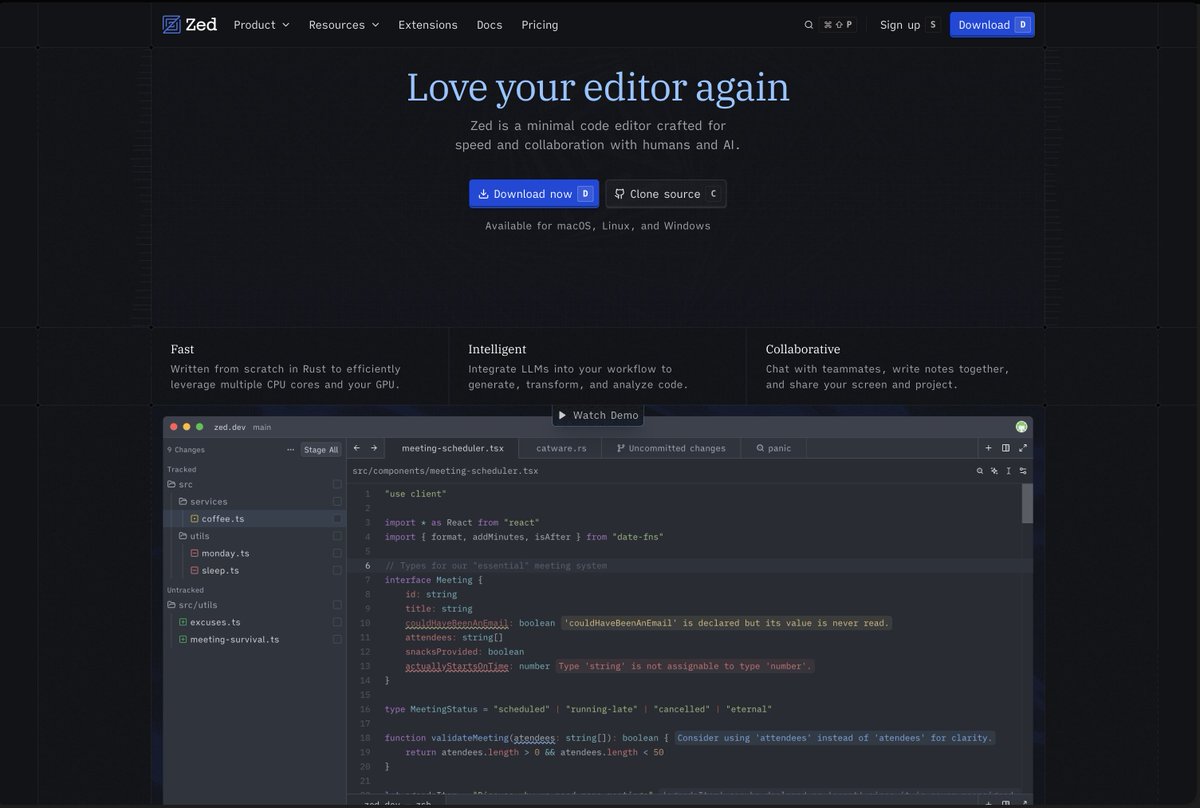
#1 - Zed
- Open Source
- ACP support - Claude without their god awful harness
- Project tabs
- Performant
- SSH tabs
- Beautiful
#2 - T3Code
- Open Source
- Good, consistent team
- Claude without the god awful harness
- Performant
- Looks Fine
#3 - CMUX
- Ghostty terminal works amazing w all agents
- Nice browser feature altho I don't like webkit
- MORE PANES BRO MORE PANES
- Tabbed projects
#4 - Ghostty
- Bare bones
- Most performant
#5 - Codex App
- Feels nice I use this the most of all the "apps"
- I love automations and plugins
- Needs to be open sourced
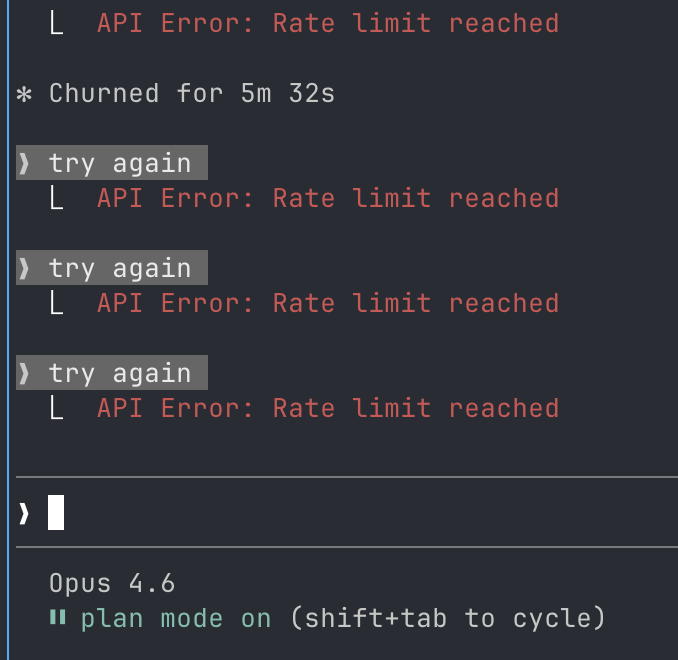
@claudeai c'mon - i know i have already cancel the subscription ... but still, few days left (its first time i'm seeing this error, and today i'm not a heavy user ... )
AI Engineering with #DarkFactory one week in and it’s starting to feel real. Not there yet, but its getting better.
Whats your experience with Dark Factory - did you already switch the lights off? 😉
It is hard to communicate how much programming has changed due to AI in the last 2 months: not gradually and over time in the "progress as usual" way, but specifically this last December. There are a number of asterisks but imo coding agents basically didn’t work before December and basically work since - the models have significantly higher quality, long-term coherence and tenacity and they can power through large and long tasks, well past enough that it is extremely disruptive to the default programming workflow.
Just to give an example, over the weekend I was building a local video analysis dashboard for the cameras of my home so I wrote: “Here is the local IP and username/password of my DGX Spark. Log in, set up ssh keys, set up vLLM, download and bench Qwen3-VL, set up a server endpoint to inference videos, a basic web ui dashboard, test everything, set it up with systemd, record memory notes for yourself and write up a markdown report for me”. The agent went off for ~30 minutes, ran into multiple issues, researched solutions online, resolved them one by one, wrote the code, tested it, debugged it, set up the services, and came back with the report and it was just done. I didn’t touch anything. All of this could easily have been a weekend project just 3 months ago but today it’s something you kick off and forget about for 30 minutes.
As a result, programming is becoming unrecognizable. You’re not typing computer code into an editor like the way things were since computers were invented, that era is over. You're spinning up AI agents, giving them tasks *in English* and managing and reviewing their work in parallel. The biggest prize is in figuring out how you can keep ascending the layers of abstraction to set up long-running orchestrator Claws with all of the right tools, memory and instructions that productively manage multiple parallel Code instances for you. The leverage achievable via top tier "agentic engineering" feels very high right now.
It’s not perfect, it needs high-level direction, judgement, taste, oversight, iteration and hints and ideas. It works a lot better in some scenarios than others (e.g. especially for tasks that are well-specified and where you can verify/test functionality). The key is to build intuition to decompose the task just right to hand off the parts that work and help out around the edges. But imo, this is nowhere near "business as usual" time in software.
I’m joining OpenAI Codex to work on the future of agentic development!
At Cursor, I got to see the shift from autocomplete to agents. The next step isn’t a better IDE. It’s an Agent Development Environment (ADE): systems and tools for orchestrating agents, reasoning over their outputs, and making them autonomous enough to reliably complete ambitious work.
After chatting with @embirico and @thsottiaux, it was clear that Codex is the best place to realize this vision. The team has consistently shipped SOTA models for agentic coding (check out gpt-5.3-codex) and I’m pumped for the future that the new Codex App points to.
What I’m most excited about is the broader mission: accelerating the knowledge work economy. All agents are coding agents, and we’re already seeing Codex used across every job function within organizations.
I’m extremely grateful for my time at Cursor, working with the incredible team, and I’m proud of what we built together. I’m excited to take an even bigger swing with Codex.
If you’re curious to get a glimpse of where we are headed, download the Codex App! If you want to work on this mission, please apply or reach out - we are hiring across all functions!
You can just build things.
@OpenAIDevs Am I missing something, or is outbound network access not possible in the Codex app?
network_access = true works in Codex CLI, but in the app I can’t use GitHub API, git clone, or call external APIs at all.
Is this a current limitation or expected behavior?
@embirico I'm already doing this, and linking .agent/skills to .claude/skills and .codex/skills or even .gemini ... - and it works (no duplications, all agents have access to the same skills)
@thdxr Linux I get. Windows is… let 's say ambitious 😄
macOS has a unified, mature dev environment and predictable sandboxing, so it’s typically the first platform teams ship
Codex (app) is the first user interface that actually fits agentic engineering.
The editor isn't treated as the centerpiece; diffs finally have a clear, readable home, and the terminal sits exactly where it should.
Early days, but this is a strong start. Kudos to @openai and the Codex team - @OpenAIDevs
Agentic coding forces better architecture - systems that are easy to verify.
Without a closed verification loop, it’s just vibe coding.
With it, it becomes scalable engineering.
Highly recommend watching the full interview with @steipete
https://t.co/eUV1eNU2rz
This is great to see - honestly, yesterday felt a bit surreal.
In the morning I was reading the MIT paper on Recursive Language Models, and in the afternoon I noticed this behavior showing up in Claude Code. It really looks like a practical implementation of the same idea: planning with full context, then compacting and executing with a clean window. With a refererence what was cleared in jsonl.
Paper for reference: https://t.co/OuDCzORCKF
Great job!
Any plans to extend this with a structured map of the cleared context for later reference?
@opencode what about you — any plans to explore this direction or similar RLM-style patterns?
Last year, around mid-year, I started building CLIs for both agent and developer workflows (AX & DX), instead of leaning on skills, agent wrappers, or similar abstractions. Using the same CLI for both humans and agents turned out to be surprisingly practical.
From hands-on experience, offloading parts of context handling and decision-making out of the model and into those tools has clear benefits: execution time dropped from ~30 s to ~1 s for nearly identical tasks, token usage decreased significantly, and error rates went down as well.
This works particularly well for workflows that are reasonably predictable, where we don’t actually need the probabilistic behavior LLMs provide.