Give AI access to your apps. Keep your data on your Mac.
Ask webAI to find the email from your client last week, check your calendar for the follow-up, and draft a reply. None of it leaves your device.
That's what Connectors do. Through MCP (Model Context Protocol), you can plug webAI into the apps you already use (Mail, Calendar, Slack, files), and keep everything local.
You decide which Persona can see which app, and webAI always asks before it takes any action, like sending that reply or booking the meeting.
Download the app at https://t.co/dVbCLkr3gb
Stop chatting with AI. Start delegating it.
We recently launched the new webAI app, and Personas & Skills is where that shift happens.
In webAI, you can build a team of expert Personas. Each one holds its own instructions, skills, and documents.
→ Call one in with @
→ Trigger their Skills with /
→ Swap experts on the fly with “Answer as”
Download the app at https://t.co/dVbCLkr3gb
Everyone’s using the same AI, trained on the same internet, giving the same answers. Yours shouldn’t be.
Think for yourself.
Download webAI: https://t.co/4mktGeMf6P
Open source is a means to an end.
It drives the commodity to zero. Models are racing there; open weights trailing frontier by ~4 months, handling 90% of agentic work at a fraction of the cost.
The delivery substrate of intelligence won’t be open source.
And it shouldn’t be, @thewebAI will always contribute to open but is not an open source company.
America could build the world’s best AI data centers and still lose the desktop to China.
Qwen3.8-27B runs on a MacBook Pro. Alibaba reports it beat Claude Opus 4.6 on LiveCodeBench v6.
We risk spending a decade building around the assumption that every prompt needs the cloud.
Pretty amazing, proud of the @thewebAI intelligence team; just getting started.
Twil 8b is not a perfect model, but it’s a big step towards frontier intelligence on your devices.
What I have found it to be great at is controlled local coding tasks, tool use, and reasoning entailments for decision models.
🏁 BENCHMARKED: @thewebAI's TwIL-8B, an 8.8B open-weight reasoning model, just went 69/69 on my tests running on my 64GB M5 Pro Mac mini.
The 4-bit MLX build runs at 53.8 tok/s from a 4.9 GB file.
Full bf16 with the whole 128K context fits too, peaking at 40.5 GB on a 64GB machine.
Same scores on both builds, thinking on:
✅ Math 20/20
✅ Code 10/10
✅ Instruction following 10/10
✅ Harder math 8/8
✅ Harder code 5/5
✅ Tool calls 5/5
✅ Hidden fact at 32K and 64K: 8/8
✅ Hidden fact at full 128K: 3/3 (bf16)
4-bit speed by context:
- 512: 53.8 tok/s
- 32K: 26.6 tok/s
- 128K: 9.2 tok/s at 27.9 GB peak
bf16 speed by context:
- 512: 16.7 tok/s
- 32K: 12.6 tok/s
- 128K: 6.6 tok/s
@Davidstout called it "small enough to run on your own hardware."
I checked and it runs at full precision with the whole 128K context on a desk I own.
Harness adapters training is now live!
We are training LoRA adapters on LFM2.5 / LFM3 from @liquidai and the recent Twil-9B model from @thewebAI using RL to make them more efficient and accurate on agentic tasks!
You can follow the training going live here: https://t.co/Li65iOX9Kr
https://t.co/tJ2hJuWtws
Andrej Karpathy:
“A 1B model can be much more effective than most current LLMs.
90% of current models waste a ton of capacity and money on remembering stuff that doesn’t matter.”
here is his 5 core thesis about Small LLM’s:
1. the intelligence was never the knowledge. Strip the memorized internet, keep the reasoning. What’s left is the cognitive core, and it’s small.
2. the core might fit in ~1B params. Maybe less. “Plenty of room at the bottom.” We’ve been paying for a library when we needed a brain.
3. size stopped being the bottleneck. What makes an agent work is the tools it can call and how tight the feedback loop is, not parameter count.
4. intelligence lives in the system, not the weights. A raw LLM is a CPU with no OS. Small core + good harness > giant model alone.
5. you can own it. A model on your hardware is one no one can rate-limit, price-hike, or deprecate on you.
in 12 months the gap between teams shipping on-device and teams paying per-token frontier bills won’t be capability.
TwIL an 8.8B model at 90%+ of frontier isn’t a benchmark flex.
It’s the thesis Karpathy’s been repeating all year, made real.
study more on this below ↓
Just days after we released TwIL-8B, the Hugging Face research team is already pushing its capabilities further.
Today, @huggingface published new research exploring how reinforcement learning and lightweight LoRA adapters can turn reasoning models into capable AI agents.
They included @thewebAI TwIL-8B alongside models from Liquid AI.
The early results are encouraging.
Despite never being explicitly trained for agentic tool use, TwIL-8B is already outperforming the smaller LFM3-1.7B across all three agent harnesses in preliminary baseline evaluations.
Now they're exploring how much further those capabilities can improve through specialized reinforcement learning.
One base model. Many specialized capabilities.
This is a direction we strongly believe in at webAI. Intelligence should be adaptable, efficient, and increasingly capable without requiring ever-larger models.
But what excites me most is the collaboration happening across the open research community.
We built TwIL to push the boundaries of what smaller models can accomplish. Seeing the Hugging Face team build on that work almost immediately is exactly why open research matters.
Huge appreciation to the Hugging Face team for including our work and advancing this research.
The future of AI will be built by more than a handful of labs.
And we're excited to help build it.
Research: https://t.co/IEgSsGlEz1
Live training: https://t.co/9NU3CLcCOQ
A necessary reminder that bigger is not always better... relevancy and accuracy improve in any situation when one has the right context and alignment on what success looks like. Promising broad sweeping outcomes of anything and everything under the sun would sound suspicious if a person claimed it -- so why not when a tech company claims it? Shouldn't intelligence be tailored to the problem at hand? Wouldn't you want the world's expert in cancer research solving your toughest cancer problems? Or just a really really smart person will do?
@Davidstout and the team at @thewebAI have pioneered the mission of delivering personal, customizable, relevant models that everyone and every company should have access to, on their own devices. Private, secure, cost effective, and most importantly, accurate.
The future of intelligence -- is yours.
@thewebAI app is officially live for everyone.
Expert AI running on your laptop. The more powerful your device, the more it can do.
Download the app: https://t.co/B6H97CT9gJ
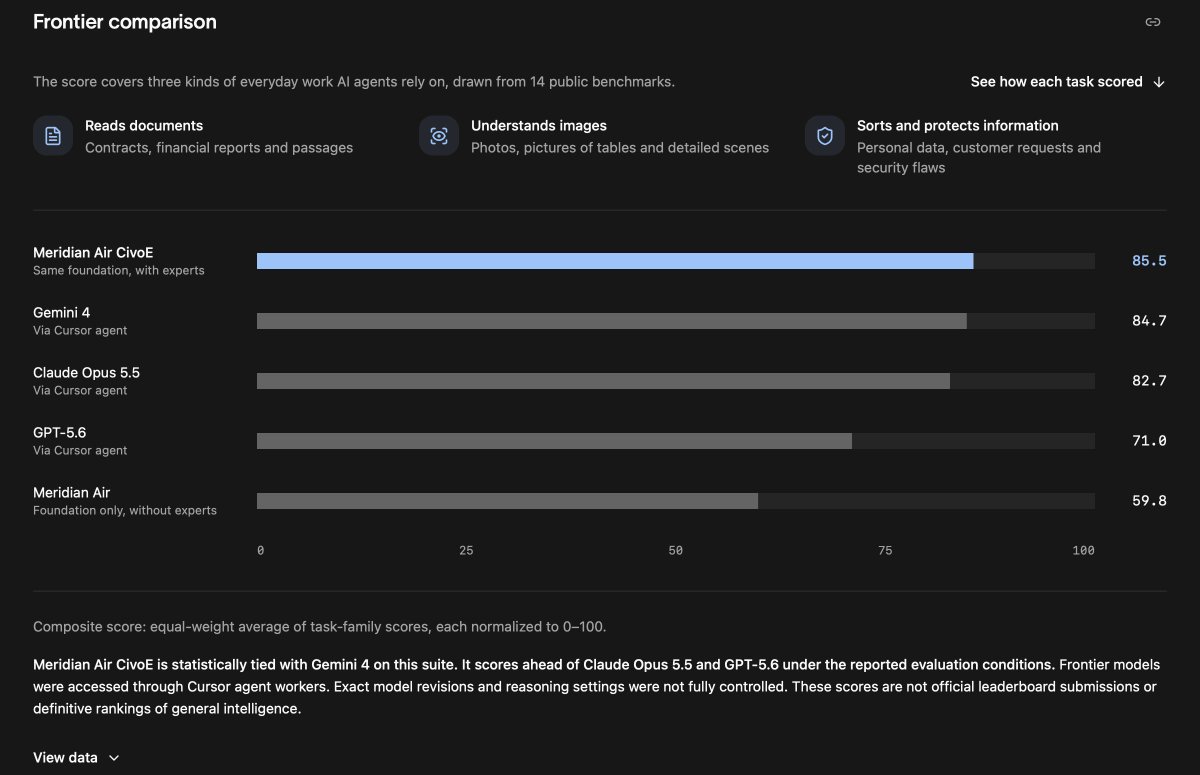
Today, we're announcing webAI Meridian-1 CivOE.
A 12B AI model that statistically matched Gemini 4 Argon and outperformed Claude Opus 5.5 in evaluation.
But the most important breakthrough isn't the benchmark.
It's how we achieved it.
Instead of endlessly scaling model size, we've built intelligence that adapts to the work through specialized experts.
Our results:
Meridian-1 CivOE: 85.5
Gemini 4: 84.7
Claude Opus 5.5: 82.7
GPT-5.6: 71.0
The same 12B foundation went from 59.8 to 85.5 through specialization. A 25.7-point improvement without making the foundation model larger.
We believe this represents a fundamental shift in how intelligence will evolve.
Just as software became personal, customizable, and accessible on everyday computers, intelligence is heading in the same direction.
Intelligence that adapts to your knowledge, your work, and your devices.
We're beginning the rollout of Meridian-1 CivOE with strategic partners over the next few weeks, before expanding access to all webAI users.
The future of intelligence isn't just bigger.
It's yours.
Read More: https://t.co/jPDLnkXKgA
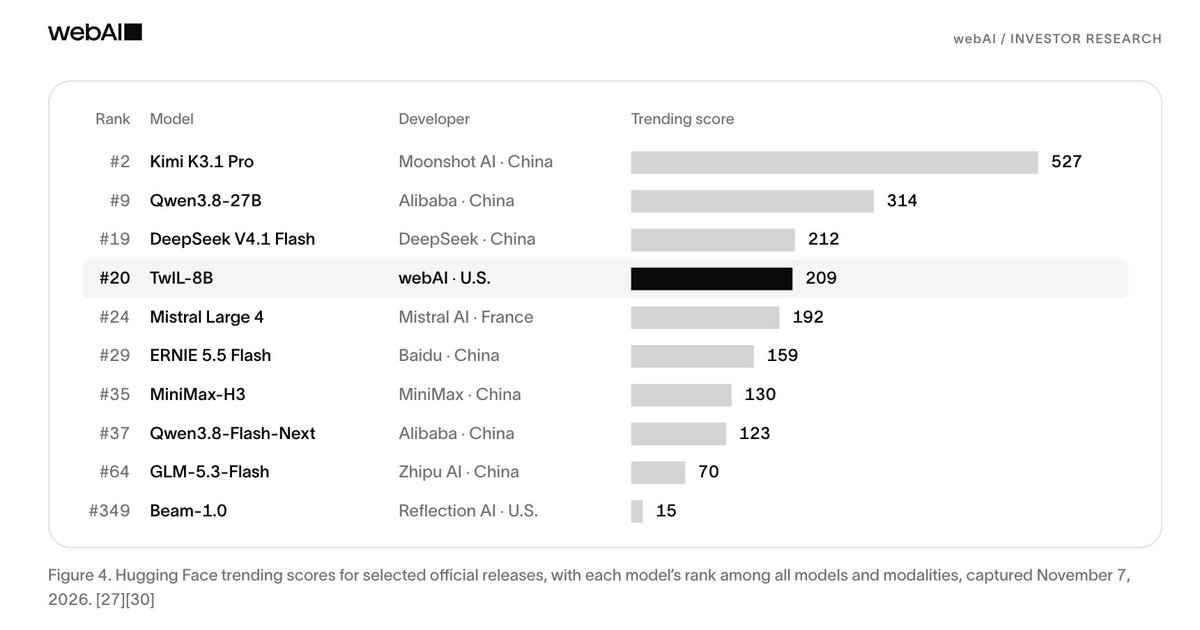
Thank you all for the incredible support. TwiL-8B hit #24 of 433,863 text generation models on Hugging Face in its first 7 hours.
We have more to share, and it’s worth waiting for. Tomorrow morning we’re releasing one more model, our best yet, and opening general access to webAI.
See you in the morning.
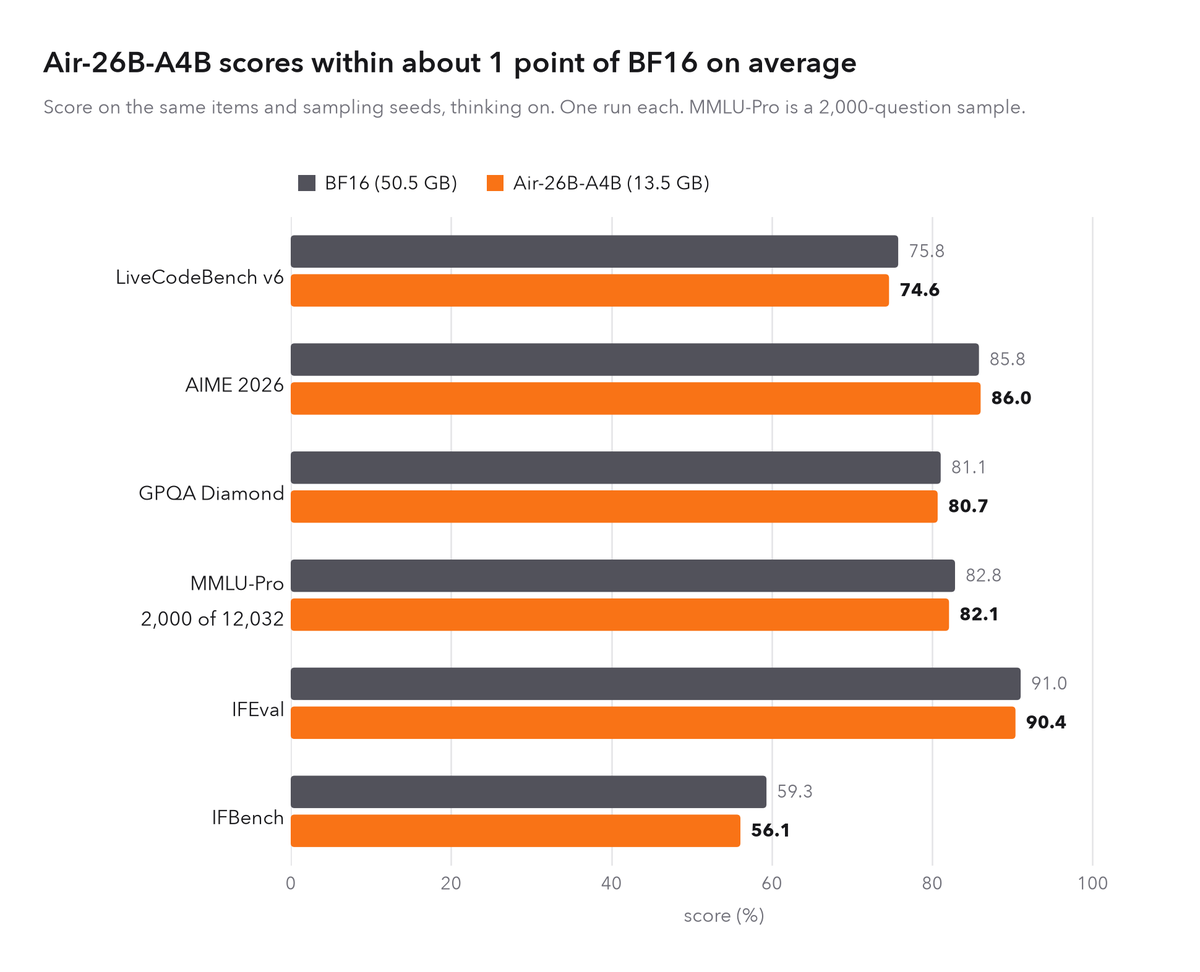
@thewebAI's Intelligence Lab is open sourcing Gemma 26b 4a Air
2.6× closer to full precision
Significantly more faithful to the original model than Google's official 4-bit release (KL divergence: 0.068 vs. 0.176).
Nearly 4× smaller
Just 13.5 GB vs. 50.5 GB, with the full 128K context fitting in 16 GB of memory.
Almost no loss in intelligence
Scores 78.3 vs. 79.3 across 6 benchmarks, retaining 99.4% of original performance on knowledge, math, and coding.
Matches the original on real-world tasks
Nearly identical wIL scores (Track A: 0.502 vs. 0.508; Track B: 0.812 vs. 0.812).
HF: https://t.co/SsQ0AW1Idy