Investing in ambitious entrepreneurs who are redefining culture & human experience in today's AI world. Mom to 3 small dictators: Izzy, James, & Early (🐶)
Introducing @ForerunnerVC Field Notes: sharing our team's internal debates as the market evolves around us.
First up: How many agents will each of us have?
I have one amazing agent that runs my workday (inbox, calendar, meeting prep). But candidly, I wouldn't ask that same agent what to wear, where to go on special date night, or how to negotiate a medical bill. Why? Because it hasn't built context or trust with me in those arenas.
Trust decides who gets the job. And trust takes TIME to build (despite what everyone might want in this accelerated landscape) and only takes a moment to break.
We humans don't have just one friend for everything; but, we don't want 1000s of friends either. I believe agents will mirror that pattern not because of what the agent can or can't do; but rather what human relationships require from both a trust, and mindshare perspective.
My bet: the max # of agents I'll use throughout my many parts of life is Dunbar's number (~150); but more specifically, the # I will hold closer to the vest will follow the social brain hypothesis that matters is the inner ~5 we trust.
Anyone else starting to curate down to this trusted circle of 5 agents? What are you using each for?
if you're wondering which university to attend to maximize your chances of getting into @ycombinator or @speedrun, here's the chart you've been looking for.
i've researched every startup across the 2026 cohorts of both accelerators and collected data on where their founders studied.
in total, the dataset covers 855 YC startups, 138 a16z speedrun startups and 1,968 founders.
the ranking features the top 50 universities by number of founders. 62% of them are in the US.
of course, accelerators don't accept you simply because of where you studied. but when reviewing thousands of applications, they need a quick way to identify exceptional people, and your educational background is one of the clearest signals.
getting into Harvard and achieving something notable while you're there already says a lot about your abilities. the university has essentially done part of the due diligence and put its reputation behind you.
but not attending one of these universities doesn't mean you're any less capable. there are another 431 universities in the dataset represented by just one founder each. exceptional people can come from anywhere. the best way to show your potential is through achievements that are easy to verify and hard to ignore.
A necessary reminder that bigger is not always better... relevancy and accuracy improve in any situation when one has the right context and alignment on what success looks like. Promising broad sweeping outcomes of anything and everything under the sun would sound suspicious if a person claimed it -- so why not when a tech company claims it? Shouldn't intelligence be tailored to the problem at hand? Wouldn't you want the world's expert in cancer research solving your toughest cancer problems? Or just a really really smart person will do?
@Davidstout and the team at @thewebAI have pioneered the mission of delivering personal, customizable, relevant models that everyone and every company should have access to, on their own devices. Private, secure, cost effective, and most importantly, accurate.
The future of intelligence -- is yours.
Today, we're announcing webAI Meridian-1 CivOE.
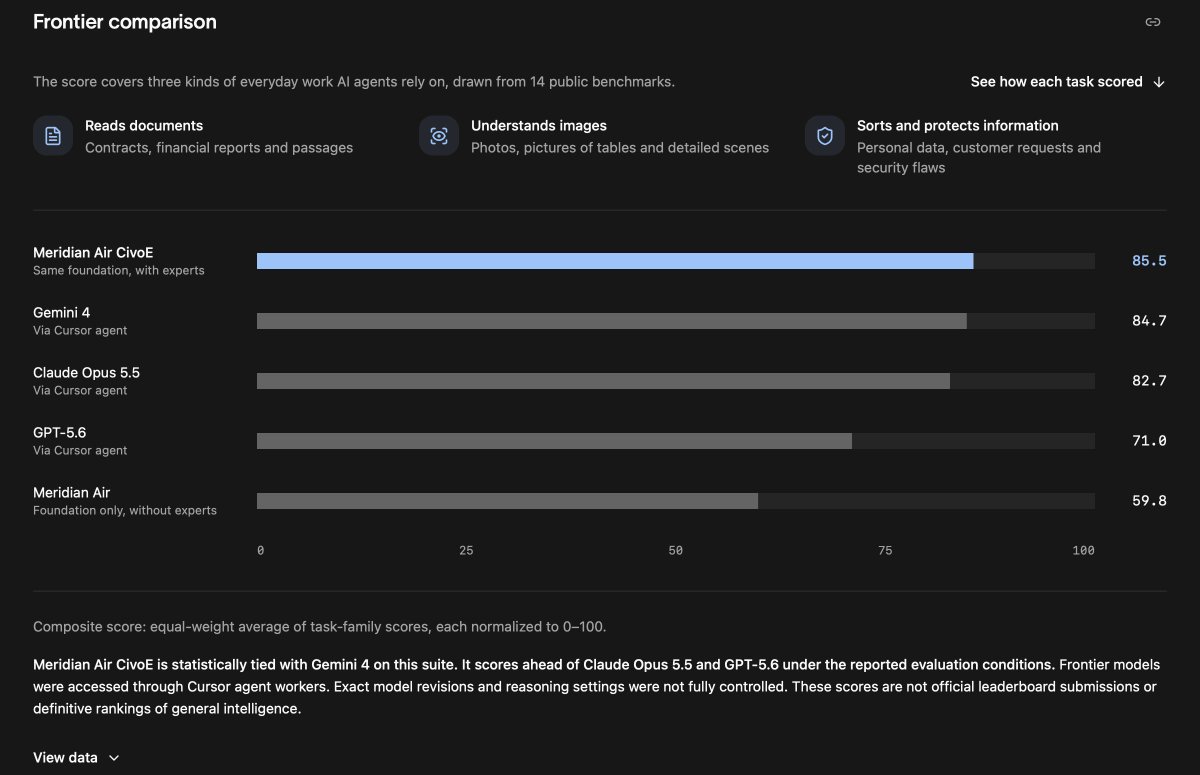
A 12B AI model that statistically matched Gemini 4 Argon and outperformed Claude Opus 5.5 in evaluation.
But the most important breakthrough isn't the benchmark.
It's how we achieved it.
Instead of endlessly scaling model size, we've built intelligence that adapts to the work through specialized experts.
Our results:
Meridian-1 CivOE: 85.5
Gemini 4: 84.7
Claude Opus 5.5: 82.7
GPT-5.6: 71.0
The same 12B foundation went from 59.8 to 85.5 through specialization. A 25.7-point improvement without making the foundation model larger.
We believe this represents a fundamental shift in how intelligence will evolve.
Just as software became personal, customizable, and accessible on everyday computers, intelligence is heading in the same direction.
Intelligence that adapts to your knowledge, your work, and your devices.
We're beginning the rollout of Meridian-1 CivOE with strategic partners over the next few weeks, before expanding access to all webAI users.
The future of intelligence isn't just bigger.
It's yours.
Read More: https://t.co/jPDLnkXKgA
After Google acquired my AR startup, I started thinking about the next interface, this time for AI. Text and voice work fine, just like DOS did before the Mac. But nothing’s more intuitive than face to face.
After two years of research, today we’re launching Atmee v2: a real-time avatar model that makes live video agents feel truly life-like.
• Any character from 1 image + 10s of audio
• Contextual expressions, gestures, even interacting with the environment
• Live video calls, voice only, or video generation
At its core, Atmee v2 is a video foundation model, it can render anything, but it’s built to excel at characters, which is what video models like Seedance 2.5 and Wan 3.0 are mostly used for. In comparison:
Atmee v2
• Up to 50x faster
• 10-100x cheaper
Build tutors, sales coaches, support agents, companions, game characters, even whole living worlds. The interface after text and voice starts today.
The cost of completing a task matters more than the raw intelligence of the model running it.
That’s the thesis behind TwIL-8B, our new 8.8B reasoning model. Open weights. Runs on hardware you already own.
Against Qwen3.5-9B, it opens a 16-point lead on LiveCodeBench (81.6 vs 65.6) and tops MATH-500 (98.2 vs 96.6). Against Gemma 4 31B, 4x the size, it still wins on MATH-500 (98.2 vs 87.9) and AIME 2025 (88.3 vs 87.1).
Tiny by frontier standards. Does the reasoning work anyway.
Download the model on @huggingface: https://t.co/WN7B6XtwXr
In a not so distant future, everyone will have their personal AI avatar who can speak on their behalf as naturally and authentically as their human self. @Atmanity is enabling this future in a cost effective, scalable way. Check it out 👇🏻
Congrats @yuchenping and team! Can’t wait to see companies leverage your models to unlock new experiences!
After Google acquired my AR startup, I started thinking about the next interface, this time for AI. Text and voice work fine, just like DOS did before the Mac. But nothing’s more intuitive than face to face.
After two years of research, today we’re launching Atmee v2: a real-time avatar model that makes live video agents feel truly life-like.
• Any character from 1 image + 10s of audio
• Contextual expressions, gestures, even interacting with the environment
• Live video calls, voice only, or video generation
At its core, Atmee v2 is a video foundation model, it can render anything, but it’s built to excel at characters, which is what video models like Seedance 2.5 and Wan 3.0 are mostly used for. In comparison:
Atmee v2
• Up to 50x faster
• 10-100x cheaper
Build tutors, sales coaches, support agents, companions, game characters, even whole living worlds. The interface after text and voice starts today.
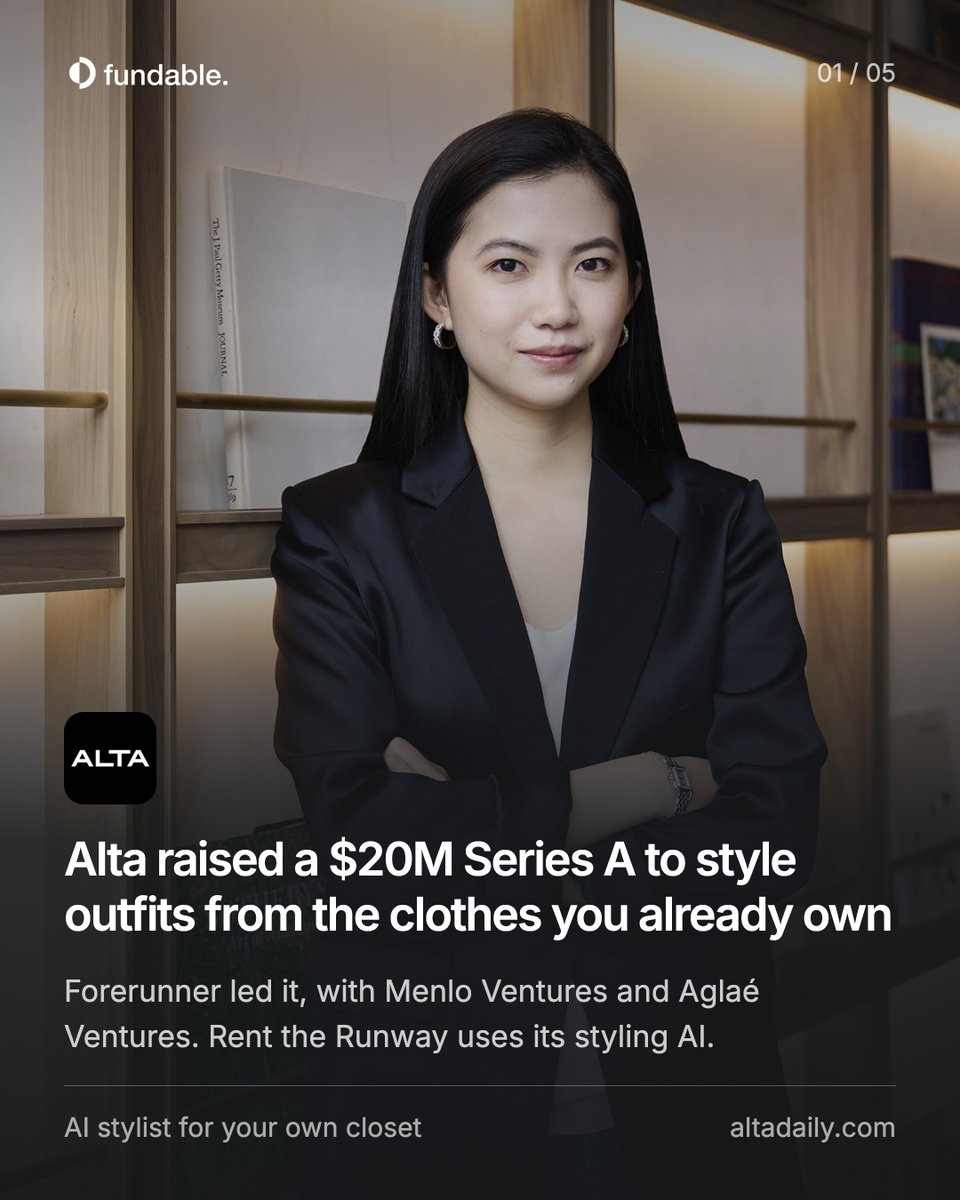
If you didn't know, my eurie-avatar is QUITE fabulous - see my catwalk below, along with all the other stylish investors of @altadaily. We couldn't be luckier to partner with @Jennywang and her incredible team at Alta in bringing this magical experience to life. It's not just about fashion, or styling; it's about how you show up, wherever you are. IRL or digital = same you!
Alta has raised a $20M Series A led by @ForerunnerVC (@euriekim), with @MenloVentures, Aglaé Ventures and angels including Meredith Koop, Paris Johnson Jr. (@parisjohnsonjr), Rylee Martell (@ryleemartell) and Karlie Kloss.
Alta is a San Francisco company that makes an AI styling app. Users add the clothes they own from photos, product links, video scans or receipts, and Alta suggests outfits from them and shows the looks on an avatar built from two selfies. More than a dozen specialized AI models drive it, and users have generated 20 million avatars and 700 million outfits. Alta also sells its styling and rendering technology to brands. It powers the AI in Rent the Runway's app, and Gap and Zimmermann have run try-on campaigns on it.
Founder and CEO Jenny Wang studied computer science at Harvard College and is a Forbes 30 Under 30 honoree and a Vogue 100 Innovator. She launched Alta in 2025 with an $11M seed round led by Menlo Ventures.
Three weeks ago we opened User Experience at 236 Powell on a hunch: that people building tech and people living with it need a place to meet in real life.
2,000+ people through the door later, we are throwing one last party before we close.
This Wednesday, Oct 28 | 5-8pm
236 Powell St, SF
Curators' conversation at 6pm, joined by the architects, artists, and exhibitors who built the space.
Link to RSVP below.