Private sector support for human rights defenders can play a major role in reinvigorating the sector, and, in providing that support, businesses can help to ensure a continually improving operating environment for business operations across the globe, argue @CSISHumanRights experts.
Read: https://t.co/1wBJayBvWl
Modern war is a contest of learning and adaptation, and the lessons travel in a matter of weeks. Fast following, or copying, improving, and fielding proven innovations at speed, is now a core competency, yet Western militaries remain slow to build it, argues @AustraliaChair's Mick Ryan.
Read: https://t.co/yprVP22VOS
A 100 mph speed limit on Starshield terminals hindered Ukraine’s efforts to intercept Russia’s jet-powered drones. The risk of losing access during an attack gives allies another reason to build their own networks instead of buying service from U.S. companies.
More from @CSISAerospace: https://t.co/b9S5BQNDp7
As Congress works to achieve consensus on the "right to repair" issue, it is increasingly important for lawmakers, industry, and the public to understand the nuances of the debate and the legal frameworks that underpin it, write @CSISDefense experts.
What is the "right to repair"?: https://t.co/WHbdSfBPG5
As Washington weighs force against Tehran alongside ongoing negotiations and an economic blockade, @csisfutures Benjamin Jensen evaluates six military options ranging from coercive diplomacy and targeted strikes to a prolonged sea control campaign and covert action.
More: https://t.co/XTbMOQW69y
To help partner nations defeat drone threats, the U.S. must confront two interlocking challenges: the pace of criminal UAS innovation and the constraints partner governments face in defense procurement and adoption, writes @HenryZiemer.
Read: https://t.co/QRkNolqPp3
THURSDAY | Join @CSIS_Tech for a discussion examining how national security considerations should factor into antitrust decisions, the potential implications of structural remedies for U.S. competitiveness, and the role of alternative policy tools in addressing security concerns.
Register: https://t.co/aVOFrzvECj
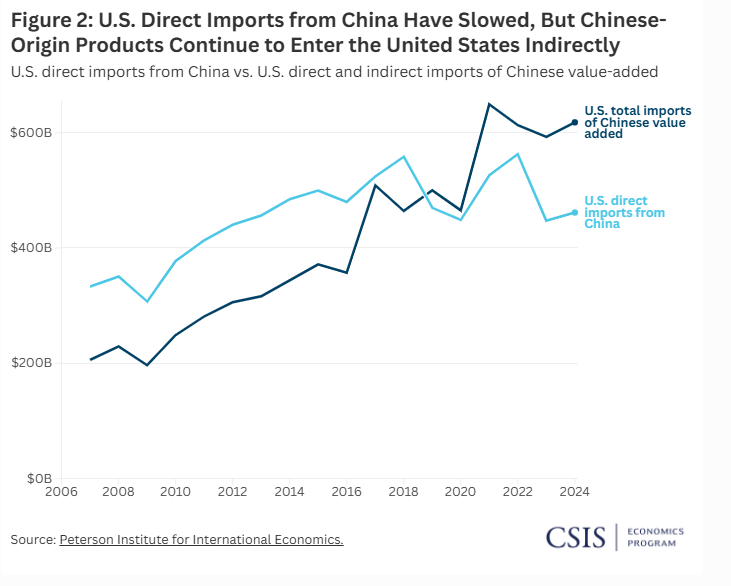
Chinese "value added"- the share of U.S. import value that originated in China- flowing into the U.S. has grown since 2018, even as U.S. direct imports from China have fallen, meaning that Chinese value added increasingly enters the U.S. via third countries, writes @HughGrantChap.
Read: https://t.co/I73uBlUicr
WEDNESDAY | Join @CSISAmericas to explore the state of South American military modernization efforts, the political economy of defense spending in the region, and how South American military efforts intersect with the U.S. increased security engagement with the Western Hemisphere.
Register: https://t.co/1hWGfAAwxk
To protect Pacific sovereignty and ensure that these island nations are secure well into the future requires sustained and sincere commitment from larger powers and international foundations alike, argue John Augé and @KathrynPaik.
Read: https://t.co/bGc1pbR4SH
A joint data center proposed as part of broader negotiations between the United States and Russia poses a substantive threat to U.S. national security. Congress should play a vital role in scrutinizing the idea before it becomes a reality, write Nikita Shah and Justin Sherman.
Read: https://t.co/6U5rF5qAoZ
With Congress delaying action on full-year appropriations and reconciliation in response to the Trump administration’s $1.5 trillion budget request, the outcome of the midterm elections will impact both the level of defense funding legislators ultimately provide and the time frame for doing so, notes @SeamusDaniels.
Read: https://t.co/rEBQGseGJh
"Fast following—the deliberate custom of observing an innovation proven by someone else and then copying, improving, and fielding it at speed—is now a core competency for military institutions," argues @AustraliaChair's Mick Ryan.
Read: https://t.co/XxpNReCcDt
11/4 | Join @CSISAmericas to explore how South American military efforts intersect with the United States' increased security engagement with the Western Hemisphere and to evaluate the political economy of defense spending in the region.
Register: https://t.co/v1zkZ7T2KS
In Foreign Affairs, @CSISMidEast expert @AllisonMinor_ and Nate Swanson argue a cease-fire brokered and managed by the Gulf Arab states can help Tehran and Washington bring an end to the Iran war.
Read: https://t.co/udJOq25TAc
The lines between military and civilian use have fundamentally blurred. How should modern companies think about this new world of warfare? How should they evaluate risk when choosing whether to assist in a conflict?
In a new report, @CSISdefense experts designed a decision guide for companies that find themselves lost in the fog of conflict.
Learn more: https://t.co/0073sBZebt
"By helping its partners in Latin America defeat their own drone threats, the United States can gain valuable insights into how it can better protect its own homeland from future attacks. To do so, the United States must confront two interlocking challenges," writes @HenryZiemer.
Read: https://t.co/5WiJ8f54Gr
Analysis by @HughGrantChap "challenges the view that transshipment is the dominant way that Chinese-origin products end up in the United States. Some economies, such as Laos and Cambodia, do show a growing trade overlap, but several other economies show the opposite trend."
Read: https://t.co/I73uBlUicr
ICYMI: @ChinaPowerCSIS hosted the 10th anniversary of the China Power Conference. This year's event brought together leading experts for two days of discussion on core issues underpinning China's power and explored the current state of U.S.-China relations.
Watch: https://t.co/nbXJ8UjwEj
11/5 | Join @CSIS_Tech for a discussion to examine how national security considerations should factor into antitrust decisions, the potential implications of structural remedies for U.S. competitiveness, and the role of alternative policy tools in addressing security concerns.
Register: https://t.co/aVOFrzvECj