Marc Andreessen: AI coding doesn’t eliminate programmers — it redefines them. The job is no longer typing code line by line, it’s orchestrating 10 coding bots in parallel, arguing with them, debugging their output, changing the spec, and pushing them toward the right result. But here’s the catch: if you don’t understand how to write code yourself, you can’t evaluate what the AI gives you.
The next layer of programming isn’t writing scripts — it’s supervising AI that writes them. Today’s best programmers spend their day jumping between terminals, managing multiple coding bots, fixing mistakes, and refining instructions. The irony? You still need deep fundamentals, because without them, you won’t know when the AI is wrong.
The job of the programmer has changed. Now it’s about arguing with coding bots, debugging AI-generated code, and understanding why something doesn’t work or isn’t fast enough. AI abstracts the work — but only people who truly understand code can tell if the abstraction is doing the right thing.
Programmers aren’t going away — they’re becoming 10x, 100x, even 1,000x more productive. Tasks are changing, the job is changing, but humans are still overseeing the process, evaluating results, fixing errors, and making judgment calls. AI changes how we code, not who is responsible.
The future programmer isn’t replaced by AI — they’re upgraded by it. You still need to learn how to write and understand code, because when the AI gets it wrong, humans are the ones who have to know why. That up-leveling of capability is the real revolution.
Huh. Looks like Plato was right.
A new paper shows all language models converge on the same "universal geometry" of meaning. Researchers can translate between ANY model's embeddings without seeing the original text.
Implications for philosophy and vector databases alike.
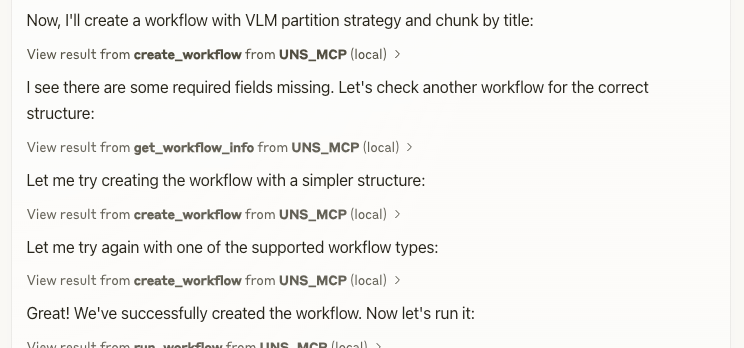
Something really cool just happened! While we're still working on the official @UnstructuredIO MCP server, Claude figured out how to build workflows in the platform by itself! 🤯
It didn't yet know the structure of input parameters to create the workflow DAG, so, Claude listed existing workflows, got one that is already configured, and created a new one based on the existing one.
It figured out the input schema all by itself. 🤯
@UnstructuredIO Back! @UnstructuredIO x @firecrawl to crawl and crunch documentations and for quick answers and work. Will sharpen this better tomorrow but really excited about how this is shaping up! 🚀
Hey- I'm Chris (@ctmaddock ), I lead Solutions Architecture at Unstructured. I spent the weekend hacking on an MCP server implementation for Unstructured’s API. It makes provisioning Unstructured data for GenAI systems super simple.
You can just ask, in English, for GenAI ready data.
Things it can do:
"Transform these PDFs into JSON"
"Embed + chunk this data"
"Run this workflow: transform, chunk, embed data on Platform, then ask Claude to summarize"
"Transform, embed this data, and push it to Pinecone"
You can integrate it with Claude, Cursor, or any other chat based tooling you're already using.
I’d love your feedback—who out there is excited about using this? Are Interested in hacking along with us or exploring use cases?
We'll be releasing the notebook later this week, so you can play around and see its potential firsthand.
Drop me a reply or DM if you're interested to hear more.
I don't know how you can't move to the Bay at this point. The industrialization of a multi decade golden era of Intelligence has begun and you are often best advantaged by being as close as possible. For there will be generational cos within a 2 mi radius.
We are fking back!
The Hugging Face Cookbook is near and dear to me, as I was involved in its creation, and contributed one of the first notebooks to it.
Naturally, I’m excited to be back with a new notebook! This time, I’m sharing a “recipe” for building RAG with custom unstructured data.
Featuring @UnstructuredIO, @langchain, @trychroma and of course models from the @huggingface Hub.
Check it out!
https://t.co/Rt0qedwTRM
Next week I’ll be speaking at @Databricks DATA+AI Summit on Refining RAG Performance Leveraging @Unstructured for Enhanced Data Ingestion.
Good data leads to good AI. Join me to learn how you can level up your unstructured data ingestion and preprocessing game to build enterprise-grade RAG applications.
Tuesday, June 11th | 3:40 PM - 4:00 PM PDT
See you at DATA+AI Summit!
Local RAG Explained with Unstructured and LangChain
Complete video: https://t.co/fzJV1DNjK1
Code: https://t.co/JZFeXQGI85
In this tutorial, I do a code walkthrough and demonstrate how to implement the RAG pipeline using Unstructured, LangChain, and Pydantic for processing invoice data and extracting structured JSON data.
RAG runs locally with @ollama
Covered topics:
Agent code and config
File processing with Unstructured
Text processing
Text splitting
Vector store and embeddings
LangChain query
Output validation
@UnstructuredIO@langchain@pydantic@katana_ml