Horticulture Lab
@ClemsonUniv
is seeking a #graduate#student to study the vegetable production systems to improve the resource use efficiency, and soil borne pest management. Fully funded a #PhD and a #MS position's are available. Details: See attached.
@CUESNews@ClemsonCAFLS
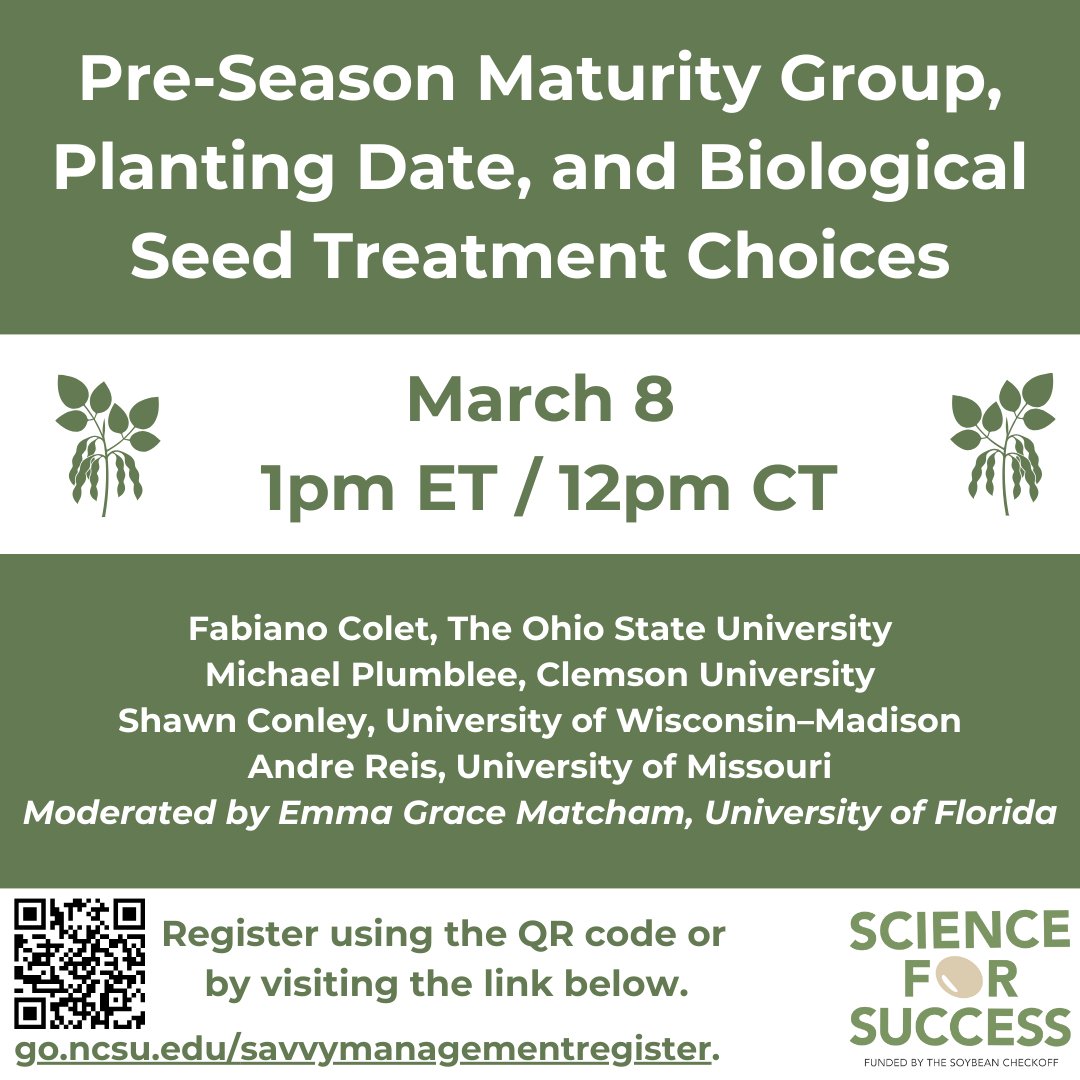
Don't forget to register and join us this Friday for the first installment of the Savvy Full Season Soybean Management webinar series! https://t.co/69WJYZKKeh
Happy #NationalSouthCarolinaDay, Tigers! From our main campus in the foothills of the Blue Ridge Mountains to our research facilities along the coastline, we’re committed to creating a significant impact across the Palmetto State.
🍉🥬🥦🍅🍓The Postharvest Lab at @ClemsonUniv is recruiting!
We are seeking a #PhD student interested in 1) fruit/vegetable #quality and #shelf-life and 2) conventional and biotechnological approaches for reducing produce #losses and #waste.
@ClemsonCAFLS
See details⬇️
#StainedGlassSunday
Sainte-Chapelle, Île de la Cité, Paris. Mid-13th century.
Fifteen stained-glass windows create dazzling walls of light which bathe the chapel in jewel-coloured reflections. Breathtaking!
📷 Feb 2023
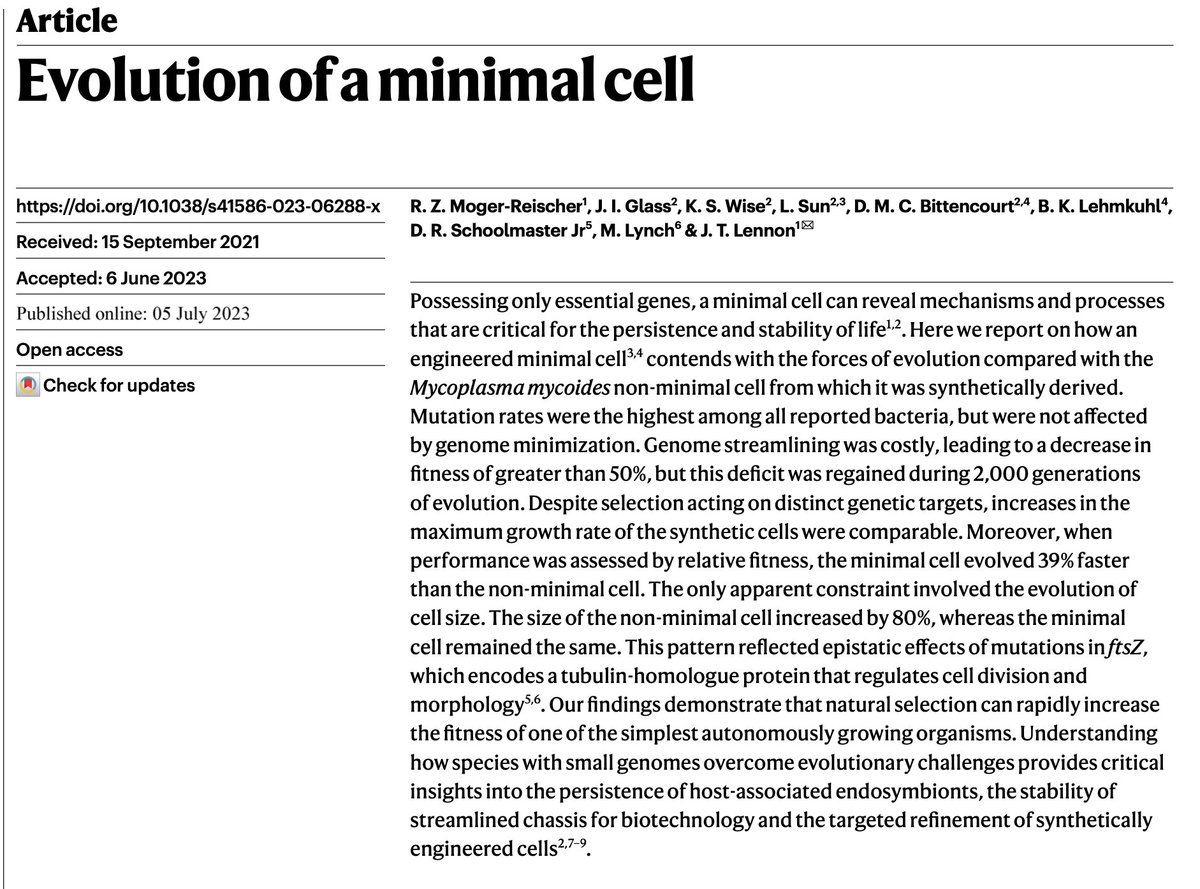
A mind-blowing paper has come out today in @Nature
In 2016, JC Venter Institute scientists trimmed a bacterial genome to its barest minimum required for life to synthesize what they called a "minimal genome" (https://t.co/Rk8oZJ0bUj).
Today, a group of scientists from Indiana University reports how that minimal genome evolved over 2000 generations in comparison to the non-minimal genome.
The authors found that even when you reduce a bacterial genome to its absolute minimum where every nucleotide matters, the genome undergoes mutational events generation after generation as much as the non-minimal genome. One simply cannot stop the evolution.
Just over 300 days of evolution (equivalent to 40,000 years in humans) the minimal cell has gained everything it lacked in fitness on day one in comparison to the non-minimal cell.
When comparing the evolved traits between the minimal and non-minimal cells, the scientists found something striking. The evolutionary process increased the cell size of non-minimal cells but not that of the minimal cell. But that is not the striking part.
The scientists were able to identify the key mutation that resulted in cell size evolution. And it turned out that the mutation that helped the non-minimal cells to grow bigger is the same that helped the minimal cells to stay smaller. Growing bigger had a survival advantage for non-minimal cells and not growing bigger had a survival advantage for minimal cells. So, the mutation had a context-dependent effect. This just demonstrates that the evolutionary effects on traits have no absolute direction. All that matter is what is beneficial for the organism's survival.
The conclusion of the paper is metaphorically a quote from the Jurassic Park movie:
“Listen, if there’s one thing the history of evolution has taught us is that life will not be contained. Life breaks free. It expands to new territories, and it crashes through barriers painfully, maybe even dangerously, but . . . life finds a way". (https://t.co/UlxRlb86CT)
https://t.co/zA9OAqSoAu
In the moments before we fall asleep we all think about the things we did not get done and about the things we have to do.
There is a beautiful egalitarianism in those moments. A shared sense of worry and possibility. A reminder that we are all human.
Good night moon.
Scientists have created a drug based on LSD that seems to fight depression and anxiety without producing a psychedelic experience. https://t.co/42mW28mRF4