Agentic Engineering has completely changed it's shape in the past few weeks if you want to get ahead here are some concepts you absolutely need to know for your own scaffolding
1. Continual Traces → Traditional logging has been rendered obsolete by these god tier models and harnesses. so instead you use continual traces logs that build upon themselves as the context grows
2. Agent Security Stack → Trust provision provenience and containment by design.
3. Stochastic Hierarchical Iterative Topology → Adaptive multi-level exploration of solution spaces. Using tree traces and the inherent laws of math to direct your agent harness for long running tasks
4. Relational Context Retrieval → Retrieve relationships, not documents, using relational dbs to constantly improve and connect your growing context
5. Filter Using Constraint Context: Current harnesses will have you believing that semantic search has been rendered obsolete but this technique allows you to improve your harness by leveraging the inherent semantic understanding of LLMs to efficently search relevant context.
DM me for the complete doc to 100x your agentic capabilities
again saying there's never been a better time to work on multi-agent systems.
learn rag, orchestration, evals, memory, routing, tool calling, validation loops, fix loops, split learning, context engineering. all of it.
getting an llm to answer questions is becoming the easy part
getting multiple agents, tools, and workflows to work together reliably in production without breaking every other day is where the real challenge is.
we're entering a phase where building the model matters less than building everything around it.
Excited to share our most powerful new Claude Code feature: dynamic workflows!
Mention "workflow" in a prompt and Claude will dynamically create an orchestration plan that it strictly follows, allowing you to confidently trust that every stage happens in the right order even across 100s of agents.
Learn Devin in 5 minutes
Cloud agent. Terminal agent. Linear assignee. Slack teammate. On schedule. Devin is everywhere your engineering team already lives.
00:00 - Introduction
00:19 - Sending sessions to @SlackHQ
00:24 - Creating your first session
00:51 - Devin Review
01:20 - Computer Use testing
01:46 - Desktop and IDE in Devin
02:33 - Scheduled Devins
03:01 - Devin for Terminal
03:40 - Terminal to cloud handoff
04:09 - DeepWiki
04:21 - Assigning Devins from @linear
If you got this far, I'm giving away $1,000 in Devin credits, $200 to 5 people for a free month of Devin Max.
Comment what you'd like to build and retweet this post to be eligible to win!
#GBrain by @garrytan is great no doubt but sometimes simplicity beats perfection so here's the way solopreneurs can start creating their down digital twin // second brain // life wiki.
https://t.co/3mdNdsRIo7
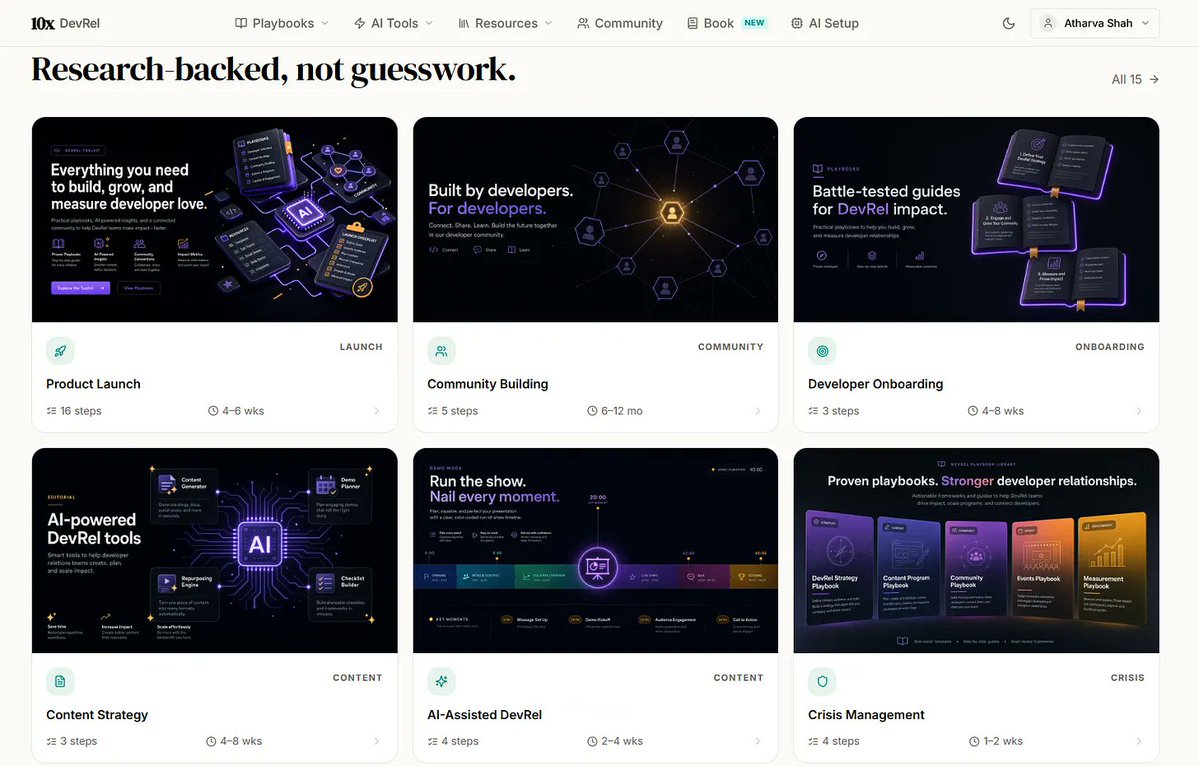
Four articles and a YouTube walkthrough dropped this week on building AI-first DevRel systems.
The one worth starting with: how I built 10x DevRel Workbench!
https://t.co/jch5TGlhv1
The workbench is free and open source: https://t.co/kkdrj2Wp9e