AI has a revenue problem disguised as compute problem.
#Anthropics 2025 numbers tell the story:
Revenue: $ 4.6bn
Compute & infrastructure spend: $ 7.3bn
Operating loss: $ 8.06bn
Revenue grew nearly 12x, yet losses widened.
The problem is that AI's biggest cost is also its growth engine and that's COMPUTE.
Data centres require billions in GPUs, servers, networking, power, and cooling. Much of this capital must be committed upfront, but revenue arrives gradually as customers use the models.
Now token prices are falling. The bet is that chapter AI will driven enough usage to offset lower prices. But if token prices fall faster than volumes rise, revenue growth can disappoint even as AI adoption accelerates.
The second order effect is that cheaper AI could attract more users, but it could also force AI companies to cut prices to compete. The third order effect? If companies keep building data centres faster than customers increase their spending, expensive infrastructure could sit underused and earn poor returns.
That's the tension behind Anthropic's IPO ambitions. AI demand can boom without AI economics improving.
The metric to watch isn't just tokens consumed or revenue growth. It's revenue per unit of compute, and whether that gap can eventually cover the cost of building and running these systems.
#Anthropic #datacentres #chips #token
#NobelPrize
This year’s nobel prize for chemistry is out.!!
Henri Kagan of France & Kenso Soai of Japan won the novel prize for crucial contribution towards drug development.
AI has a revenue problem disguised as compute problem.
#Anthropics 2025 numbers tell the story:
Revenue: $ 4.6bn
Compute & infrastructure spend: $ 7.3bn
Operating loss: $ 8.06bn
Revenue grew nearly 12x, yet losses widened.
The problem is that AI's biggest cost is also its growth engine and that's COMPUTE.
Data centres require billions in GPUs, servers, networking, power, and cooling. Much of this capital must be committed upfront, but revenue arrives gradually as customers use the models.
Now token prices are falling. The bet is that chapter AI will driven enough usage to offset lower prices. But if token prices fall faster than volumes rise, revenue growth can disappoint even as AI adoption accelerates.
The second order effect is that cheaper AI could attract more users, but it could also force AI companies to cut prices to compete. The third order effect? If companies keep building data centres faster than customers increase their spending, expensive infrastructure could sit underused and earn poor returns.
That's the tension behind Anthropic's IPO ambitions. AI demand can boom without AI economics improving.
The metric to watch isn't just tokens consumed or revenue growth. It's revenue per unit of compute, and whether that gap can eventually cover the cost of building and running these systems.
#Anthropic #datacentres #chips #token
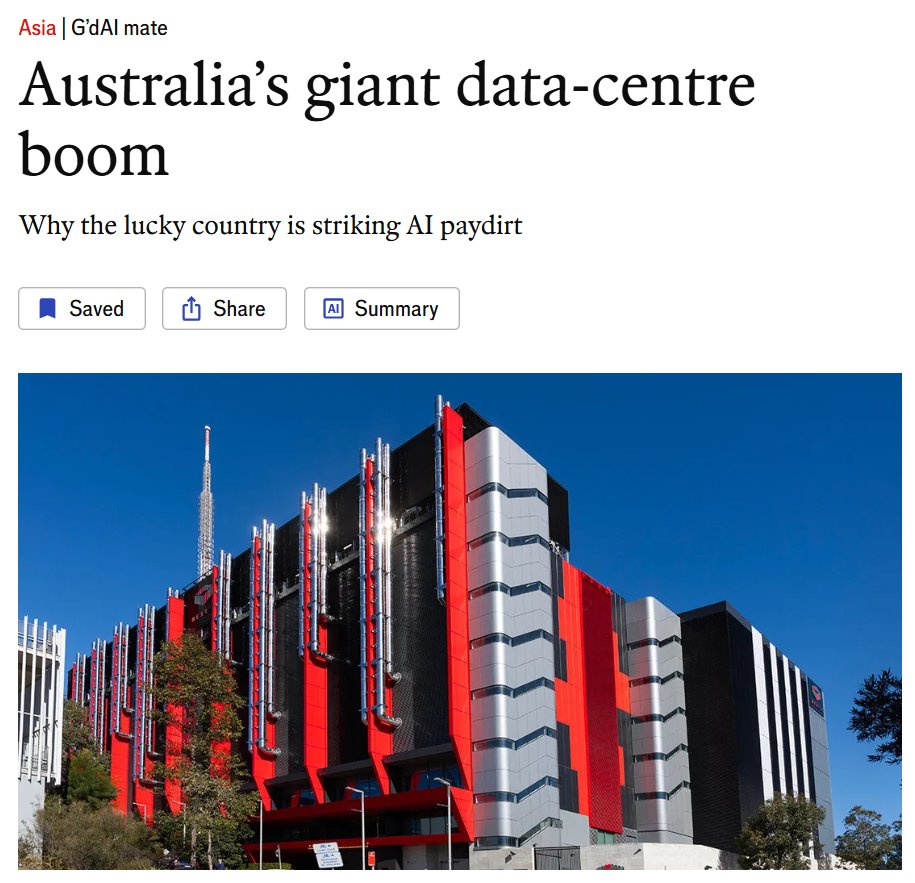
Australia's AI Data Centre boom is about much more than cheap power
Australia is positioning itself as one of the next major AI compute hubs.
Around $ 155-156bn of data centre investment is in pipeline, putting Australia behind only the US and China on the scale of planned investment.
At first glance, the story looks simple:
Cheap power + Lots of land + Strong connectivity
But the real story is much more interesting
@TheEconomist
Some listed companies that could directly or indirectly benefit from Australia's AI infrastructure boom:
NEXTDC (data centre operator)
Goodman Group (data centre land & infrastructure)
Macquarie Technology Group (data centre & cloud infrastructure)
Megaport (data centre connectivity)
Telstra (fibre & subsea cable network)
Origin Energy (electricity & renewable power)
#Australia #datacentre #AI #Nvidia #China
Australia's AI Data Centre boom is about much more than cheap power
Australia is positioning itself as one of the next major AI compute hubs.
Around $ 155-156bn of data centre investment is in pipeline, putting Australia behind only the US and China on the scale of planned investment.
At first glance, the story looks simple:
Cheap power + Lots of land + Strong connectivity
But the real story is much more interesting
@TheEconomist
This is why I think Australia's AI story is worth watching.
The winning data centre locations may not simply be the places with the cheapest electricity.
They may be the places that combine:
Power
Connectivity
Security
Geopolitical alignment
Regulatory stability
Australia happens to score well across all relatively.
The biggest takeaway is that AI infrastructure in becoming geopolitical infrastructure.
#DINK Dual Income No Kids
I mean everyone get’s irritated to have a kid next to our seat on a flight/train & especially the whole theatre is worried someone brings a kid to a theatre. All of us can agree to this I guess.
@cb_doge Competition can improve access and affordability, but telecom is more than a consumer service
It is #strategicinfrastructure
Satellite connectivity can expand India’s reach, while network security, resilience and strategic autonomy remain equally important.
@elonmusk Competition can improve access and affordability, but telecom is more than a consumer service.
It is strategic infrastructure.
Satellite connectivity can expand India’s reach, while network security, resilience and strategic autonomy remain equally important.
@elonmusk
#Jubilantfoodworks
Decent numbers
The interesting part is the combination of 4.1% LFL growth with 88 new stores.
It shows growth is coming from both existing store productivity and network expansion.
The key monitor now is whether new store additions can sustain returns at this pace.
#QSR @dominos_india
#Elevated Shipping Cost
Have heard this commentary from the management saying increase in freight cost and delay in shipping and the numbers that came out in an article were shocking.
@Normal_2610 Very interesting change in retail behaviour
Story here isn't declining participation, it’s changing participation. Breadth is slowing, while activity and leverage is rising among existing participants.
@Normal_2610
𝐓𝐡𝐞 𝐑𝐁𝐈 𝐡𝐚𝐬 𝐡𝐢𝐤𝐞𝐝 𝐢𝐧𝐭𝐞𝐫𝐞𝐬𝐭 𝐫𝐚𝐭𝐞𝐬 𝐛𝐲 𝟐𝟓 𝐛𝐩𝐬 𝐭𝐨 𝟓.𝟓%. 𝐑𝐚𝐭𝐞𝐬 𝐡𝐢𝐤𝐞𝐝 𝐟𝐨𝐫 𝐭𝐡𝐞 𝟏𝐬𝐭 𝐭𝐢𝐦𝐞 𝐬𝐢𝐧𝐜𝐞 𝟐𝟎𝟐𝟑.
RBI has stated that it is changing its stance from neutral to 𝐜𝐚𝐥𝐢𝐛𝐫𝐚𝐭𝐞𝐝 𝐭𝐢𝐠𝐡𝐭𝐞𝐧𝐢𝐧𝐠.
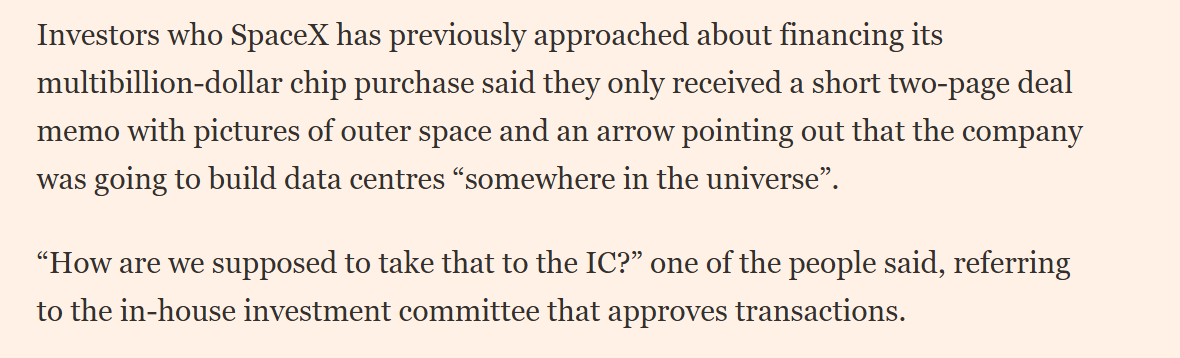
The peculiarity of $SPCX explaining their goals and deals is nothing new.
Here they strike again in their pitch deck to raise $40B to buy $NVDA chips
https://t.co/fkhkZrEwbH