If you use Claude, you need to know this.
Anthropic is making some massive changes to Claude's privacy policy - effective July 8th.
Verification data will be collected from ALL Cladude users.
Age, identity, email, date of birth - all verified by government photo ID.
Open-sourced models have never been more important.
I’ve been building my personal AI agent for a while now. But something is missing. The ease of use.
I’m starting to experiment building a UI for my agent, which should also do some basic level context management for me.
Curious to see what this’ll become.
We have been working closely with @nvidia to ensure Hermes Agent works smoothly on their new @NVIDIARTXSpark superchip and integrates with the new OpenShell runtime, which connects Hermes to @Microsoft's security primitives.
Watch our feature in the big announcement at Computex:
What if you could take three completely different model families… and distill them into one tiny model? 🤯
📜 Paper: https://t.co/K2iKD4xFvp
MOPD (Multi-Teacher On-Policy Distillation) has become a standard procedure in post-training. We already distill multiple specialized variants of the same model into a single set of weights.
But what if we could go further - and distill models from entirely different families? Turns out, it is possible.
Today we’re releasing a paper on cross-tokenizer distillation - our first steps in this exciting direction. 📄
We distilled Qwen3-4B, Phi-4-Mini, and Llama-3B into Llama-3.2-1B.
MMLU jumped from 32.05 → 46.32 when using multiple teachers. 📈
The team is now working on Nemo-RL integration so the community can try this method in their own settings. Plus, we are scaling experiments up. 🚀
@steipete I idea on how to get the full cmux experience when connected to devcontainers (docker)?
‘cmux docker compose exec …’ doesn’t work unfortunately
How many times have you re-explained your project to Claude today?
Same context.
Same corrections.
Same wasted time.
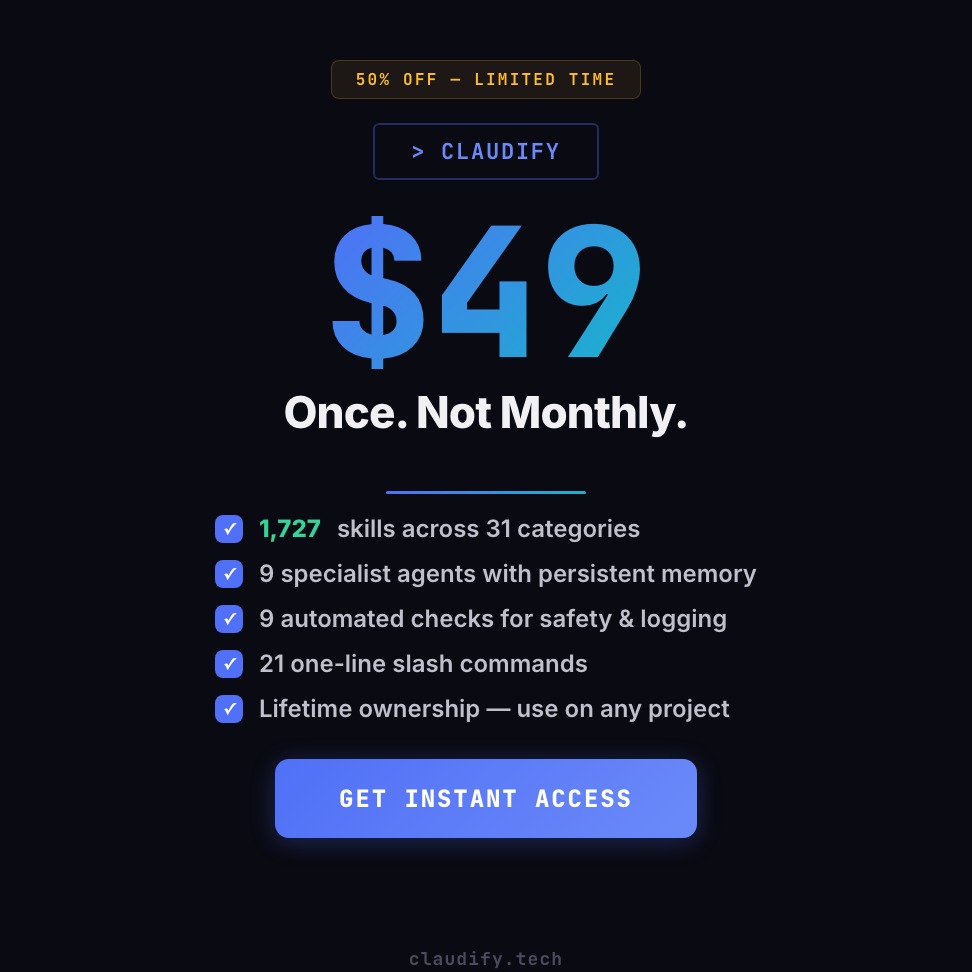
Claudify gives your AI coding tool persistent memory, specialist agents, and automated quality checks.
One install. Works in Claude Code, Cursor, Windsurf.
Personal update: I've joined Anthropic. I think the next few years at the frontier of LLMs will be especially formative. I am very excited to join the team here and get back to R&D. I remain deeply passionate about education and plan to resume my work on it in time.
This morning I started using t3code from @theo
I wasn’t able to connect to my docker devcontainers, so I forked the repo and feature vibed it in. Claude Code oneshot it.
Be sure to understand this is not a complement to CC. But a big compliment to t3code’s architecture
IFYKYK
By having a solid base architecture, ANYONE can add their own features they are missing.
As long as you are aware you don’t always have to push your new features back to the original repo. Most likely those vibe coded features won’t make it in main. (Assumption)
Agent view is the best Claude Code native way to manage multiple sessions, kind of like tmux built for CC.
We spent a lot of time getting the details right, I hope you enjoy it.
Regarding the audio, I’ve been using Voicebox for this. Combine this with AquaVoice and you basically have a voice only experience (with text responses as extra output)
This works really well btw, at the end of your query ask your LLM to "structure your response as HTML", then view the generated file in your browser. I've also had some success asking the LLM to present its output as slideshows, etc.
More generally, imo audio is the human-preferred input to AIs but vision (images/animations/video) is the preferred output from them. Around a ~third of our brains are a massively parallel processor dedicated to vision, it is the 10-lane superhighway of information into brain. As AI improves, I think we'll see a progression that takes advantage:
1) raw text (hard/effortful to read)
2) markdown (bold, italic, headings, tables, a bit easier on the eyes) <-- current default
3) HTML (still procedural with underlying code, but a lot more flexibility on the graphics, layout, even interactivity) <-- early but forming new good default
...4,5,6,...
n) interactive neural videos/simulations
Imo the extrapolation (though the technology doesn't exist just yet) ends in some kind of interactive videos generated directly by a diffusion neural net. Many open questions as to how exact/procedural "Software 1.0" artifacts (e.g. interactive simulations) may be woven together with neural artifacts (diffusion grids), but generally something in the direction of the recently viral https://t.co/z21CP5iQfu
There are also improvements necessary and pending at the input. Audio nor text nor video alone are not enough, e.g. I feel a need to point/gesture to things on the screen, similar to all the things you would do with a person physically next to you and your computer screen.
TLDR The input/output mind meld between humans and AIs is ongoing and there is a lot of work to do and significant progress to be made, way before jumping all the way into neuralink-esque BCIs and all that. For what's worth exploring at the current stage, hot tip try ask for HTML.