The Canadian Security Intelligence Service (@csiscanada) produced this report on disinformation and #deepfakes as part of its Academic Outreach and Stakeholder Engagement (AOSE) and Analysis and Exploitation of Information Sources (AXIS) programs.
It nice to see that it cites our (@7_dials, @TimKietzmann, @curiousllee) work how deepfakes are produced, see here:
https://t.co/Odm1D2EcqH
Nature rejected her paper for not being original,
University of Pennsylvania (her employer) demoted her,
and yesterday Katalin Karikó won the Noble Prize in physiology.
In mid-2000s, Karikó and her Drew Weismann submitted their paper on mRNA (messenger Ribonucleic Acid) to Nature.
Nature desk rejected their paper for being "an incremental contribution" only. The paper was later published in another journal, Immunity.
Earlier in her career at the University of Pennsylvania, Karikó was demoted because her applications for grants kept getting rejected.
But Karikó persevered and kept on going.
In 2013, she joined BioNTech, a German company founded by two scientists, Uğur Şahin and Özlem Türeci. In 2018, BioNTech partnered with Pfizer to develop mRNA vaccines against the influenza virus.
When the COVID-19 hit the world, Karikó's research helped Pfizer to produce the first vaccine against the disease.
I don't know how the Nature editors who desk rejected Karikó's paper and the Penn administration who demoted her feel about Karikó Nobel Prize.
Takeaway: Many academics and scientists worry about getting published in "prestigious" journals. Instead of worrying about prestige, we should try to put our work out as quickly as possible like Karikó did.
Once you put your work out without caring about prestige, two good things happen:
1. Your work will lead to newer opportunities.
2. You will start getting feedback from the scholarly community, which you can use to iterate and improve.
Here's another interesting Nobel Prize story.
Peter Higgs, a British physicist, joined the University of Edinburgh in 1956. By 1964, Higgs has published his groundbreaking work about subatomic particles.
After 1964, Higgs published less than 10 papers.
When his department would ask him how many papers, he published in a given year, he would reply "None."
It happened so often that he stared feeling like an "embarrassment to the department."
The University of Edinburgh, however, never fired Higgs because in 1980 he had been nominated for the Nobel Prize.
Higgs retired in 1996 and stayed on as an emeritus professor at Edinburg.
In 2012, experiments conducted at the CERN laboratory confirmed Higgs work and the existence of Higgs Particle.
And in 2013, Higgs was awarded the Noble Prize in physics and the University of Edinburgh got rewarded for being patient.
@EdgeHotelSchool at @Uni_of_Essex is looking for lecturers (assistant profs) and senior lecturers (associate profs) who are passionate about tourism and hospitalty research. Come work with us! https://t.co/kN8N5rl0JN
https://t.co/yV2NKJGER8
@MktResearchNBS@curiousllee@ABCaustralia It's long overdue, but here is an open-access version of the article: Deepfakes: Trick or Treat?
https://t.co/KKuonJ9N2q
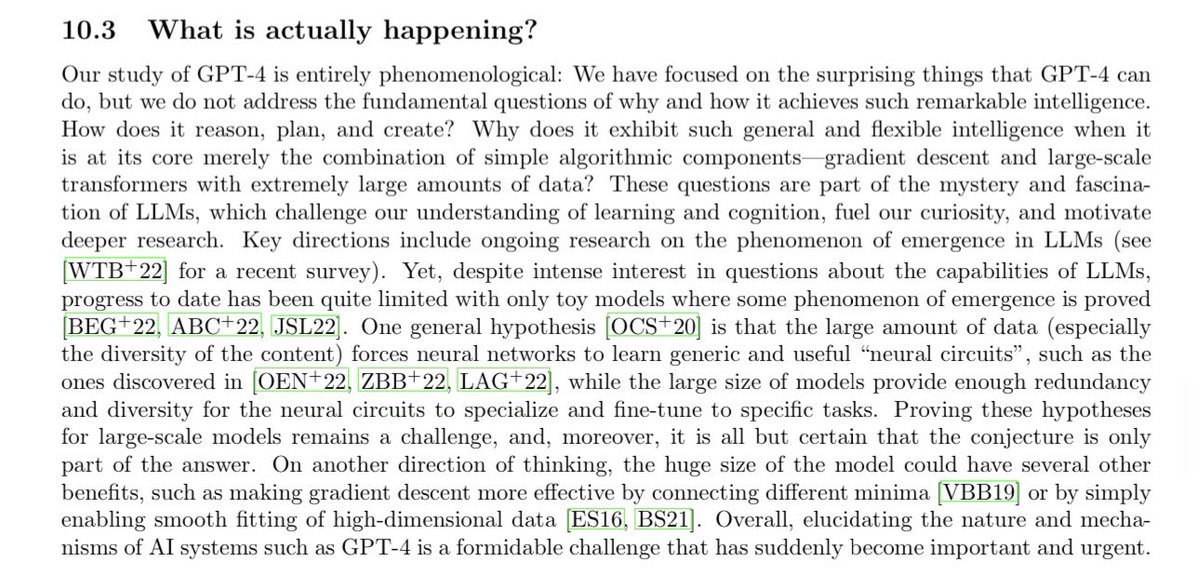
👀After 154 pages of tests of GPT-4, this paper concludes “Given the breadth and depth of GPT-4's capabilities, we believe that it could reasonably be viewed as an early (yet still incomplete) version of an artificial general intelligence (AGI) system.” https://t.co/KNPa9bLO2d
How can deepfakes be detected and how can they be used positively? In a reality check on the latest research on deepfakes, our centre member @curiousllee discusses positive applications of deepfakes in a podcast by @ABCaustralia:
https://t.co/1zqBXIFF6J
https://t.co/Xvrx4F4n9i
Should we fear or embrace the power of deepfakes? I see great potential in the use of the technology, as I explain in this interview with ABC (my section starts at about 9:20). The other speakers in this podcast discuss how deepfakes can be detected.
https://t.co/g1IC1QfQnF
What's the key to sustained creativity? Balancing a high "need for certainty" with a low "need for competence." In today's Science of Creativity newsletter:
https://t.co/6sCWFp6Lor
As an academic researcher, I frequently ask businesspeople for their views on topics I'm researching. I am so grateful for the thoughtful feedback from very kind and busy people. This makes such a difference - thank you!
Quantitative research is like baking a cake: the research design & execution should be as good as possible before putting it in the oven.
Qualitative research is like cooking a stew: you can adjust the ingredients & spices as you learn how it tastes.
(Davide Ravasi, AMJ)